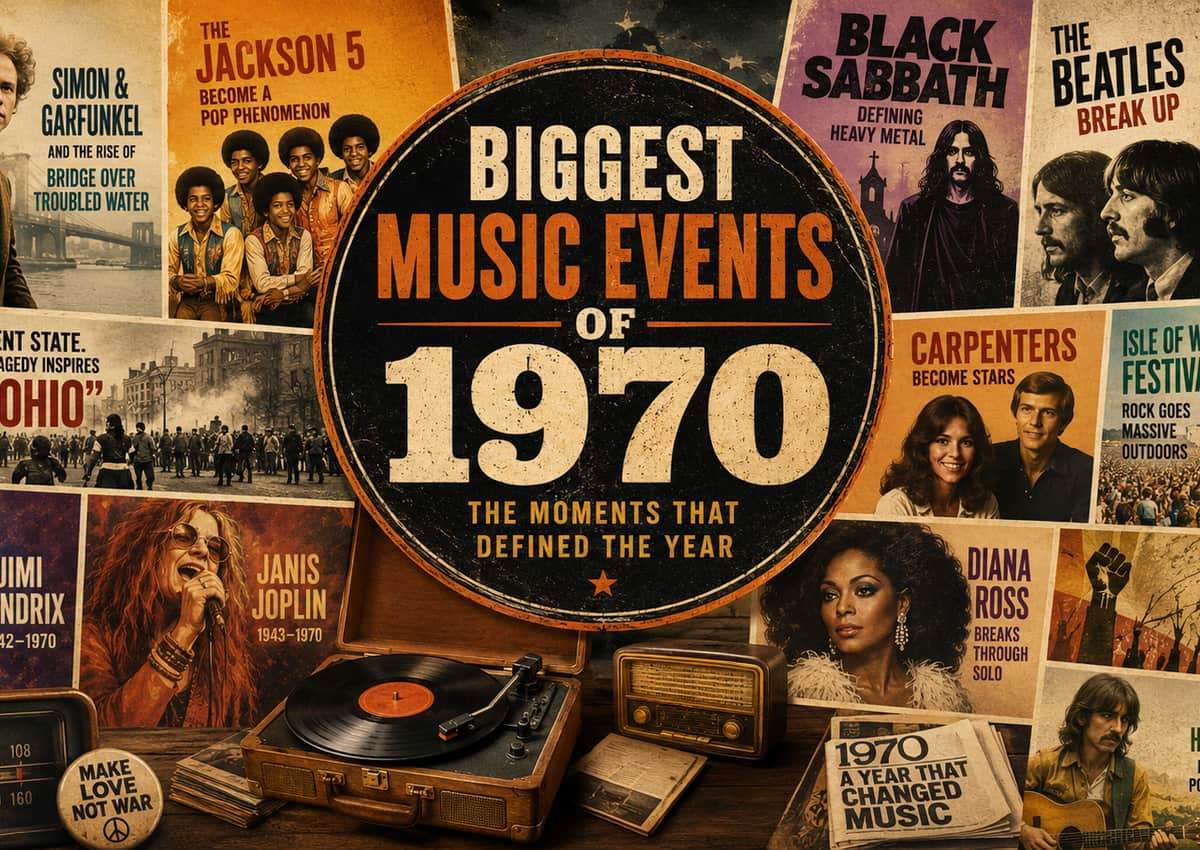
1970 did not ease the music world into a new decade. It arrived with endings, breakthroughs, tragedy, and a startling amount of reinvention. The Beatles broke apart, Jimi Hendrix and Janis Joplin died within weeks of each other, Black Sabbath helped establish a new language for heavy rock, and the Jackson 5 became a pop phenomenon almost overnight.
At the same time, the album was becoming an even more important artistic statement. Singer-songwriters were moving toward the center of popular music, protest songs were still responding to events in real time, and giant outdoor festivals showed both the promise and the growing complications of rock culture. These are the moments that made 1970 feel less like an extension of the 1960s and more like the beginning of something new.
Howard Dee’s Take
What strikes me about 1970 is how much of the decade was already visible. Heavy metal was arriving. The singer-songwriter boom was taking shape. Motown had a new generation of stars. The Beatles were finished as a band, but their solo careers were only beginning.
If you were buying records then, you probably did not think of any of this as the opening chapter of history. You were simply hearing new records every week. From this distance, though, 1970 looks like one of those years when the musical ground shifted under everybody’s feet.
January: Simon & Garfunkel Reach Their Peak with Bridge Over Troubled Water
Simon & Garfunkel opened the year with one of the defining albums of their career. Bridge Over Troubled Water combined the intimacy people already loved about the duo with a much larger studio sound, and its title track became one of 1970’s dominant singles. The success was enormous, but it also arrived as Paul Simon and Art Garfunkel were moving toward separate paths.
The importance of the moment is the contrast: one of the most successful records of the year was also effectively a farewell. That tension between peak achievement and sudden change would become a recurring theme in 1970.
Key songs: “Bridge Over Troubled Water”, “The Boxer”, “Cecilia”
January-October: The Jackson 5 Take Over Pop Radio
The Jackson 5 turned 1970 into a remarkable run of youthful energy and Motown precision. After ‘I Want You Back’ reached No. 1, ‘ABC,’ ‘The Love You Save,’ and ‘I’ll Be There’ followed. Michael Jackson was still a child, but his voice and stage presence made him instantly recognizable.
This was more than a string of hits. It announced a new generation of Motown stars and began one of the most consequential careers in popular music. The Jackson 5 helped make 1970 sound bright, rhythmic, and forward-looking even while so much of the rock world was dealing with endings.
Key songs: “I Want You Back”, “ABC”, “The Love You Save”, “I’ll Be There”
February and September: Black Sabbath Help Define Heavy Metal
Black Sabbath released their self-titled debut early in 1970 and followed it with Paranoid later in the year. The records were darker, heavier, and more ominous than most mainstream rock. Tony Iommi’s riffs, Ozzy Osbourne’s voice, and the band’s sense of dread gave hard rock a new center of gravity.
The term heavy metal existed before Black Sabbath, but the band’s 1970 records helped turn it into a recognizable musical language. The decade would produce many heavier bands, but the blueprint was suddenly much clearer.
Key songs: “Black Sabbath”, “Paranoid”, “Iron Man”, “War Pigs”
April: The Beatles Break Up
When Paul McCartney publicly indicated in April that he was no longer working with the Beatles, the news confirmed what many fans had feared: the most influential band of the 1960s was finished. Let It Be would still appear in May, but the group itself had effectively reached the end.
The breakup mattered far beyond celebrity news. For much of the previous decade, the Beatles had helped set the pace of popular music. Their separation symbolically closed one era while creating four solo careers that would immediately become part of the story of the 1970s.
Key songs: “Let It Be”, “The Long and Winding Road”
May: Kent State Inspires ‘Ohio’
After four students were killed at Kent State University on May 4, Neil Young wrote ‘Ohio,’ and Crosby, Stills, Nash & Young moved quickly to record and release it. The song reached listeners while the shock and argument surrounding the shootings were still fresh.
‘Ohio’ is one of the clearest examples of popular music responding to a national event in real time. It carried the protest tradition of the 1960s directly into the new decade and showed that current events could still move from headlines to radio with remarkable speed.
Key songs: “Ohio”
Read more: ‘Ohio’ by Crosby, Stills, Nash & Young: Meaning, History, and the Kent State Tragedy
Summer: The Carpenters Become Major Stars
The success of ‘(They Long to Be) Close to You’ established the Carpenters as one of the new decade’s most distinctive pop acts. Karen Carpenter’s low, warm voice and Richard Carpenter’s careful arrangements offered a striking contrast to the heavier sounds gaining attention elsewhere.
That contrast is important. 1970 was not simply the year rock became louder. It was also a year when polished pop, melody, and intimate vocals could dominate the charts. The Carpenters would become one of the defining soft-pop acts of the decade.
Key songs: “(They Long to Be) Close to You”, “We’ve Only Just Begun”
August: The Isle of Wight Festival Draws a Massive Crowd
The 1970 Isle of Wight Festival assembled an extraordinary lineup that included Jimi Hendrix, the Who, the Doors, Joni Mitchell, Leonard Cohen, Miles Davis, Jethro Tull, and many others. The enormous gathering demonstrated how large the festival culture that had exploded in the late 1960s had become.
It also showed the strain behind the dream. Crowd control, free-festival demands, finances, and logistics were becoming harder to manage. The event stands as both a celebration of the era’s musical abundance and a sign that the giant-festival model was becoming difficult to sustain.
Key songs: “All Along the Watchtower”, “Young Man Blues”, “Both Sides, Now”
September 18: Jimi Hendrix Dies at 27
Jimi Hendrix died in London at age 27, ending one of rock’s shortest and most transformative major careers. In only a few years, he had changed expectations for electric guitar, stage performance, studio experimentation, and the possibilities of a rock trio.
His death was especially jarring because Hendrix still sounded like the future. The 1970s were beginning just as one of the musicians most capable of shaping them disappeared.
Key songs: “Purple Haze”, “Voodoo Child (Slight Return)”, “All Along the Watchtower”
October 4: Janis Joplin Dies at 27
Only sixteen days after Hendrix’s death, Janis Joplin died in Los Angeles at age 27. Her rasp, emotional intensity, and willingness to sound completely unguarded had made her one of the defining voices to emerge from the late-1960s rock scene.
The closeness of the Hendrix and Joplin deaths gave the autumn of 1970 a devastating sense of loss. Joplin’s final album, Pearl, would arrive posthumously in 1971, ensuring that her voice remained central to the music conversation even after she was gone.
Key songs: “Piece of My Heart”, “Cry Baby”, “Me and Bobby McGee”
September: Diana Ross Proves She Can Stand Alone
After leaving the Supremes, Diana Ross established herself as a solo star when ‘Ain’t No Mountain High Enough’ reached No. 1. The record dramatically reworked a familiar Motown song and gave Ross a performance that sounded expansive and independent.
Her breakthrough fits one of 1970’s biggest themes: famous groups were changing or dissolving while individual artists were building new identities. Ross showed that leaving a legendary group did not have to mean stepping away from the center of pop music.
Key songs: “Ain’t No Mountain High Enough”, “Reach Out and Touch (Somebody’s Hand)”
Fall: Protest Music Remains Part of the Mainstream
Edwin Starr’s ‘War’ became a No. 1 hit, while ‘Ohio’ turned a specific national tragedy into an urgent record. Together they made it clear that protest music had not disappeared when the calendar changed from the 1960s to the 1970s.
The tone was changing, though. The idealism associated with earlier protest music was increasingly mixed with exhaustion, anger, and distrust. These songs are valuable historical documents because they capture how political conflict sounded to people hearing it on ordinary radio stations.
Key songs: “War”, “Ohio”
Related reading: The 10 Most Popular Protest Songs of the 1960s | The 10 Most Popular Protest Songs of the 1970s
November: George Harrison’s All Things Must Pass Expands the Post-Beatles Story
George Harrison’s All Things Must Pass arrived as a sprawling demonstration of how much music he had accumulated outside the limited space available to him within the Beatles. ‘My Sweet Lord’ became the album’s most famous song, but the larger statement was just as important.
Within months of the Beatles breakup, Harrison had produced one of the year’s major albums. The post-Beatles era was not going to be a footnote to the 1960s; it was already becoming one of the defining musical stories of the new decade.
Key songs: “My Sweet Lord”, “What Is Life”, “Isn’t It a Pity”
What 1970 Sounded Like
Taken as a whole, 1970 sounded like several decades colliding. The harmony-rich pop and folk traditions of the 1960s were still strong, but Black Sabbath was making rock heavier, the Carpenters were making pop smoother, the Jackson 5 were bringing a young new energy to Motown, and singer-songwriters were beginning to occupy more space on radio and record-store shelves. The same listener could move from ‘Bridge Over Troubled Water’ to ‘War,’ from ‘Paranoid’ to ‘We’ve Only Just Begun,’ without leaving the year’s mainstream conversation.
That variety is one reason the year remains so useful as an encyclopedia starting point. It connects naturally backward to the Beatles, Hendrix, Joplin, Motown, and 1960s protest music, while also pointing forward to heavy metal, soft rock, the singer-songwriter boom, post-Beatles solo careers, and the polished pop that would define much of the decade.
How 1970 Fits the Decade
Another reason 1970 matters is that the old categories were beginning to break down. A record buyer who identified as a rock fan might also hear Motown, singer-songwriter music, country-rock, soul, or soft pop on the same stations. FM radio was giving longer tracks and album cuts more room, while AM radio still made giant singles. The decade would become famous for fragmentation, but in 1970 the mainstream still allowed an unusually broad range of sounds to sit beside one another.
The losses and breakups also changed how fans thought about music history. The Beatles were suddenly a completed story instead of a current band. Hendrix and Joplin were already becoming legends rather than working artists. That sense of looking backward while moving forward is one reason 1970 makes such a natural doorway into the decade.
What Did We Leave Out?
No list of the biggest music events of 1970 can capture everything that happened. A record release, concert, breakup, television appearance, or personal memory may have mattered more to you than any headline on this page. What event from 1970 do you remember most clearly – and what would you add?
Why 1970 Was Such an Important Year in Music
Taken together, these events show why 1970 deserves its own chapter in the story of 1970s music. The year was not defined by one genre or one kind of star. Popular music was changing through records, concerts, technology, television, clubs, cultural movements, and the decisions artists made about how they wanted to work.