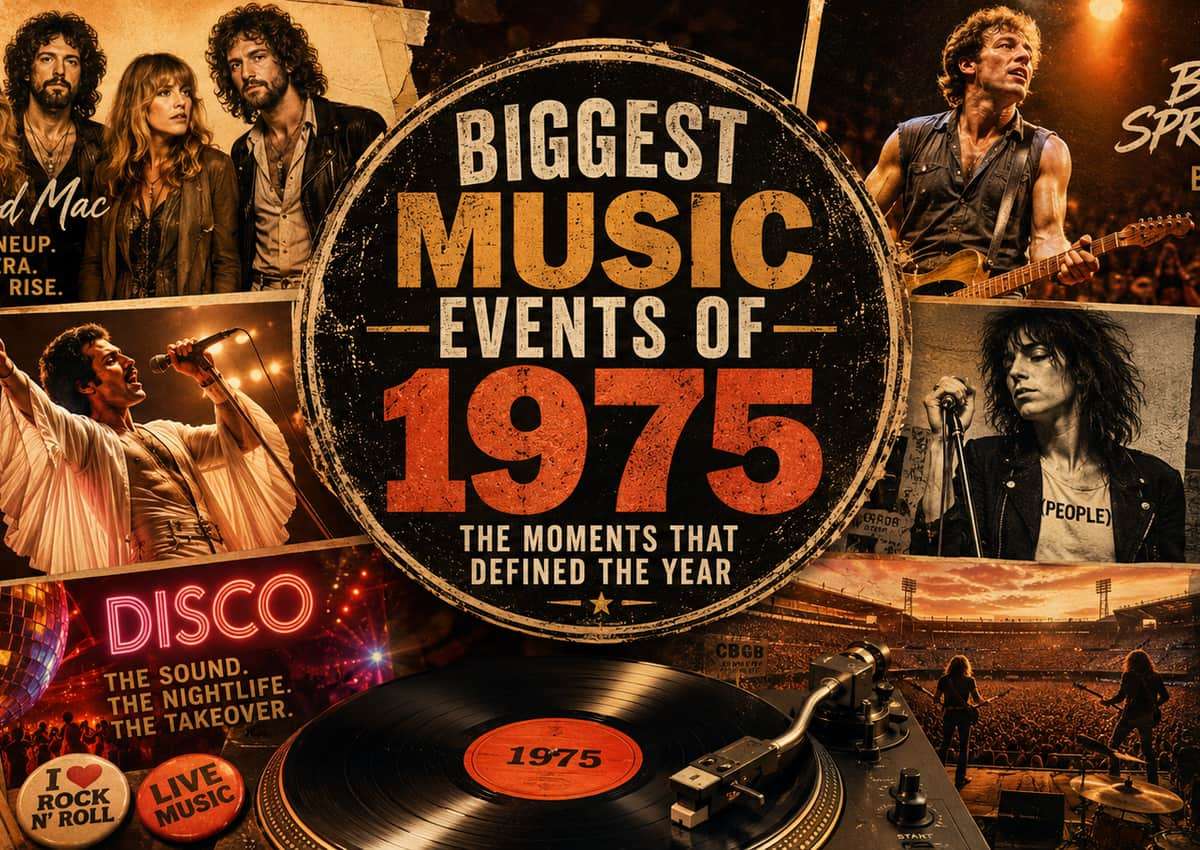
1975 was a breakthrough year in almost every direction. Bruce Springsteen went from cult favorite to national cover story, Queen turned ‘Bohemian Rhapsody’ into a rule-breaking hit, Fleetwood Mac introduced the Lindsey Buckingham-Stevie Nicks lineup, and Kiss proved that a live album could transform a band’s career.
Other events pointed toward the future: Patti Smith connected poetry to the emerging New York punk scene, Peter Gabriel left Genesis, and John Lennon stepped away from music after finally winning his fight to remain in the United States. The year felt like a handoff between established 1970s stars and the artists who would dominate the decade’s second half.
Howard Dee’s Take
1975 is where a lot of the names we think of as late-70s giants really lock into place. Springsteen, Fleetwood Mac, Queen, Kiss – they were all becoming something bigger than they had been a year earlier.
It was also a great year for albums that demanded to be heard from beginning to end. Physical Graffiti, Wish You Were Here, Born to Run, Horses – these were not background records.
February: Led Zeppelin Release Physical Graffiti
Physical Graffiti expanded Led Zeppelin’s catalog into a double album that mixed newly recorded material with tracks developed over several years. The record moved from crushing hard rock to acoustic pieces, funk, Eastern-influenced textures, and the monumental ‘Kashmir.’
The album showed a superstar band using commercial power to be more expansive rather than safer. It also reinforced the importance of the double album as a statement of ambition in 1970s rock.
Key songs: “Kashmir”, “Trampled Under Foot”, “Ten Years Gone”
Summer: Fleetwood Mac Introduce Buckingham and Nicks
Fleetwood Mac’s self-titled 1975 album introduced Lindsey Buckingham and Stevie Nicks into a band that had already gone through numerous versions. The new lineup produced ‘Rhiannon,’ ‘Landslide,’ and ‘Say You Love Me.’
The album’s success set up the extraordinary phenomenon that would follow with Rumours. More broadly, it is one of the decade’s clearest examples of a veteran band reinventing itself through new members rather than starting over under a different name.
Key songs: “Rhiannon”, “Landslide”, “Say You Love Me”
August: Bruce Springsteen Releases Born to Run
Born to Run was the album Bruce Springsteen needed. After two critically admired but modest-selling records, he spent months refining a larger, cinematic sound built around escape, youth, cars, streets, and the possibility of something better beyond the horizon.
The album’s success turned Springsteen into a national figure. When Time and Newsweek both put him on their covers in October, it became clear that a new major American rock star had arrived.
Key songs: “Born to Run”, “Thunder Road”, “Jungleland”
September: Kiss Alive! Changes the Band’s Career
Kiss had built a loyal concert audience through makeup, costumes, fire, blood, and relentless touring, but its studio albums had not captured the impact of the live show. Alive! finally translated that energy onto record.
The album became a breakthrough and helped establish Kiss as a major arena act. It also reinforced the commercial possibilities of live albums during a decade when several artists would release concert records that became central to their careers.
Key songs: “Rock and Roll All Nite”, “Deuce”, “Strutter”
September: Pink Floyd Release Wish You Were Here
Wish You Were Here followed the massive success of The Dark Side of the Moon with a more reflective record centered partly on absence, the music business, and the memory of former bandmate Syd Barrett.
The album demonstrated that Pink Floyd could follow an era-defining commercial breakthrough without simply repeating it. Their place at the center of album-oriented rock became even more secure.
Key songs: “Shine On You Crazy Diamond”, “Wish You Were Here”, “Have a Cigar”
Fall: Peter Gabriel Leaves Genesis
Peter Gabriel’s departure from Genesis ended the band’s most theatrical early period and created uncertainty about whether the group could continue without its distinctive frontman.
Instead, Genesis would eventually emerge with drummer Phil Collins as lead singer and become even more commercially successful. The split therefore became the beginning of two important 1970s and 1980s careers rather than the end of one band.
Key songs: “The Lamb Lies Down on Broadway”, “Carpet Crawlers”
October: John Lennon Wins His Fight to Stay in the United States
After years of legal battles over deportation, John Lennon won a major court victory allowing him to remain in the United States. Two days later, his son Sean was born.
Lennon then stepped away from the music business for several years to focus on family life. For one of the most famous musicians in the world, disappearing voluntarily from the industry was itself a remarkable act.
Key songs: “Imagine”, “Whatever Gets You thru the Night”
October-November: Queen Turn ‘Bohemian Rhapsody’ Into a Phenomenon
‘Bohemian Rhapsody’ ignored almost every rule of the conventional pop single. It was long, dramatically structured, moved through multiple musical styles, and arrived with a promotional film that helped establish a new visual language for rock marketing.
The song’s success proved that audiences would embrace something strange and ambitious if the performance was compelling enough. It transformed Queen from a successful rock band into global superstars.
Key songs: “Bohemian Rhapsody”, “You’re My Best Friend”
November: Patti Smith Releases Horses
Patti Smith’s Horses fused garage-rock minimalism, poetry, art-school ambition, and the raw atmosphere of the emerging New York club scene. Produced by John Cale, the album sounded deliberately different from polished mainstream rock.
Horses became a foundational record for punk and alternative music, not because it followed a rigid punk formula but because it suggested that artists could strip away rock’s conventions and rebuild them around attitude and ideas.
Key songs: “Gloria”, “Land”, “Free Money”
Late 1975: Disco Becomes Impossible to Ignore
KC and the Sunshine Band, the Bee Gees, Donna Summer, and other artists helped push dance music further into mainstream pop. Donna Summer’s ‘Love to Love You Baby,’ with Giorgio Moroder, pointed toward a more electronic, extended club sound.
The center of gravity was beginning to move toward dance floors and DJs. Disco was no longer a specialized club culture on the margins; it was becoming one of the defining commercial forces of the second half of the decade.
Key songs: “That’s the Way (I Like It)”, “Jive Talkin'”, “Love to Love You Baby”
What 1975 Sounded Like
1975 may be the moment when the decade’s second half truly begins. Fleetwood Mac found the lineup that would make Rumours, Springsteen became a national story, Queen crossed from successful rock band to phenomenon, and Kiss translated its live spectacle into a breakthrough album. At the same time, Patti Smith was helping define a downtown alternative to arena-rock polish.
Dance music was also becoming more central. The Bee Gees were changing direction, KC and the Sunshine Band were scoring major hits, and Donna Summer’s work with Giorgio Moroder suggested a more electronic future. The year therefore contains both the height of album-oriented rock and the beginnings of the club-centered pop culture that would dominate the end of the decade.
How 1975 Fits the Decade
1975 also demonstrated how much career momentum could change in a single year. Springsteen moved from critical favorite to national symbol, Fleetwood Mac discovered a lineup that would soon become historic, Queen found the song that permanently changed its commercial scale, and Kiss turned a touring reputation into record sales. None of those stories was inevitable at the start of the year.
At the edges, meanwhile, a different future was forming. Patti Smith and the CBGB scene rejected arena-rock polish, while disco producers were learning how to build records around the dance floor and extended groove. Those developments would soon compete directly for cultural attention, setting up the musical arguments of the late 1970s.
What Did We Leave Out?
No list of the biggest music events of 1975 can capture everything that happened. A record release, concert, breakup, television appearance, or personal memory may have mattered more to you than any headline on this page. What event from 1975 do you remember most clearly – and what would you add?
Why 1975 Was Such an Important Year in Music
Taken together, these events show why 1975 deserves its own chapter in the story of 1970s music. The year was not defined by one genre or one kind of star. Popular music was changing through records, concerts, technology, television, clubs, cultural movements, and the decisions artists made about how they wanted to work.