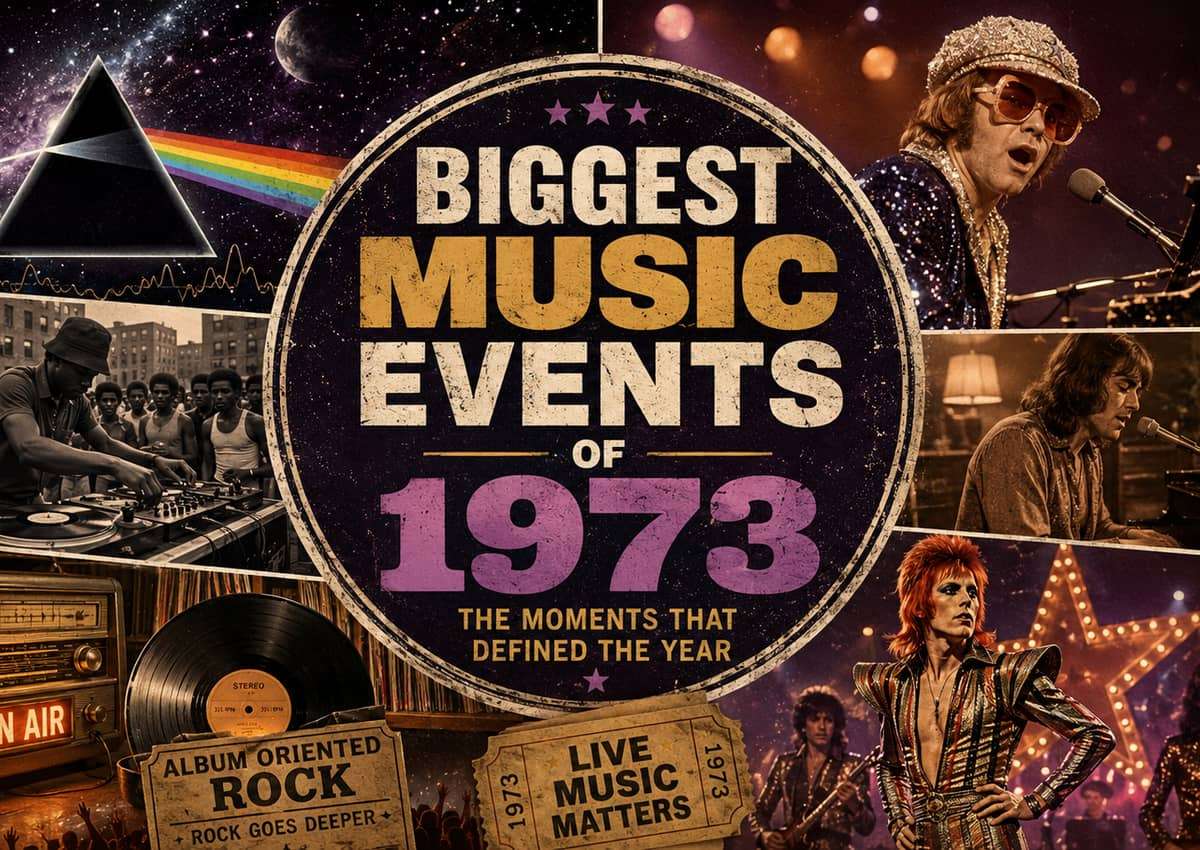
1973 may be one of the strongest single years in 1970s music. Pink Floyd released The Dark Side of the Moon, hip-hop’s origin story took shape at a Bronx party, Elvis Presley performed a satellite-broadcast concert from Hawaii, and giant crowds gathered for rock festivals and tours. Meanwhile, Queen and Lynyrd Skynyrd released debut albums, and the Who delivered the ambitious Quadrophenia.
The year also revealed how quickly the music business was changing. Television could carry a concert around the world, new clubs were creating local scenes, and even an international oil crisis affected the availability of vinyl. Music was now inseparable from technology, economics, youth culture, and mass media.
Howard Dee’s Take
If you wanted to argue that 1973 was the point where the decade fully arrived, I would not fight you very hard. Dark Side of the Moon alone would make the year historic, but then you add hip-hop’s beginnings, Queen, Skynyrd, Quadrophenia, and the enormous live-music culture.
This is also where the 1970s start feeling bigger than rock. Funk, soul, reggae, country, progressive rock, and new forms of dance music were all growing at the same time.
January: Elvis Presley’s Aloha from Hawaii Shows the Power of Global Television
Elvis Presley performed Aloha from Hawaii via Satellite from Honolulu, creating one of the era’s most famous televised concert events. The program demonstrated how satellite technology could turn a live performance into an international media moment.
Elvis had been a symbol of the first rock-and-roll generation. In 1973, he was also showing how music stardom could be packaged for a global television audience on a scale that would become increasingly normal in later decades.
Key songs: “Burning Love”, “An American Trilogy”, “Suspicious Minds”
March: Pink Floyd Release The Dark Side of the Moon
The Dark Side of the Moon combined progressive-rock ambition with unusually accessible songs, studio effects, synthesizers, tape loops, and a coherent set of themes involving time, money, anxiety, mortality, and modern life.
Its extraordinary chart longevity made it more than a successful album. It became one of the clearest demonstrations of the album as a complete listening experience and a defining record of FM and hi-fi culture.
Key songs: “Money”, “Time”, “Us and Them”
Spring: Reggae Moves Further Into International Rock Culture
Bob Marley and the Wailers released Catch a Fire and Burnin’ in 1973, while songs such as ‘Get Up, Stand Up’ and ‘I Shot the Sheriff’ introduced a growing international audience to reggae’s rhythms and political force.
The breakthrough mattered because reggae was no longer simply a Jamaican phenomenon reaching specialized listeners. It was becoming part of the global popular-music conversation and would influence rock, punk, and pop throughout the decade.
Key songs: “Get Up, Stand Up”, “I Shot the Sheriff”, “Stir It Up”
July: Watkins Glen Draws an Enormous Rock Crowd
The Summer Jam at Watkins Glen brought the Grateful Dead, the Band, and the Allman Brothers Band to a racetrack in upstate New York and drew a crowd estimated in the hundreds of thousands.
The event showed that the appetite for mass outdoor rock gatherings had survived well beyond Woodstock. It also demonstrated how a relatively small bill of established touring bands could attract a population comparable to a major city.
Key songs: “Jessica”, “Casey Jones”, “The Weight”
August 11: A Bronx Party Becomes Part of Hip-Hop’s Origin Story
DJ Kool Herc’s back-to-school party at 1520 Sedgwick Avenue in the Bronx is widely recognized as a foundational moment in hip-hop history. Herc extended the instrumental ‘breaks’ of records by moving between two turntables, creating longer rhythmic sections for dancers.
No one at the party could have known how far the idea would travel. Yet the techniques, dance culture, MCing, and neighborhood creativity surrounding events like this formed the foundation of a genre that would eventually reshape global popular music.
Key songs: “Apache”, “Give It Up or Turnit a Loose”
Summer: Lynyrd Skynyrd Release Their Debut Album
Pronounced ‘Lĕh-‘nérd ‘Skin-‘nérd introduced a wider audience to the Jacksonville band’s mix of blues, country, hard rock, and Southern identity. ‘Free Bird’ would become one of rock radio’s most enduring songs.
The record helped establish Southern rock as one of the decade’s major movements, alongside the Allman Brothers Band and a growing network of bands that combined regional roots with arena-scale guitar music.
Key songs: “Free Bird”, “Tuesday’s Gone”, “Gimme Three Steps”
July: Queen Release Their Debut Album
Queen’s first album did not make them immediate global superstars, but it introduced the combination of hard rock, layered vocals, theatrical ambition, and musical complexity that would soon become unmistakable.
Debuts matter in a year-history article because they show where the future was beginning. In 1973, Queen was still emerging; within a few years, the band would be one of the biggest acts in the world.
Key songs: “Keep Yourself Alive”, “Liar”
September 20: Jim Croce Dies in a Plane Crash
Jim Croce died in a plane crash in Louisiana at age 30 just as his career was accelerating.
The tragedy transformed a rising career into a posthumous legacy. Songs including ‘Time in a Bottle’ and ‘I’ll Have to Say I Love You in a Song’ became even more prominent after his death.
Key songs: “Bad, Bad Leroy Brown”, “Time in a Bottle”, “Operator (That’s Not the Way It Feels)”
September: Don Kirshner’s Rock Concert Brings Live Rock to Late-Night Television
Don Kirshner’s Rock Concert premiered in syndication, offering full performances by major artists rather than relying entirely on lip-syncing or variety-show formats.
The series reflected a changing relationship between television and rock. As the audience aged and album-oriented acts became more important, viewers wanted performances that treated musicians as concert artists rather than novelty guests.
Key songs: “Various live performances”
October: The Oil Crisis Hits the Record Business
The 1973 oil crisis affected far more than gasoline. Vinyl records were petroleum-based products, and shortages raised manufacturing costs and disrupted release schedules and pressing availability.
This is a useful reminder that music history is also business history. Even during a creatively extraordinary year, the physical materials required to manufacture albums could become a limiting factor.
Key songs: “Record manufacturing and vinyl shortages”
October: The Who Release Quadrophenia
Quadrophenia told the story of Jimmy, a young mod struggling with identity, class, belonging, and disillusionment. Pete Townshend’s concept was supported by dense production, recurring musical themes, synthesizers, and some of the Who’s most powerful performances.
The album captured a growing 1970s fascination with looking back at youth cultures that were already becoming history. It was both a rock opera and an act of cultural memory.
Key songs: “The Real Me”, “5:15”, “Love, Reign o’er Me”
What 1973 Sounded Like
1973 sounded expansive. Progressive rock reached a commercial high point with The Dark Side of the Moon, reggae moved further into international rock culture, Southern rock grew through Lynyrd Skynyrd, and the Who showed that the rock opera could still be ambitious and emotionally direct. At the same time, a small party in the Bronx was developing techniques that would eventually help create an entirely new global genre.
The year also showed how technology was changing music culture. Satellite television carried Elvis around the world, studio technology made albums more immersive, and the physical economics of vinyl suddenly mattered during the oil crisis. Music was not just songs and performers anymore; it was increasingly connected to media systems, manufacturing, and new ways of reaching enormous audiences.
How 1973 Fits the Decade
1973 also showed how scenes could develop at radically different scales. Pink Floyd could spend enormous time and technology creating a studio masterpiece while Kool Herc could transform a neighborhood party with turntables and records already in circulation. One form depended on a major album industry; the other grew through live community participation. Both would change popular music.
The year therefore challenges any simple story that the 1970s were dominated by one genre. Progressive rock, reggae, Southern rock, soul, funk, glam, country, and the earliest hip-hop culture were all active. The decade’s identity came from that coexistence, not from a single sound.
What Did We Leave Out?
No list of the biggest music events of 1973 can capture everything that happened. A record release, concert, breakup, television appearance, or personal memory may have mattered more to you than any headline on this page. What event from 1973 do you remember most clearly – and what would you add?
Why 1973 Was Such an Important Year in Music
Taken together, these events show why 1973 deserves its own chapter in the story of 1970s music. The year was not defined by one genre or one kind of star. Popular music was changing through records, concerts, technology, television, clubs, cultural movements, and the decisions artists made about how they wanted to work.