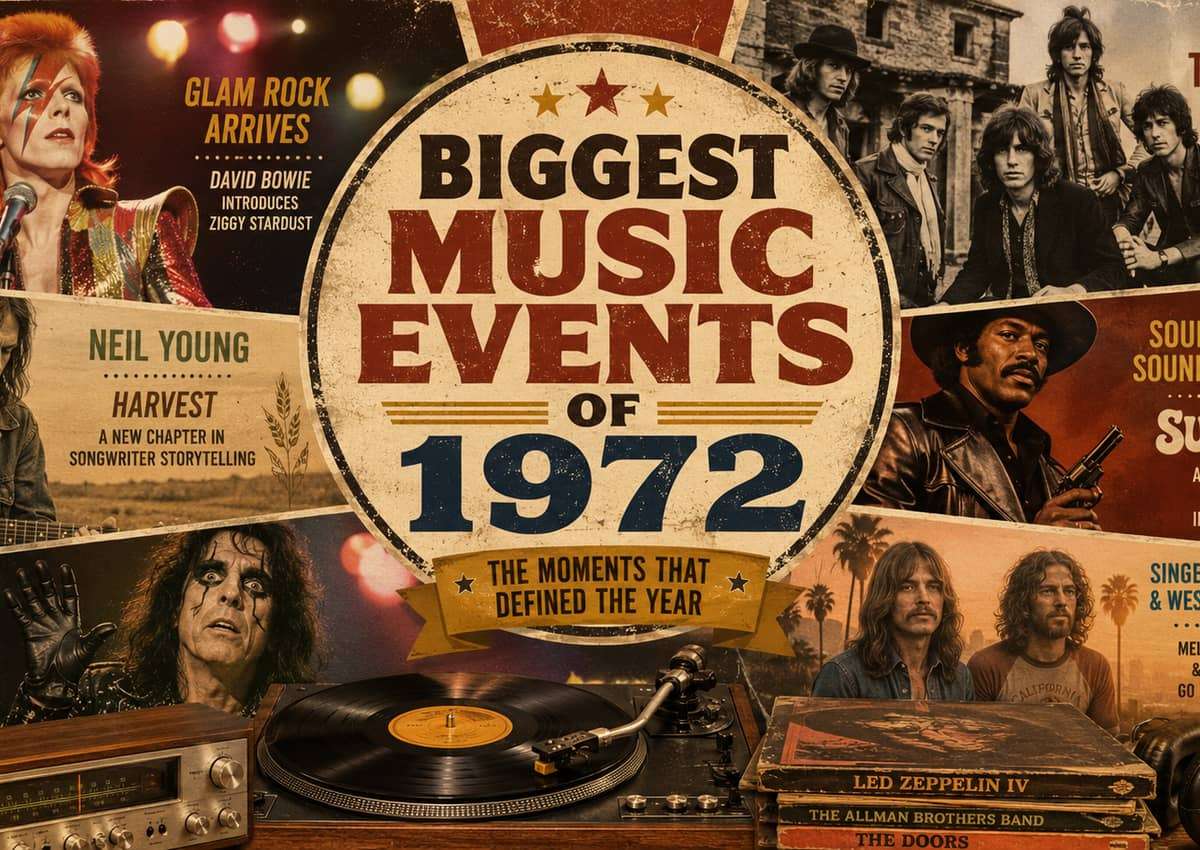
1972 was a year when rock became more theatrical, soul became more cinematic, and several artists who would dominate the decade moved decisively into the mainstream. David Bowie introduced Ziggy Stardust, the Rolling Stones made Exile on Main St., the Eagles released their debut, and Stevie Wonder entered the extraordinary creative run that would define his 1970s work.
The year also showed how large music culture had become. Major tours were now cultural events, benefit concerts could fill stadiums, and recordings moved constantly between rock, soul, country, funk, glam, and singer-songwriter styles. 1972 did not have one sound. Its importance comes from how many directions were expanding at once.
Howard Dee’s Take
1972 is one of those years where the record shelf tells the story. Bowie, the Stones, Stevie Wonder, Al Green, Curtis Mayfield, the Eagles, Neil Young, Elton John – every one of them was pushing in a slightly different direction.
For me, the biggest change was personality. Rock stars were becoming characters and brands as much as musicians, while soul artists were making albums with enormous social and artistic ambition.
January: Don McLean’s ‘American Pie’ Reaches No. 1
‘American Pie’ turned a long, cryptic meditation on rock history and cultural change into a mainstream phenomenon. Its length broke the usual rules of AM radio, yet listeners embraced it enough to send the song to No. 1.
The record demonstrated how deeply the first era of rock and roll had already entered popular memory. By 1972, artists were not only making rock history; they were writing songs about what that history meant.
Key songs: “American Pie”
February: Neil Young’s Harvest Becomes a Landmark
Harvest pushed Neil Young into the center of mainstream popular music and produced his only U.S. No. 1 single, ‘Heart of Gold.’ The album’s country-rock textures and reflective songwriting fit perfectly with the singer-songwriter audience of the early 1970s.
Its success showed that quiet, personal music could compete commercially with arena rock and glam. The boundaries between folk, country, and rock were increasingly fluid.
Key songs: “Heart of Gold”, “Old Man”, “The Needle and the Damage Done”
Spring: The Eagles Introduce a New California Sound
The Eagles’ debut album arrived in 1972 with ‘Take It Easy,’ ‘Witchy Woman,’ and ‘Peaceful Easy Feeling.’ The band’s blend of country harmony, rock rhythm, and polished songwriting became one of the decade’s most commercially durable sounds.
The debut also signaled the growing power of Southern California as a center of the music business. Country-rock was no longer a niche experiment; it was becoming mainstream pop.
Key songs: “Take It Easy”, “Witchy Woman”, “Peaceful Easy Feeling”
May: Exile on Main St. Captures the Rolling Stones at Their Messiest and Best
The Rolling Stones released Exile on Main St., a sprawling double album shaped by blues, gospel, country, soul, and ragged rock and roll. Its murky sound and loose atmosphere initially divided some listeners but later became central to the band’s reputation.
The album also arrived alongside the Stones’ huge North American tour, when rock touring itself was turning into a major media spectacle. The band was no longer simply promoting a record; it was operating as a traveling cultural event.
Key songs: “Tumbling Dice”, “Happy”, “Rocks Off”
June: David Bowie Introduces the World to Ziggy Stardust
The Rise and Fall of Ziggy Stardust and the Spiders from Mars transformed David Bowie from an intriguing British artist into one of rock’s defining personalities. Ziggy blurred music, theater, fashion, sexuality, and science-fiction imagery into a complete identity.
The importance of the album went beyond its songs. Bowie showed how a rock artist could deliberately construct a character and visual world, helping shape glam rock and generations of image-conscious performers.
Key songs: “Starman”, “Suffragette City”, “Ziggy Stardust”
August: Wattstax Turns a Concert Into a Statement
Stax Records staged Wattstax at the Los Angeles Memorial Coliseum, bringing together major soul and gospel artists including Isaac Hayes, the Staple Singers, the Bar-Kays, and others. The event was conceived partly as a celebration of Black culture and community.
Wattstax demonstrated how a label’s catalog, artists, and cultural identity could come together in a large-scale event. The resulting film and recordings preserved a vivid snapshot of early-1970s soul at a moment when the genre was expanding musically and politically.
Key songs: “Theme from Shaft”, “Respect Yourself”
Summer-Fall: Stevie Wonder Begins His Classic 1970s Run
Music of My Mind and Talking Book showed Stevie Wonder taking greater control of composition, production, keyboards, and synthesizers. ‘Superstition’ in particular announced a funkier, more self-directed sound.
This was the beginning of one of the most celebrated creative runs by any artist in the decade. Wonder’s use of new studio technology demonstrated that electronic instruments could deepen soul music rather than make it less human.
Key songs: “Superstition”, “You Are the Sunshine of My Life”, “I Believe (When I Fall in Love It Will Be Forever)”
Fall: Curtis Mayfield’s Super Fly Brings Social Commentary to the Soundtrack
Curtis Mayfield’s Super Fly soundtrack became more than music attached to a film. Songs such as ‘Freddie’s Dead’ and ‘Superfly’ examined drugs, poverty, ambition, and urban life with a perspective more complicated than the movie’s surface glamour.
The album helped establish the soundtrack as a major artistic form in 1970s soul and funk. It also showed how popular music could comment on a film rather than merely support it.
Key songs: “Freddie’s Dead”, “Superfly”, “Pusherman”
Fall: Alice Cooper Makes Shock Rock Mainstream
School’s Out became Alice Cooper’s commercial breakthrough on a new scale, combining a giant teen anthem with a theatrical stage show built around provocation, horror imagery, and dark humor.
The success helped establish concert spectacle as an increasingly important part of hard rock. By the middle of the decade, audiences would expect major rock tours to deliver a visual experience as well as music.
Key songs: “School’s Out”, “Elected”
October: Motown Begins Moving Its Center of Gravity to Los Angeles
Motown’s shift from Detroit toward Los Angeles reflected a larger change in the music business. Film, television, artist management, and recording were becoming increasingly interconnected, and Berry Gordy’s company was expanding beyond the Detroit model that had defined the 1960s.
The move symbolized the end of one Motown era and the beginning of another. The label’s stars would remain important, but the company itself was becoming a broader entertainment business.
Key songs: “Papa Was a Rollin’ Stone”, “Ben”
Late 1972: Elton John Becomes an Arena-Level Superstar
Honky Chateau produced ‘Rocket Man’ and ‘Honky Cat’ and helped push Elton John from rising star to one of the dominant album and concert artists of the decade. His partnership with Bernie Taupin was producing songs at an extraordinary pace.
Elton’s rise mattered because he combined singer-songwriter craft with the scale and flamboyance of rock showmanship. That combination would become one of the signatures of 1970s stardom.
Key songs: “Rocket Man”, “Honky Cat”, “Mona Lisas and Mad Hatters”
What 1972 Sounded Like
1972 had no single dominant sound, and that may be its greatest strength. Glam rock, country-rock, soul, funk, singer-songwriter music, hard rock, and socially conscious soundtracks were all becoming larger. Bowie made image and character part of the music, the Eagles polished California country-rock for a mass audience, Stevie Wonder used synthesizers to deepen soul, and Curtis Mayfield proved that a film soundtrack could carry an argument of its own.
The business was also becoming more spectacular. Huge tours generated headlines beyond the music pages, artists became visual personalities, and labels increasingly thought about records, concerts, films, fashion, and television as parts of the same career. The modern idea of the pop or rock superstar was becoming more complete.
How 1972 Fits the Decade
The growing importance of image also deserves attention. Bowie’s Ziggy persona, Alice Cooper’s stage theatrics, Elton John’s flamboyance, and the Rolling Stones’ touring spectacle all made it harder to separate the music from the visual presentation. The modern rock star was becoming a complete media figure whose clothing, stage design, interviews, and mythology could be as recognizable as the songs.
Meanwhile, soul and funk artists were using the album form to widen their subject matter. Curtis Mayfield, Stevie Wonder, Al Green, and others demonstrated that commercial Black music could be romantic, political, experimental, cinematic, and technically adventurous at the same time. That creative range would become one of the decade’s greatest strengths.
What Did We Leave Out?
No list of the biggest music events of 1972 can capture everything that happened. A record release, concert, breakup, television appearance, or personal memory may have mattered more to you than any headline on this page. What event from 1972 do you remember most clearly – and what would you add?
Why 1972 Was Such an Important Year in Music
Taken together, these events show why 1972 deserves its own chapter in the story of 1970s music. The year was not defined by one genre or one kind of star. Popular music was changing through records, concerts, technology, television, clubs, cultural movements, and the decisions artists made about how they wanted to work.