
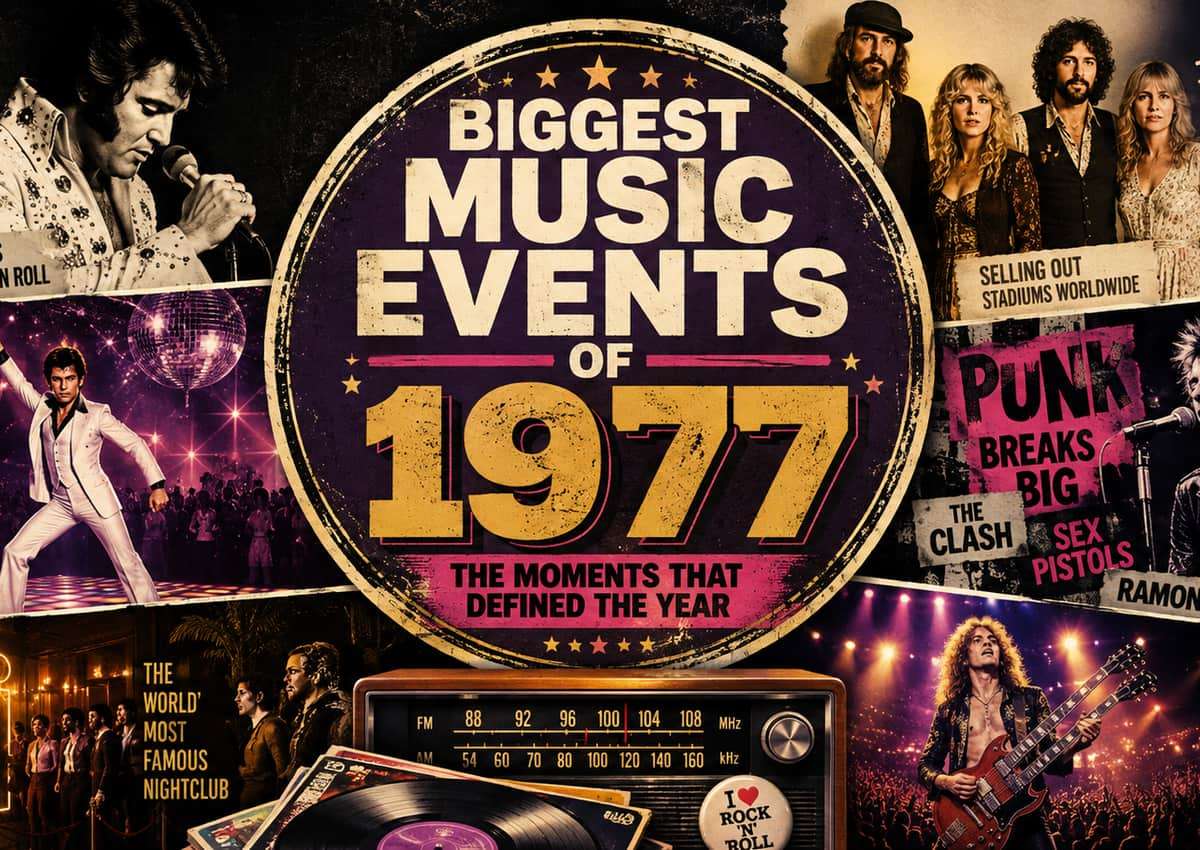
1977 may be the most emotionally loaded year of the decade. Elvis Presley died, Lynyrd Skynyrd lost members in a plane crash, punk exploded in Britain, Studio 54 opened in New York, and Saturday Night Fever helped push disco toward worldwide saturation.
At the same time, Fleetwood Mac released Rumours, the Eagles’ Hotel California dominated the year, and Queen delivered two stadium anthems that would outlive almost everything around them. 1977 was not one musical story. It was several different futures colliding at full speed.
Howard Dee’s Take
When people picture the late 1970s, they are often picturing 1977 without realizing it. Rumours. Elvis dying. Saturday Night Fever. Studio 54. The Sex Pistols. ‘We Will Rock You.’ It is almost too much for one year.
What makes it even more interesting is how little these worlds had in common. Punk fans and Studio 54 regulars were not necessarily listening to the same records, but both scenes were reshaping what youth culture looked like.
February: Fleetwood Mac Release Rumours
Rumours turned the personal fractures inside Fleetwood Mac into one of the most commercially successful albums ever made. Relationships within the band were breaking down even as Lindsey Buckingham, Stevie Nicks, Christine McVie, John McVie, and Mick Fleetwood created remarkably polished pop-rock.
The record’s emotional directness helped listeners feel that the songs were part of one continuing story. It also showed how studio craftsmanship and personal confession could combine on an arena-rock scale.
Key songs: “Dreams”, “Go Your Own Way”, “Don’t Stop”, “The Chain”
April: Studio 54 Opens in New York
Studio 54 opened in Manhattan and quickly became the most famous nightclub associated with the disco era. Celebrities, fashion, spectacle, selective admission, and an elaborate dance-floor environment turned the club itself into a cultural symbol.
Disco had existed long before Studio 54, but the club gave mainstream media a visual shorthand for the lifestyle surrounding the music. The DJ, the dance floor, and the nightclub became central characters in popular culture.
Key songs: “I Feel Love”, “Le Freak”, “Don’t Leave Me This Way”
May: The Sex Pistols Release ‘God Save the Queen’
The Sex Pistols released ‘God Save the Queen’ during Queen Elizabeth II’s Silver Jubilee year, turning punk provocation into a national argument. The record was banned by portions of British broadcasting but still became a major commercial event.
Punk was no longer a club-scene curiosity. It was now confronting institutions, media, and the music business directly, and the controversy only increased its visibility.
Key songs: “God Save the Queen”, “Pretty Vacant”
Summer: Donna Summer and Giorgio Moroder Point Toward Electronic Dance Music
‘I Feel Love’ used a largely electronic backing track built by Giorgio Moroder beneath Donna Summer’s voice. The result sounded strikingly different from orchestral disco records and many conventional band recordings.
The track’s influence reached far beyond disco. Synth-pop, electronic dance music, new wave, and club production all drew from the possibilities it revealed.
Key songs: “I Feel Love”
August 16: Elvis Presley Dies
Elvis Presley died at Graceland at age 42. His career had begun before the Beatles, before the counterculture, and before the album-rock era, yet his image and catalog remained central to popular music.
His death transformed Elvis from an active, complicated star into an American cultural monument. The mourning also demonstrated the extraordinary depth of attachment between rock-and-roll audiences and the artists who had shaped their youth.
Key songs: “Suspicious Minds”, “Burning Love”, “Can’t Help Falling in Love”
October 20: The Lynyrd Skynyrd Plane Crash
A plane carrying Lynyrd Skynyrd crashed in Mississippi, killing singer Ronnie Van Zant, guitarist Steve Gaines, backing vocalist Cassie Gaines, and others. The tragedy came only days after the release of Street Survivors.
The crash abruptly ended the band’s classic era just as Southern rock had become a major force. Songs such as ‘Sweet Home Alabama’ and ‘Free Bird’ took on an even deeper memorial role in rock culture.
Key songs: “Free Bird”, “Sweet Home Alabama”, “What’s Your Name”
October: Queen Release News of the World
Queen’s News of the World contained ‘We Will Rock You’ and ‘We Are the Champions,’ two songs deliberately designed around audience participation and communal performance.
They became far more than hit singles. Sporting events, arenas, school gyms, and public celebrations adopted them, demonstrating how recorded music could become part of ritual and crowd behavior.
Key songs: “We Will Rock You”, “We Are the Champions”
October: Never Mind the Bollocks Makes Punk Impossible to Ignore
The Sex Pistols’ only studio album compressed the controversy, aggression, and anti-establishment posture of British punk into a major-label release that immediately became a cultural flashpoint.
Its historical importance is not just musical. Punk challenged the assumption that rock’s future belonged to increasingly polished musicianship and huge productions. It reopened the door to amateur urgency.
Key songs: “Anarchy in the U.K.”, “God Save the Queen”, “Pretty Vacant”
November-December: Saturday Night Fever Turns Disco Into a Mass Phenomenon
The Saturday Night Fever soundtrack, dominated by Bee Gees songs, connected disco music to a hugely successful film and pushed the genre into homes far beyond established club audiences.
‘Stayin’ Alive,’ ‘How Deep Is Your Love,’ and ‘Night Fever’ became defining records of the era. Disco was no longer merely one strong genre among many; for a period, it became the center of American pop culture.
Key songs: “Stayin’ Alive”, “How Deep Is Your Love”, “Night Fever”, “More Than a Woman”
1977: Talking Heads and the New York New-Wave Scene Move Forward
Talking Heads released their debut album after developing in the same downtown club environment that had produced the Ramones and Blondie. Their nervous rhythms, art-school perspective, and stripped-down sound pointed toward a broader post-punk and new-wave future.
The New York scene was proving that punk’s importance would not be limited to one rigid style. It was creating an ecosystem where radically different bands could grow from the same small clubs.
Key songs: “Psycho Killer”, “Uh-Oh, Love Comes to Town”
What 1977 Sounded Like
1977 was a year of extremes. Rumours represented immaculate studio pop-rock, punk deliberately attacked polish, and disco turned the nightclub into one of popular culture’s central spaces. Queen created songs designed for stadium crowds while the Sex Pistols created songs designed to provoke the establishment. The Bee Gees and Donna Summer were as central to the year as Fleetwood Mac and the Clash.
The emotional weight of the year also came from loss. Elvis Presley’s death closed a chapter reaching back to the birth of rock and roll, while the Lynyrd Skynyrd crash ended one of Southern rock’s defining lineups. Those events sat beside new scenes and new stars, making 1977 feel like a year in which music history was simultaneously being mourned and rewritten.
How 1977 Fits the Decade
Few years illustrate musical tribalism as clearly as 1977. Disco clubs, punk venues, FM-rock audiences, and mainstream pop radio could feel like separate cultural worlds, even when listeners moved between them. Fashion, politics, sexuality, neighborhood identity, and age increasingly shaped which music communities people considered their own.
Yet the records themselves often crossed those boundaries. Donna Summer’s electronic production influenced rock and new wave, punk bands borrowed reggae, and mainstream artists absorbed dance rhythms. The arguments between scenes were often louder than the actual musical borders. That cross-pollination is part of what made the year so creative.
What Did We Leave Out?
No list of the biggest music events of 1977 can capture everything that happened. A record release, concert, breakup, television appearance, or personal memory may have mattered more to you than any headline on this page. What event from 1977 do you remember most clearly – and what would you add?
Why 1977 Was Such an Important Year in Music
Taken together, these events show why 1977 deserves its own chapter in the story of 1970s music. The year was not defined by one genre or one kind of star. Popular music was changing through records, concerts, technology, television, clubs, cultural movements, and the decisions artists made about how they wanted to work.


