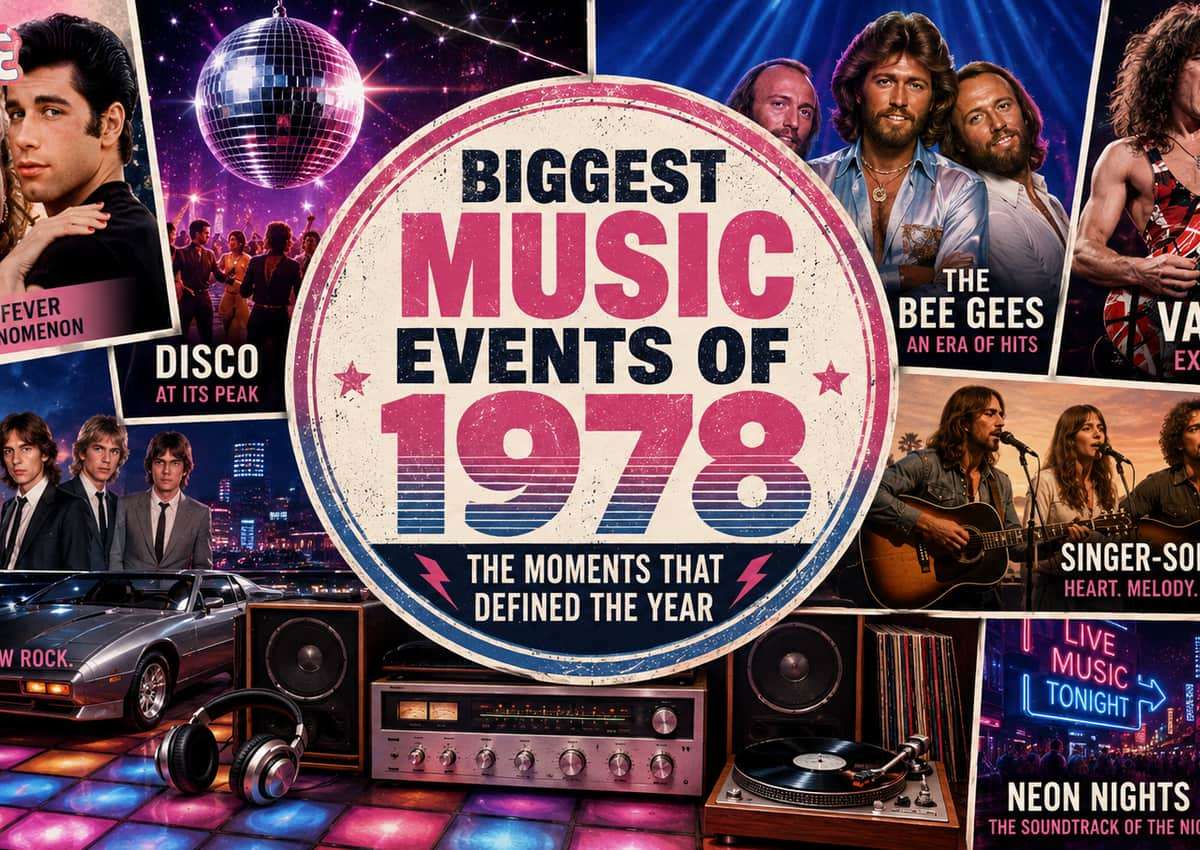
1978 was the year the late 1970s split into competing musical worlds. Disco remained a commercial powerhouse, but new wave and punk were spreading, Van Halen’s debut changed the language of hard-rock guitar, and artists such as the Cars, Dire Straits, and Blondie introduced sounds that would carry directly into the 1980s.
The year was also marked by the death of Keith Moon and the breakup of the Sex Pistols’ original run. Even as some defining 1970s stories were ending, a new generation of records was arriving with cleaner lines, sharper rhythms, and a very different attitude toward rock.
Howard Dee’s Take
1978 feels like the doorway between decades even though there were still two years left on the calendar. Put Van Halen, the Cars, Blondie, Dire Straits, and the punk bands next to the big disco records and you can hear the 1980s taking shape.
But the old 70s were still there too: the Stones made Some Girls, Springsteen toured Darkness on the Edge of Town, and the Who were still a major force until Keith Moon’s death changed everything.
January: The Sex Pistols’ U.S. Tour Implodes
The Sex Pistols’ chaotic American tour ended at San Francisco’s Winterland Ballroom, where Johnny Rotten closed by asking the audience if it ever felt cheated. Soon afterward, the original band effectively came apart.
The breakup did not kill punk. In some ways, it proved that punk had already escaped the control of any single band. Scenes in London, New York, Los Angeles, and elsewhere were producing their own versions of the movement.
Key songs: “Anarchy in the U.K.”, “God Save the Queen”
February: Van Halen Release Their Debut
Van Halen’s first album introduced Eddie Van Halen’s astonishing guitar technique to a mass audience. ‘Eruption’ became a short demonstration piece that sent guitar players everywhere back to their instruments, while ‘Runnin’ with the Devil’ and ‘Ain’t Talkin’ ’bout Love’ gave the band immediate hard-rock identity.
The record helped reset expectations for guitar playing and launched the flashy, technically demanding hard-rock style that would dominate much of the following decade.
Key songs: “Runnin’ with the Devil”, “Eruption”, “Ain’t Talkin’ ’bout Love”
Spring: The Cars Bring New Wave to American Radio
The Cars’ debut album blended synthesizers, clipped guitar riffs, pop hooks, and an emotionally cool vocal style. Songs including ‘Just What I Needed’ and ‘My Best Friend’s Girl’ sounded both radio-friendly and distinctly newer than traditional arena rock.
The album became one of the key bridges between 1970s rock and 1980s new wave. It showed that modern production and pop economy could coexist with rock guitars.
Key songs: “Just What I Needed”, “My Best Friend’s Girl”, “Good Times Roll”
June: The Rolling Stones Answer Punk and Disco with Some Girls
Some Girls found the Rolling Stones reacting to New York punk, disco, and the changing sound of popular music without abandoning their own identity. ‘Miss You’ embraced a dance groove, while ‘Shattered’ and ‘Respectable’ sounded leaner and more urgent.
The album was a reminder that veteran bands could survive changing trends by absorbing new influences rather than pretending the culture around them had not changed.
Key songs: “Miss You”, “Beast of Burden”, “Shattered”
Summer: Grease Extends the Soundtrack Boom
Grease became a film and soundtrack phenomenon, producing huge hits for John Travolta, Olivia Newton-John, and Frankie Valli. Along with the continuing success of Saturday Night Fever, it showed how powerfully movies and pop music could reinforce one another.
The soundtrack model would become increasingly important in later decades. A film could create radio hits, while familiar songs could in turn keep a movie culturally visible.
Key songs: “You’re the One That I Want”, “Hopelessly Devoted to You”, “Grease”
Summer-Fall: Bruce Springsteen’s Darkness Tour Builds His Live Legend
Darkness on the Edge of Town was leaner and more conflicted than Born to Run, and the tour supporting it became central to Bruce Springsteen’s reputation as an extraordinary live performer.
The marathon shows helped establish the E Street Band as one of rock’s great concert groups. Springsteen’s career was becoming as much about the communal experience of the show as the records themselves.
Key songs: “Badlands”, “Prove It All Night”, “The Promised Land”
September 7: Keith Moon Dies
Keith Moon died in London at age 32. His explosive drumming and unpredictable personality had been inseparable from the Who’s sound and public identity.
The Who would continue, but Moon’s death ended the classic four-man lineup. It was another moment when one of the foundational bands of 1960s rock was forced to confront whether and how it could exist in a new era.
Key songs: “Won’t Get Fooled Again”, “Baba O’Riley”, “Who Are You”
September: The Grateful Dead Perform at the Pyramids
The Grateful Dead played a series of concerts near the Great Pyramid and Sphinx in Giza, Egypt. The setting reflected the band’s long-standing interest in turning concerts into unusual communal experiences rather than simply repeating a standard arena production.
The shows became part of Grateful Dead lore and demonstrated how established rock bands were increasingly thinking globally about where and how live music could happen.
Key songs: “Fire on the Mountain”, “Shakedown Street”
Fall: Blondie’s Parallel Lines Turns a Downtown Band Into Pop Stars
Parallel Lines transformed Blondie from a respected New York scene band into an international pop act. The album’s mix of punk attitude, pop melody, disco rhythm, and new-wave style produced songs including ‘Heart of Glass’ and ‘One Way or Another.’
The crossover showed that the boundaries between punk, pop, and disco were much more flexible than the scenes’ rivalries suggested. Blondie could borrow from all of them and still sound unmistakably like itself.
Key songs: “Heart of Glass”, “One Way or Another”, “Hanging on the Telephone”
Fall: Dire Straits Introduce a Different Kind of Guitar Hero
Dire Straits’ debut album and ‘Sultans of Swing’ introduced Mark Knopfler’s clean, fingerpicked guitar style at a moment when rock guitar was often associated with distortion and spectacle.
The band’s rise proved there was still room for restraint and musicianship inside late-1970s rock. Not every new sound had to be louder, faster, or more theatrical.
Key songs: “Sultans of Swing”, “Down to the Waterline”
Late 1978: Chic’s ‘Le Freak’ Becomes a Disco Peak
Chic’s ‘Le Freak’ combined Nile Rodgers’ precise rhythm guitar, Bernard Edwards’ bass, orchestral accents, and a groove engineered for the dance floor. It became one of disco’s signature commercial successes.
The record captured disco at its most sophisticated just before the genre became the target of an increasingly aggressive backlash. That tension would define much of the following year.
Key songs: “Le Freak”, “I Want Your Love”
What 1978 Sounded Like
1978 sounded increasingly modern. Van Halen reset expectations for hard-rock guitar, the Cars and Blondie made new wave commercially inviting, Dire Straits offered a cleaner and more restrained guitar sound, and Chic refined disco into something sleek and sophisticated. The lines separating rock, pop, punk, and dance music were being crossed constantly.
That is why the year feels so close to the 1980s. Synthesizers were becoming normal, compact pop arrangements were returning, image and video mattered more, and punk’s influence was spreading even when a band did not sound punk. Yet major 1970s institutions – the Stones, Springsteen, the Who, the Grateful Dead – remained very much alive, making the transition gradual rather than abrupt.
How 1978 Fits the Decade
1978 also revealed how quickly punk’s initial shock was turning into a broader vocabulary. Blondie, the Cars, Talking Heads, and other new-wave acts kept punk’s economy and attitude while embracing melody, keyboards, art-school ideas, and pop craft. The result was music that could reach mainstream radio without simply returning to the arena-rock formulas punk had challenged.
At the same time, virtuosity did not disappear; it changed shape. Eddie Van Halen made technical guitar playing feel playful and futuristic rather than ponderous, while Mark Knopfler’s restraint offered another path entirely. The guitar remained central to rock, but there was no longer one accepted model for what a guitar hero should sound like.
What Did We Leave Out?
No list of the biggest music events of 1978 can capture everything that happened. A record release, concert, breakup, television appearance, or personal memory may have mattered more to you than any headline on this page. What event from 1978 do you remember most clearly – and what would you add?
Why 1978 Was Such an Important Year in Music
Taken together, these events show why 1978 deserves its own chapter in the story of 1970s music. The year was not defined by one genre or one kind of star. Popular music was changing through records, concerts, technology, television, clubs, cultural movements, and the decisions artists made about how they wanted to work.