Some artists build careers around dozens of hits. Others get one perfect moment. 1970 had plenty of those moments — songs that seemed to come out of nowhere, took over American radio, and then became permanently attached to the name on the label.
That does not mean these musicians disappeared or stopped making good music. Many had long careers, major success in other countries, strong album catalogs, or important work behind the scenes. But on the U.S. Billboard Hot 100, the artists in this article crossed into the Top 40 only once.
That is the definition we are using throughout this series. It keeps the rules consistent, and it also creates some fascinating surprises: a respected album-rock artist can technically sit beside a genuine flash-in-the-pan pop act because the singles chart tells only one part of the story.
Howard Dee’s Take
I have always thought the phrase one-hit wonder sounds more dismissive than it should. Making one record that people still know fifty years later is not a small accomplishment. Most musicians would happily take one song that can bring back a summer, a car, a dance, or an old radio within the first few seconds.
The fun of looking back at 1970 is hearing how different these records are from one another. Some were novelty records, some were serious rock or soul, and some belonged to artists whose careers were much bigger than their pop-chart statistics suggest. The common thread is simple: one song broke through, and we never quite forgot it.
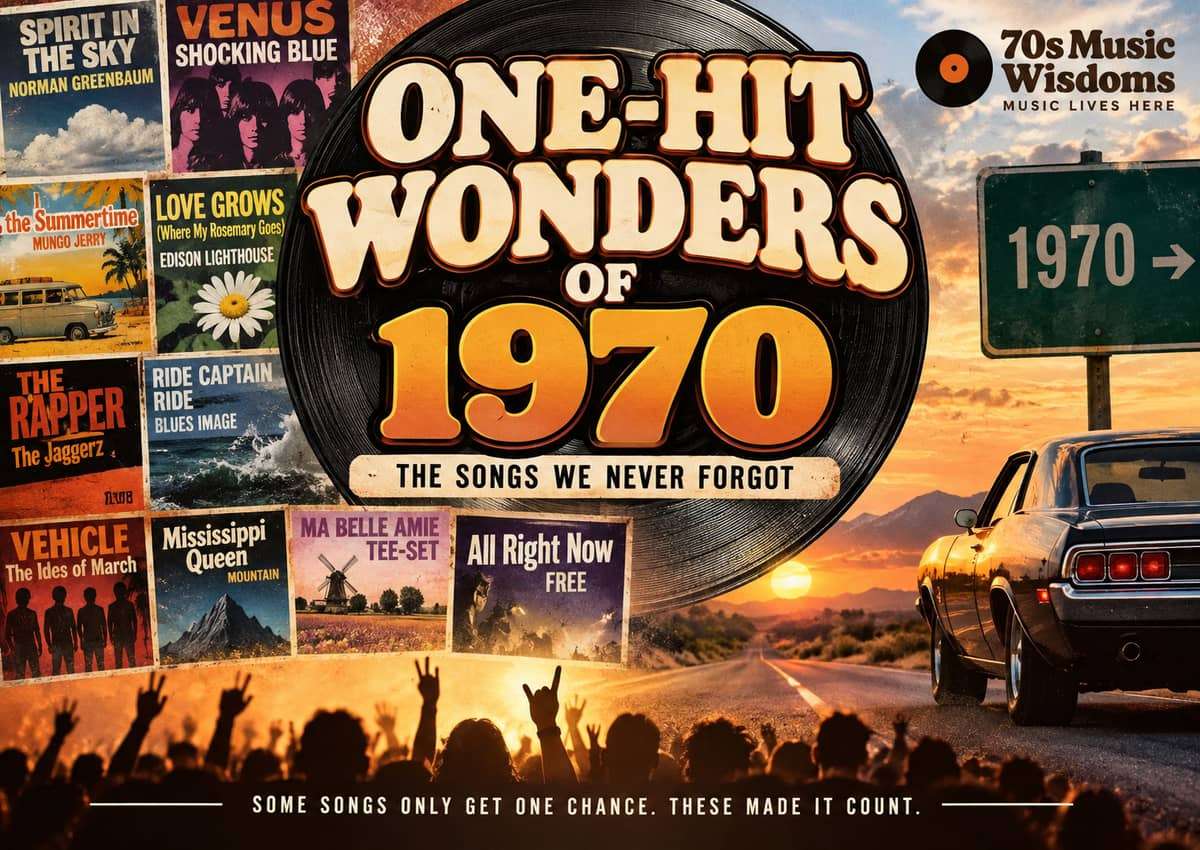
Norman Greenbaum — “Spirit in the Sky”
That fuzzed-out guitar announces the song before Greenbaum even begins singing. Gospel-style backing vocals, handclaps, and a lyric about preparing for the afterlife somehow came together as one of the most recognizable records of the early 1970s.
What makes the record so unusual is the way those pieces fit without sounding polished smooth. The guitar tone is abrasive and almost mechanical, while the backing voices bring warmth and lift. The rhythm keeps a steady, stomping pulse underneath it all. It is a strange combination on paper, but on the radio it was immediate: the opening seconds already told you exactly which song had arrived.
Its durability is remarkable. Movies, television, commercials, and cover versions have kept introducing the record to listeners who were not alive when it first hit AM radio. Greenbaum recorded more music, but under this series’ U.S. Billboard Hot 100 Top 40 rule, “Spirit in the Sky” is the one crossover that defines his chart history. That is less a comment on the rest of his catalog than a measure of just how enormous this particular record became.
1970 hit: “Spirit in the Sky”
Billboard Hot 100 peak: No. 3
Shocking Blue — “Venus”
The Dutch band Shocking Blue brought a hard, hypnotic groove to American radio with “Venus,” powered by Mariska Veres’ commanding vocal and Robbie van Leeuwen’s songwriting.
The record has more bite than the title might suggest. Its churning rhythm, clipped guitar figures, organ color, and Veres’ cool, forceful delivery gave “Venus” a sound that was both pop-friendly and slightly mysterious. Shocking Blue had roots in the late-1960s Dutch rock scene, and the band’s music could move through psychedelic, folk, country, and straight-ahead rock ideas rather than fitting neatly into one box.
The band had a much broader career in Europe, which is why the American one-hit-wonder label needs context. In the United States, however, “Venus” was their only Top 40 hit. Its No. 1 peak made that lone American crossover especially hard to escape, and the song’s basic construction was strong enough to survive changing production fashions. Long after 1970, the melody and groove still sounded instantly familiar.
1970 hit: “Venus”
Billboard Hot 100 peak: No. 1
Mungo Jerry — “In the Summertime”
Few records sound as much like their title as “In the Summertime.” The loose jug-band rhythm, Ray Dorset’s distinctive vocal, and the famous engine-noise effect make the record feel like a hot afternoon with nowhere to be.
Mungo Jerry’s approach stood apart from the heavier British rock that was also flourishing in 1970. The group leaned into skiffle, jug-band looseness, blues, and an intentionally homemade feel. “In the Summertime” does not depend on a huge drum sound or a wall of guitars; the stop-start pulse, piano, vocal interjections, and acoustic textures make it feel almost spontaneous. That informality is a big part of the charm.
The single was the group’s debut and became a major success in Britain before turning into an international signature song. Mungo Jerry remained successful in Britain and Ray Dorset continued working under the name for decades, but American Top 40 listeners knew the group for this one enormous summer record. It is a perfect example of how a worldwide career can look very different when viewed only through the U.S. singles chart.
1970 hit: “In the Summertime”
Billboard Hot 100 peak: No. 3
Edison Lighthouse — “Love Grows (Where My Rosemary Goes)”
Bright, immediate, and almost impossible not to sing along with, “Love Grows” is pure early-1970s AM-radio pop. The studio recording featured Tony Burrows, whose voice appeared on several hits credited to different groups around the same period.
Burrows is one of the great reminders that the name printed on a single did not always tell the whole story in that era. Edison Lighthouse began as a studio vehicle, and Burrows was simultaneously associated with records released under other group names. “Love Grows” works because none of that business-side complexity is audible in the final result. The record is concise, melodic, buoyant, and built around a chorus that arrives exactly when you want it to.
The unusual studio-project story makes the song even more memorable: the hit became famous before a conventional performing band had fully formed around the name. That gives Edison Lighthouse one of the purest one-hit-wonder stories on this list. The record was not the accidental work of inexperienced musicians; it was carefully assembled pop made by people who understood how to build a single that could jump out of a radio speaker.
1970 hit: “Love Grows (Where My Rosemary Goes)”
Billboard Hot 100 peak: No. 5
The Jaggerz — “The Rapper”
Long before “rapper” meant what it means today, the Jaggerz used the word for a smooth-talking character who always seems to know the right line. The Pittsburgh group’s soul-rock groove carried the song almost to the top.
The Jaggerz were not a studio name invented for one recording. They had formed in the Pittsburgh area in the 1960s, built a local following, and made an album before “The Rapper” became their national breakthrough. That background matters because the record has the tightness of a working band: rhythm guitar, bass, drums, vocals, and the central hook all lock together without much wasted motion. The lyric is playful, but the performance is muscular enough to keep it from feeling like a novelty record.
The song also has an important career footnote. Dominic Ierace, later known widely as Donnie Iris, was a central member of the group and went on to enjoy further chart success as a solo artist in the 1980s. So the Jaggerz qualify here because of the band’s own U.S. Top 40 history, not because its musicians vanished. It was a massive hit for a band that is rarely included in the standard classic-rock rotation, which is exactly why one-hit-wonder history can be so much fun.
1970 hit: “The Rapper”
Billboard Hot 100 peak: No. 2
Blues Image — “Ride Captain Ride”
The opening keyboard figure and relaxed harmony vocals immediately place “Ride Captain Ride” in the transition between late-1960s psychedelia and the smoother rock sound of the new decade.
Blues Image had come out of the late-1960s rock world, and “Ride Captain Ride” carries traces of that era without getting lost in extended psychedelic wandering. The song is unusually economical: a memorable keyboard entrance, an inviting vocal, a compact narrative, and a clean instrumental build all move in the same direction. Producer Richard Podolor and engineer Bill Cooper gave the record a polished surface that helped its slightly mysterious story sit comfortably beside mainstream pop hits.
Its durability comes partly from that balance. The record is odd enough to invite questions about what the story means, but melodic enough that you do not need an answer to enjoy it. Guitarist Mike Pinera went on to work in other rock settings, another reminder that the band’s one Top 40 hit did not represent the full musical lives of its members. “Ride Captain Ride” simply became the moment when Blues Image connected with the widest American audience.
1970 hit: “Ride Captain Ride”
Billboard Hot 100 peak: No. 4
The Ides of March — “Vehicle”
Brass blasts, a muscular rhythm section, and Jim Peterik’s forceful vocal made “Vehicle” sound like horn rock with the accelerator pushed down.
The timing was ideal. Horn-driven rock already had a strong audience thanks to groups such as Chicago and Blood, Sweat & Tears, but the Ides of March attacked the style with their own sharp, hard-edged energy. The band had existed in earlier forms before adding horns, and by the time “Vehicle” arrived the arrangement sounded fully committed to that new power. The brass does not decorate the song; it is one of the main engines pushing it forward.
Peterik’s story did not end with the Ides of March; he later helped found Survivor and became a major songwriter. That makes “Vehicle” another useful warning against taking the one-hit-wonder label too literally. The Ides had a real history before the single and Peterik had major work ahead of him. But under the band-name/U.S.-Top-40 rule used here, this explosive No. 2 hit is the one record that qualifies them for the series.
1970 hit: “Vehicle”
Billboard Hot 100 peak: No. 2
Mountain — “Mississippi Queen”
Calling Mountain a one-hit wonder feels strange to anyone who knows Leslie West or the band’s place in hard-rock history. But by the U.S. Top 40 rule, “Mississippi Queen” was their lone qualifying single.
Few records on this list sound heavier. Corky Laing’s cowbell count-in, Leslie West’s thick guitar riff, and the compact arrangement make “Mississippi Queen” feel enormous without becoming complicated. Mountain co-founder Felix Pappalardi had produced Cream, and the connection to the late-1960s heavy blues world is easy to hear, but West’s guitar tone gives the track its own identity. The song gets in, establishes the riff, and never loosens its grip.
That tension makes the song ideal for this series. Mountain was not a one-song band; it was an important album-rock band with a serious live reputation and musicians whose influence extended far beyond one single. Yet “Mississippi Queen” was the song that crossed into the American Top 40. It remains a classic-rock staple because it compresses a whole hard-rock attitude into a few minutes: loud, direct, blues-rooted, and unmistakable from the first beat.
1970 hit: “Mississippi Queen”
Billboard Hot 100 peak: No. 21
Tee-Set — “Ma Belle Amie”
Tee-Set gave 1970 another Dutch success story with the buoyant “Ma Belle Amie,” a record that had already found European listeners before breaking in America.
The song had been recorded in 1969 and was already a substantial hit in the Netherlands before an American release carried it to a much larger market. That path is worth remembering because international pop did not always travel as quickly or automatically as it does now. A record could have an established life overseas and still feel completely new when American radio programmers discovered it months later.
Musically, “Ma Belle Amie” is light on its feet: bright melody, crisp rhythm, stacked vocals, and an easy chorus that keeps the song moving. Like Shocking Blue, Tee-Set’s home-country career was much broader than its American chart footprint. The U.S. Top 40 gives us only one snapshot, and in this case that snapshot is a cheerful, highly polished pop record that became the group’s lone major American hit.
1970 hit: “Ma Belle Amie”
Billboard Hot 100 peak: No. 5
Free — “All Right Now”
Free became an enduring classic-rock name because “All Right Now” never really went away. Paul Rodgers’ vocal and Paul Kossoff’s guitar gave the record the swagger of a band built for big stages.
The group had formed in London in 1968 and came out of the British blues-rock tradition, but Free’s sound was unusually spacious. Instead of filling every second, the band left room around Andy Fraser’s bass, Simon Kirke’s drums, Kossoff’s guitar, and Rodgers’ voice. “All Right Now,” written by Fraser and Rodgers, turns that restraint into a strength. The famous riff lands harder because there is space around it, while Rodgers sings with the kind of confidence that makes the chorus feel inevitable.
In the U.S. Top 40, though, this was Free’s one defining crossover. The band had respected albums and other songs that became important to rock listeners, and Rodgers later built another major chapter of his career with Bad Company. That is why calling Free a one-hit wonder without explanation would be misleading. Here the term describes one narrow chart statistic: one Free single reached the American Top 40, and it happened to become one of the most enduring rock records of its era.
1970 hit: “All Right Now”
Billboard Hot 100 peak: No. 4
Why These Songs Still Work
The one-hit wonders of 1970 do not share one sound, and that is exactly what makes the list interesting. A great one-hit wonder usually announces itself quickly — with a riff, a vocal, a rhythm, a title phrase, or some other detail that can unlock the entire song in a listener’s memory.
There is also something revealing about hearing these songs together. 1970 was not moving toward one dominant style. Heavy blues-rock, horn rock, Dutch pop, skiffle, studio-crafted AM pop, psychedelic leftovers, and soul-inflected rock could all compete for the same listeners. A car radio could move from “Mississippi Queen” to “Love Grows” without asking anyone to choose a musical tribe first. The one-hit-wonder category accidentally preserves some of that variety.
The label can also hide more than it reveals. Some of these acts really did have one brief national pop moment. Others had respected albums, regional audiences, international careers, country or R&B hits, or important work with other bands. The U.S. Top 40 rule gives us a clean way to build the series, but the stories behind the songs are where the fun begins.
What Did We Leave Out?
One-hit wonders are guaranteed to start arguments because everybody has a slightly different definition. Should a famous album-rock band count because it had only one Top 40 single? Should international hits matter? What about artists who became successful songwriters, actors, producers, or members of other bands?
That debate is part of what makes the subject worth revisiting. A chart rule gives us consistency, but it should never erase the larger careers behind the records. Shocking Blue and Tee-Set had substantial lives outside the American Top 40. Mountain and Free mean far more to rock history than one single apiece. Jim Peterik, Donnie Iris, and Paul Rodgers all continued making music that reached audiences in different ways. The one-hit label is the doorway into those stories, not the end of them.
For this series, we are sticking with the U.S. Billboard Hot 100 Top 40 rule so the standard remains consistent from 1970 through 1979. But the better question is the fun one: which one-hit wonder from 1970 do you still turn up when it comes on?