Every decade in popular music has its defining moments. The British Invasion reshaped rock in the mid-1960s. MTV changed how audiences consumed music in the 1980s. The streaming revolution transformed the industry again in the 21st century.
But if you ask music historians, critics, and lifelong fans to name the single greatest year in music history, one answer appears again and again: 1971.
It wasn’t just a strong year. It was an astonishing convergence of creativity. In a single twelve-month period, artists released albums that would shape rock, soul, folk, and pop music for decades. Many of these records are now considered among the greatest albums ever recorded.
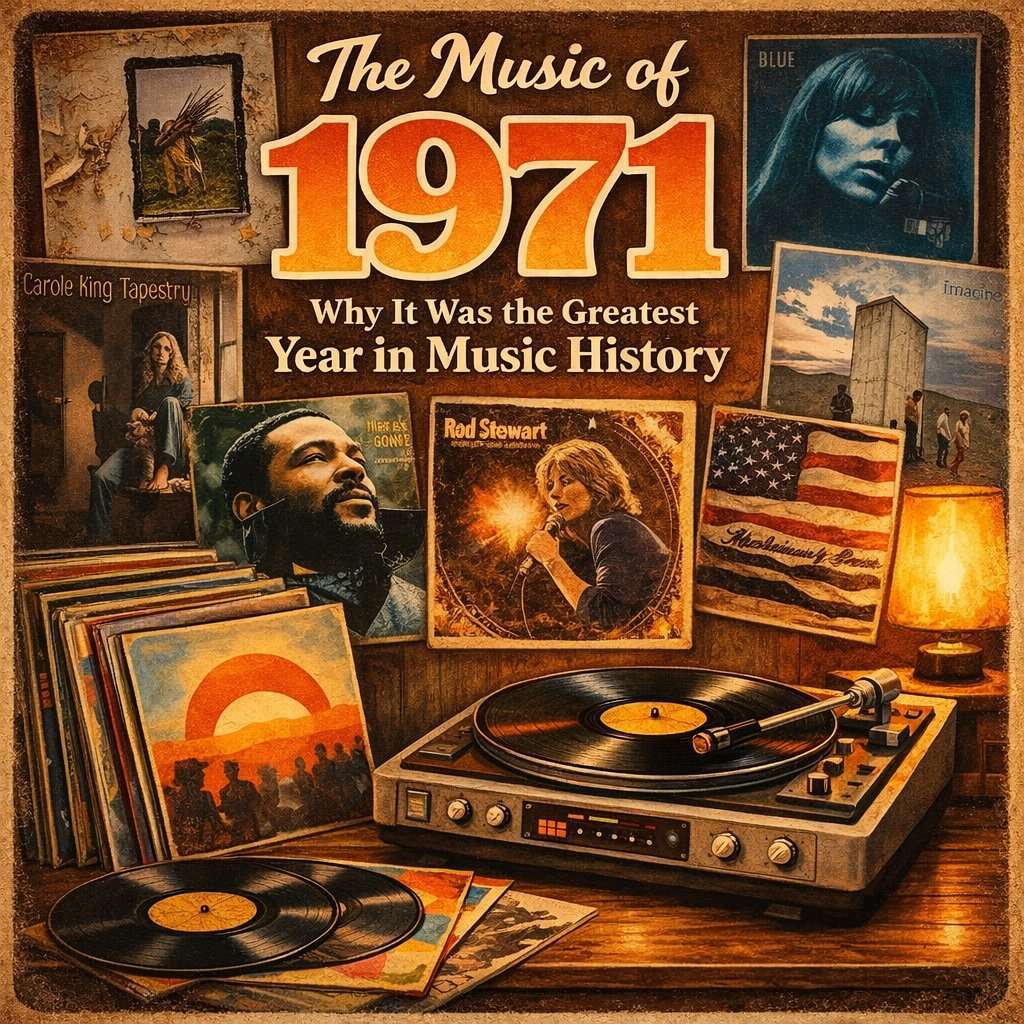
From Marvin Gaye’s deeply reflective What’s Going On to Led Zeppelin’s thunderous Led Zeppelin IV, from Carole King’s intimate songwriting on Tapestry to The Who’s explosive Who’s Next, the music of 1971 captured a moment when artists were expanding both the sound and the meaning of popular music.
It was a year when rock became more ambitious, soul music became more socially aware, and singer-songwriters stepped forward with a new kind of honesty.
And more than fifty years later, the music from that year still sounds timeless.
1971 Music Snapshot
Before diving into the deeper story, it’s worth stepping back and looking at just how remarkable the musical landscape of 1971 really was.
Major Albums Released in 1971
Within a single year, listeners were introduced to a collection of albums that would become pillars of modern music.
Among the most influential releases were:
- Led Zeppelin IV – Led Zeppelin
- What’s Going On – Marvin Gaye
- Tapestry – Carole King
- Blue – Joni Mitchell
- Sticky Fingers – The Rolling Stones
- Who’s Next – The Who
- Imagine – John Lennon
- Aqualung – Jethro Tull
- Every Picture Tells a Story – Rod Stewart
- There’s a Riot Goin’ On – Sly & the Family Stone
Many of these albums appear consistently on lists of the greatest albums ever recorded, and several defined the creative direction of the entire decade.
The diversity of these records also tells an important story. Rock music was evolving rapidly, soul artists were producing more socially conscious work, and singer-songwriters were beginning to dominate the cultural conversation.
Songs That Defined 1971
Alongside these groundbreaking albums were singles that captured the sound and spirit of the time.
Some of the most memorable songs of the year included:
- “Joy to the World” – Three Dog Night
- “Maggie May” – Rod Stewart
- “Brown Sugar” – The Rolling Stones
- “Imagine” – John Lennon
- “It’s Too Late” – Carole King
- “Family Affair” – Sly & the Family Stone
- “Ain’t No Sunshine” – Bill Withers
- “American Pie” – Don McLean
- “Me and Bobby McGee” – Janis Joplin
These songs weren’t just popular. They reflected a moment when artists were increasingly writing material that felt personal, thoughtful, and culturally aware.
You can explore more of the music that defined the year in Songs That Defined 1971.
Musical Trends of 1971
Several important musical movements reached a turning point in 1971.
The singer-songwriter movement was exploding, with artists like Carole King, James Taylor, and Joni Mitchell writing deeply personal songs that connected with listeners on a new level.
Soul music was becoming more sophisticated and socially conscious, led by artists such as Marvin Gaye and Sly & the Family Stone.
At the same time, rock music was expanding its ambition, with bands experimenting with longer compositions, new production techniques, and larger sonic landscapes.
Taken together, these trends helped transform popular music from simple entertainment into something more reflective and artistically ambitious.
Howard Dee’s Take
When people ask me what makes 1971 special, I usually say the same thing: it’s the year when popular music truly grew up.
Before the late 1960s, much of rock and pop music still revolved around radio singles and straightforward love songs. By the time 1971 arrived, artists had begun thinking of albums as complete artistic statements.
You could hear it everywhere. Marvin Gaye was confronting social injustice and environmental concerns. Carole King was writing songs that felt like pages from a personal diary. The Who were experimenting with synthesizers and pushing rock music into new sonic territory.
What makes 1971 remarkable is not just the number of great records released that year. It’s the depth of the music itself.
These albums weren’t simply entertaining. They were thoughtful, ambitious, and emotionally honest. And they set the tone for the rest of the decade.
The Explosion of Great Albums
If there’s one reason critics often point to 1971 as the greatest year in music history, it’s the extraordinary concentration of classic albums released during that period.
Led Zeppelin’s Led Zeppelin IV delivered one of the most famous songs in rock history, “Stairway to Heaven,” while also showcasing the band’s range from hard rock to folk-influenced acoustic music.
Marvin Gaye’s What’s Going On represented a turning point for soul music. Rather than recording a collection of unrelated singles, Gaye created a cohesive album that addressed war, poverty, environmental issues, and the struggles of everyday life.
Carole King’s Tapestry became one of the best-selling albums of all time. The record’s warmth and honesty resonated with millions of listeners and helped establish the singer-songwriter movement as a dominant force in popular music.
Joni Mitchell’s Blue offered a deeply personal and emotionally raw collection of songs that many critics still consider one of the finest albums ever recorded.
Meanwhile, The Rolling Stones delivered Sticky Fingers, a gritty blend of rock, blues, and country influences that produced classics like “Brown Sugar” and “Wild Horses.”
And The Who released Who’s Next, an album that combined powerful rock songwriting with innovative synthesizer work that would influence generations of musicians.
Taken together, these records represent an extraordinary burst of creativity. If you want to explore more albums from that remarkable year, take a look at Best Albums of 1971.
The Rise of the Singer-Songwriter
Another defining story of 1971 was the rise of the singer-songwriter era.
Artists were no longer relying primarily on professional songwriting teams. Instead, musicians were writing deeply personal material drawn from their own lives.
Carole King’s Tapestry became the defining album of this movement. Songs like “It’s Too Late” and “You’ve Got a Friend” felt intimate and emotionally authentic, connecting with listeners in a way that polished pop productions often could not.
James Taylor had already helped open the door for this style with albums like Sweet Baby James, and his influence continued to grow as audiences embraced quieter, more reflective songwriting.
Joni Mitchell took the genre even further with Blue, crafting songs that explored love, vulnerability, and personal transformation with remarkable honesty.
The success of these artists helped reshape the music industry and paved the way for countless singer-songwriters who would follow throughout the 1970s and beyond.
You can explore this movement further in Top Singer-Songwriters of the 1970s.
Soul Music Reaches New Depth
While singer-songwriters were redefining pop and folk music, soul music was undergoing its own transformation.
Marvin Gaye’s What’s Going On is often regarded as one of the most important soul albums ever recorded. Released in May 1971, the record addressed issues like war, poverty, and environmental destruction, offering a thoughtful reflection on American society.
Bill Withers emerged as a powerful new voice during this era. Songs like “Ain’t No Sunshine” demonstrated how emotional depth and simplicity could create unforgettable music.
Al Green was beginning a run of extraordinary recordings that blended gospel influence with romantic soul, helping define the sound of Memphis soul in the early 1970s.
Sly & the Family Stone, meanwhile, pushed soul music into darker and more experimental territory with There’s a Riot Goin’ On, reflecting the political and cultural tensions of the time.
Together, these artists expanded the emotional and thematic possibilities of soul music.
You can explore more songs from that remarkable year in Songs That Defined 1971.
Rock Music Expands Its Ambition
Rock music in 1971 was no longer confined to three-minute radio singles. Bands were pushing boundaries in both songwriting and production.
Led Zeppelin had already established themselves as one of the most powerful bands in rock, but Led Zeppelin IV demonstrated their ability to blend hard rock, folk influences, and epic storytelling.
The Who continued to expand their musical scope with Who’s Next, incorporating synthesizers into their sound while maintaining the raw energy that defined their earlier work.
The Rolling Stones, already rock royalty by the early 1970s, released Sticky Fingers, an album that fused blues, country, and hard rock into a gritty and unforgettable sound.
These bands were redefining what rock music could be, creating albums that felt ambitious, expansive, and artistically bold.
You can explore more of the era’s rock classics in Top Songs of 1971.
Why 1971 Still Matters
More than fifty years later, the music of 1971 continues to influence artists across genres.
Modern musicians still cite albums like What’s Going On, Tapestry, and Led Zeppelin IV as foundational inspirations. These records helped define the idea of the album as an artistic statement rather than just a collection of songs.
Many of the themes explored in 1971 remain strikingly relevant today. Marvin Gaye’s reflections on social injustice, Joni Mitchell’s exploration of personal vulnerability, and Carole King’s honest songwriting still resonate with listeners across generations.
Perhaps that’s why so many critics and historians continue to point to 1971 as a unique moment in music history.
It wasn’t just a great year.
It was a year when artists pushed the boundaries of what popular music could be.
Closing Thoughts
Looking back, it’s hard to find another year in popular music that produced such an extraordinary collection of albums, artists, and ideas.
The music of 1971 captured a moment when musicians were pushing boundaries and exploring deeper emotional and social themes. Rock bands were expanding their sound, singer-songwriters were writing with new honesty, and soul artists were addressing the realities of the world around them.
That rare combination of creativity and cultural significance is why so many listeners still point to 1971 as the greatest year in music history.
And more than half a century later, the songs from that remarkable year continue to remind us just how powerful music can be.
Explore More Music from 1971
If 1971 truly was the greatest year in music history, there’s a lot more to explore from this remarkable moment in time. Throughout 1971, artists across rock, soul, and the growing singer-songwriter movement released songs and albums that still resonate today.
If you’d like to dive deeper into the music that defined the year, check out these additional guides on 70sMusicWisdoms:
• Top Songs of 1971 (Billboard Year-End Hot 100)
• Songs That Defined 1971
• Best Albums of 1971
Explore the Music of the 1970s by Year
Dive deeper into the music, albums, and defining songs of each year from the 1970s.
1971 Music Frequently Asked Questions
Why do many critics consider 1971 the greatest year in music history?
Many critics point to 1971 because of the extraordinary number of influential albums released that year. Records such as Led Zeppelin IV, What’s Going On, Tapestry, Blue, and Who’s Next continue to appear on lists of the greatest albums ever recorded. The diversity of genres and the depth of songwriting also helped redefine what popular music could achieve artistically.
What were the most important albums released in 1971?
Some of the most influential albums from 1971 include Led Zeppelin IV by Led Zeppelin, What’s Going On by Marvin Gaye, Tapestry by Carole King, Blue by Joni Mitchell, Sticky Fingers by The Rolling Stones, and Who’s Next by The Who. These albums helped shape the direction of rock, soul, and singer-songwriter music for decades.
What musical trends were emerging in 1971?
Several major musical trends were gaining momentum in 1971. The singer-songwriter movement was becoming dominant, soul music was exploring deeper social themes, and rock bands were creating more ambitious and experimental albums. These developments helped define the sound of the 1970s.
What songs were popular in 1971?
Some of the biggest songs of 1971 included “Joy to the World” by Three Dog Night, “Maggie May” by Rod Stewart, “Imagine” by John Lennon, “It’s Too Late” by Carole King, and “Family Affair” by Sly & the Family Stone. Many of these songs remain staples of classic rock and oldies radio.