
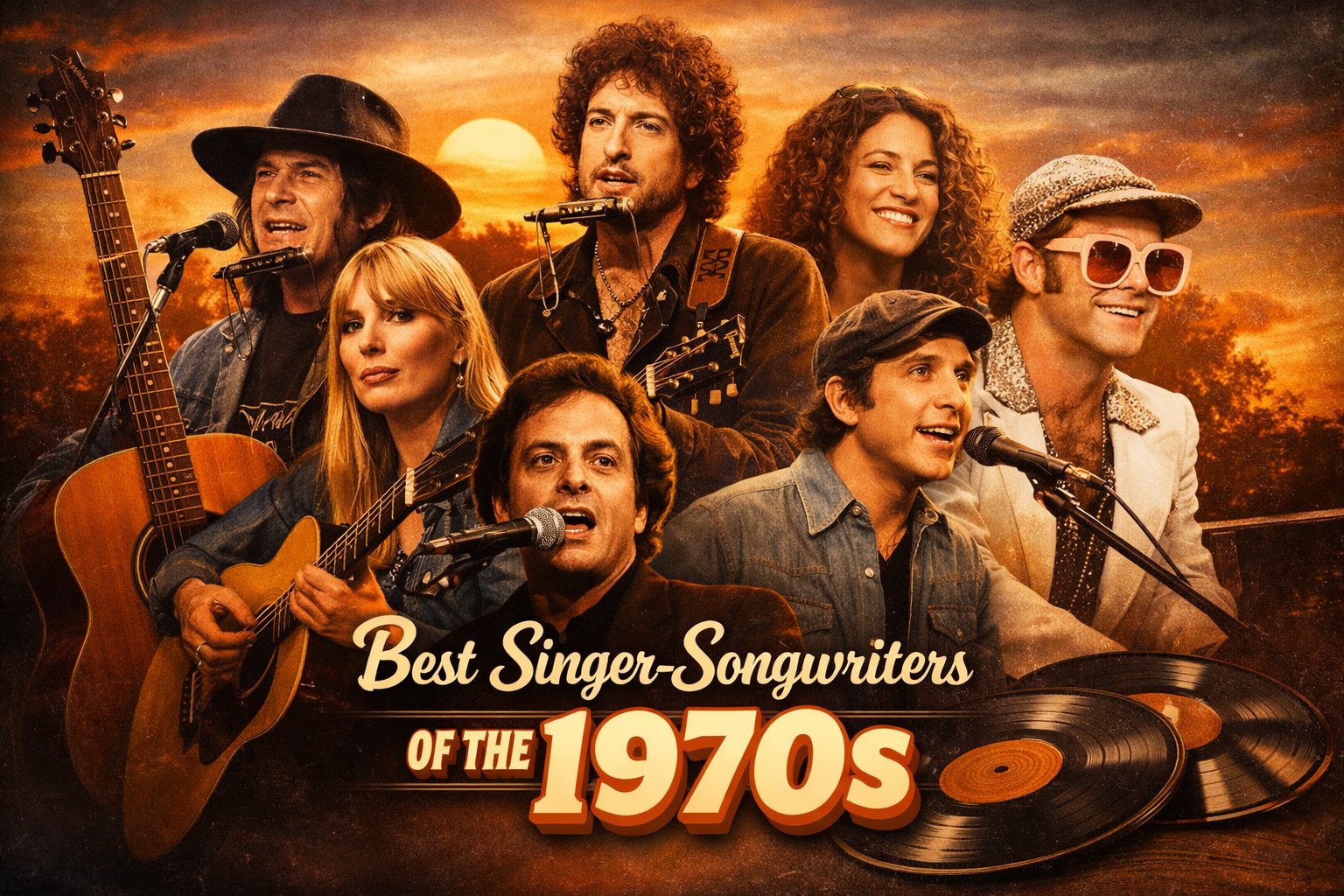
Singer-songwriters played a defining role in shaping the sound and direction of popular music during the 1970s. This was the decade when artists who wrote their own lyrics and music moved from the margins to the center of the charts, proving that personal storytelling, introspection, and craftsmanship could resonate with massive audiences.
This ranked list of the top singer-songwriters of the 1970s focuses specifically on what artists achieved during the decade itself. Rankings are based on songwriting impact, cultural relevance, commercial performance, influence on other artists, and the lasting importance of their 1970s work. Folk, rock, pop, soul, and country singer-songwriters are all represented, reflecting the breadth of voices that defined the era.
Rather than nostalgia or personal favorites, this list aims to present a clear, historically grounded view of the singer-songwriters who most shaped 1970s music and whose work continues to be studied, covered, and rediscovered today.
Table of Contents
Howard Dee’s Take
One thing that stands out when you really look at the 1970s is how much trust listeners placed in the songwriter. These weren’t just performers delivering someone else’s material — they were artists asking the audience to sit still, listen closely, and engage with ideas, emotions, and stories that weren’t always comfortable or easy.
What’s also striking is how different these artists were from one another. Some were deeply introspective, some openly political, others deceptively simple on the surface but incredibly precise underneath. Yet they all shared a belief that songs could carry meaning, not just melody, and that audiences were willing to meet them halfway.
That’s why this list matters. It’s not about who was the loudest or the most theatrical — it’s about who could write songs that still feel honest decades later. The 1970s didn’t just produce great singer-songwriters; it proved that songwriting itself could be the main event.
Why the 1970s Became the Singer-Songwriter Era
The rise of the singer-songwriter in the 1970s did not happen overnight. It grew out of cultural and musical shifts that had already begun in the late 1960s, when audiences started paying closer attention to the person behind the song rather than just the performance itself. Folk music had long emphasized personal authorship, and artists such as Bob Dylan helped demonstrate that a songwriter’s voice and perspective could become the centerpiece of popular music. By the early 1970s, that idea had moved firmly into the mainstream.
A major factor in this shift was the emergence of a community of writers centered around places like Laurel Canyon in Los Angeles. Artists including Carole King, James Taylor, and Joni Mitchell built careers on songs that felt personal, reflective, and grounded in real experience. Rather than relying on elaborate studio production or theatrical personas, these musicians placed the craft of songwriting itself at the center of their work.
The changing structure of the music industry also played a role. During the 1970s, albums became more important than individual singles, giving artists space to explore themes and develop a consistent voice across a full record. Singer-songwriters thrived in this environment because their music was often built around storytelling, introspection, and emotional nuance—qualities that rewarded attentive listening rather than quick radio impact.
The movement reached its commercial and artistic peak around 1971, a year that produced landmark albums like Tapestry and Blue. Many critics still consider 1971 the greatest year in music history.
By the middle of the decade, the singer-songwriter had become one of the defining figures of popular music. Artists from folk, rock, soul, and country all contributed to the movement, proving that songwriting could carry the same cultural weight as performance. The result was a decade in which audiences placed extraordinary trust in the writer behind the microphone, allowing songs rooted in personal perspective to reach a level of influence rarely matched before or since.
With that context in mind, the following list ranks the 25 singer-songwriters whose work most shaped the sound and direction of the 1970s.
Ranking Criteria
This ranking evaluates singer-songwriters based on their work and impact during the 1970s, not on lifetime achievements alone. Each artist was assessed using the following criteria:
Songwriting Impact
The primary factor in this ranking is the strength and originality of an artist’s songwriting. This includes whether the artist wrote or co-wrote their own lyrics and music, the depth and consistency of their catalog during the decade, and whether their songs became enduring standards through continued airplay, covers, or cultural references.
1970s Output and Relevance
Only material released in the 1970s was considered. Artists were evaluated on the volume, quality, and cultural visibility of their work during the decade itself, rather than on success achieved before or after the 1970s.
Commercial and Chart Performance
While sales alone did not determine ranking, album performance, chart placements, and sustained popularity during the 1970s were considered as evidence of reach and audience connection at the time of release.
Influence on Other Artists
This criterion measures how strongly an artist’s songwriting approach influenced other musicians, either within the 1970s or in the decades that followed. Influence includes stylistic imitation, thematic borrowing, and acknowledgment by later artists.
Enduring Legacy
Finally, the ranking considers how well an artist’s 1970s work has held up over time. Songs that continue to be performed, recorded, studied, or cited decades later carry greater weight than those primarily remembered as period pieces.
1. Carole King
Carole King stands at the top of any serious discussion of 1970s singer-songwriters because her impact during the decade was both immediate and sustained. Between 1970 and 1979, King released 10 studio albums, a level of output that few singer-songwriters matched, while maintaining consistent commercial and cultural relevance throughout the decade.
Her 1971 album Tapestry remains the cornerstone of that run, spending 15 weeks at No. 1 on the Billboard 200 and remaining on the chart for more than six consecutive years. As a performing artist in the 1970s, King also placed four singles in the Billboard Hot 100 Top 10, including the No. 1 hit “It’s Too Late,” demonstrating that her songwriting translated directly into mainstream chart success.
What ultimately set King apart was how she reshaped expectations for singer-songwriters in popular music. Her work emphasized emotional clarity, conversational lyrics, and restrained arrangements, proving that personal, inward-looking songs could dominate the charts without theatricality or excess. In doing so, King helped define the singer-songwriter movement as a central force in 1970s music, making her the most influential figure of the era in this category.
2. Bob Dylan
Bob Dylan enters the 1970s already established as one of the most influential songwriters in popular music, but his work during the decade reaffirmed his relevance rather than relying on past reputation. Between 1970 and 1979, Dylan released eight studio albums, navigating folk, rock, country, and gospel while remaining a central figure in serious songwriting discussions throughout the decade.
That run included two landmark releases that reached No. 1 on the Billboard 200: Blood on the Tracks (1975) and Desire (1976). Blood on the Tracks, in particular, is widely regarded as one of the most important songwriting albums of the 1970s, marked by its emotional directness and narrative clarity, while Desire expanded Dylan’s storytelling into more cinematic and character-driven territory.
What distinguishes Dylan’s 1970s work is not chart dominance alone, but how decisively it shaped the language of modern songwriting. His lyrics continued to treat songs as vehicles for character, conflict, and introspection, reinforcing the idea that popular music could sustain literary ambition. Even in a decade crowded with strong singer-songwriters, Dylan’s 1970s output helped set the standard against which others were measured.
3. Neil Young
Neil Young’s 1970s output stands as one of the most prolific and influential runs by any singer-songwriter of the decade. Between 1970 and 1979, Young released nine studio albums, often shifting styles from record to record while maintaining a consistent focus on personal, political, and social themes.
Commercially, Young achieved sustained success throughout the decade, with three albums reaching No. 1 on the Billboard 200: Harvest (1972), Tonight’s the Night (1975), and Rust Never Sleeps (1979). Harvest alone became one of the best-selling albums of the decade, while later releases demonstrated Young’s willingness to challenge audiences rather than repeat formulas.
What ultimately separates Young from many of his peers is the breadth and risk-taking of his songwriting during the 1970s. His work addressed introspection, loss, disillusionment, and cultural unrest with an unfiltered directness that influenced generations of rock and folk artists. Few singer-songwriters balanced commercial success and artistic independence as effectively as Neil Young during this period.
4. Paul Simon
Paul Simon’s 1970s work represents one of the most intellectually ambitious songwriting runs of the decade, combining literary precision with expanding musical scope. Between 1970 and 1979, Simon released five solo studio albums, each showing a deliberate evolution away from traditional folk structures toward rhythm-driven and globally influenced songwriting.
That progression culminated in Still Crazy After All These Years (1975), which reached No. 1 on the Billboard 200 and won the Grammy for Album of the Year. Earlier releases such as There Goes Rhymin’ Simon (1973) demonstrated his ability to pair introspective lyrics with accessible melodies, keeping him firmly rooted in the mainstream while pushing stylistic boundaries.
Simon’s lasting importance lies in how he expanded the definition of singer-songwriter music. His 1970s work proved that deeply personal songwriting could coexist with rhythmic complexity and international influences, setting a precedent for artists who viewed songwriting as both craft and exploration.
5. Joni Mitchell
Joni Mitchell’s 1970s output stands as one of the most artistically significant bodies of work in singer-songwriter history. During the decade, Mitchell released seven studio albums, each reflecting a willingness to challenge both audience expectations and conventional song structures.
Her 1971 album Blue is widely regarded as a foundational text for confessional songwriting, while Court and Spark (1974) reached No. 2 on the Billboard 200 and marked her most commercially successful period. As the decade progressed, albums like Hejira and Don Juan’s Reckless Daughter demonstrated her growing interest in jazz harmony and extended compositional forms.
Mitchell’s influence is difficult to overstate. Her 1970s work reshaped how songwriters approached vulnerability, perspective, and musical complexity, establishing a model that continues to influence artists across genres more than five decades later.
6. James Taylor
James Taylor played a central role in bringing the singer-songwriter movement into the American mainstream during the early 1970s. Between 1970 and 1979, Taylor released seven studio albums, maintaining consistent commercial success and radio presence throughout the decade.
Albums such as Sweet Baby James (1970) and Mud Slide Slim and the Blue Horizon (1971) established his signature style, while Mud Slide Slim reached No. 2 on the Billboard 200 and produced the No. 1 single “You’ve Got a Friend.” Taylor continued to place albums in the Top 10 through the mid-1970s, reinforcing his broad, cross-generational appeal.
Taylor’s importance lies in his restraint. His 1970s songwriting demonstrated that subtlety, warmth, and emotional clarity could thrive in a popular music landscape increasingly dominated by spectacle, helping define the softer side of the decade’s sound.
7. Elton John
Elton John’s 1970s dominance was unmatched in terms of sustained commercial success and songwriting output. During the decade, he released nine studio albums, many of them in rapid succession, creating one of the most concentrated runs of hit records in popular music history.
Between 1970 and 1979, Elton John achieved six No. 1 albums on the Billboard 200, including Honky Château, Goodbye Yellow Brick Road, and Captain Fantastic and the Brown Dirt Cowboy. Working with lyricist Bernie Taupin, he consistently paired character-driven storytelling with memorable melodies, resulting in both critical acclaim and massive sales.
Elton John’s significance as a singer-songwriter lies in scale. His 1970s work proved that ambitious songwriting partnerships could dominate global pop culture while still producing songs with narrative depth and emotional resonance.
8. Leonard Cohen
Leonard Cohen’s 1970s catalog offered a stark, literary counterpoint to the decade’s more commercially oriented singer-songwriters. Between 1970 and 1979, Cohen released five studio albums, marked by minimalist arrangements and an unflinching focus on language.
Albums such as Songs of Love and Hate (1971) and New Skin for the Old Ceremony (1974) became touchstones for artists who valued lyrical gravity over chart performance. While his albums did not dominate U.S. charts during the decade, their influence spread steadily through critical acclaim and peer recognition.
Cohen’s legacy rests in how he treated songs as written statements rather than performances. His 1970s work helped establish songwriting as a literary discipline within popular music, influencing generations of lyric-first artists.
9. Billy Joel
Billy Joel’s 1970s output represents one of the most complete and versatile songwriting runs of the decade, balancing narrative ambition with sustained commercial success. Between 1971 and 1979, Joel released six studio albums, each expanding his stylistic range while sharpening his ability to write character-driven songs that resonated with a broad audience.
That progression reached its peak with The Stranger (1977) and 52nd Street (1978), the latter reaching No. 1 on the Billboard 200. During the decade, Joel placed multiple singles in the Billboard Hot 100 Top 10, including “Just the Way You Are,” “My Life,” and “Only the Good Die Young,” demonstrating that his songwriting could succeed both as album-centered storytelling and as standalone hits.
What separates Joel from many of his contemporaries is his command of narrative perspective. His 1970s songs often function as short stories, populated by specific characters, settings, and emotional tensions, while remaining grounded in strong melodic structure. Drawing from pop, rock, jazz, and classical influences, Joel’s songwriting bridged the gap between craft and accessibility, helping define a mainstream path for narrative-driven songs that did not rely on excess or theatrical personas. His 1970s catalog laid the foundation for one of the most enduring songwriting careers to follow, firmly rooted in the traditions established during the decade.
10. Gordon Lightfoot
Gordon Lightfoot emerged in the 1970s as one of the decade’s most respected narrative songwriters. During the decade, Lightfoot released eight studio albums, maintaining a steady presence on both folk and pop charts.
His commercial and cultural peak came with Sundown (1974), which reached No. 1 on the Billboard 200 and produced the No. 1 single “Sundown.” Songs such as “If You Could Read My Mind” and “The Wreck of the Edmund Fitzgerald” became enduring examples of detailed, story-driven songwriting achieving mainstream success.
Lightfoot’s importance lies in precision. His 1970s work demonstrated that carefully observed storytelling could resonate widely without sacrificing narrative complexity, making him one of the era’s defining songwriters.
11. Cat Stevens
Cat Stevens (later known as Yusuf Islam) delivered one of the most culturally resonant singer-songwriter runs of the early 1970s, combining introspective lyrics with wide mainstream appeal. Between 1970 and 1978, Stevens released seven studio albums, many of which arrived during the peak of the singer-songwriter movement.
That period included Tea for the Tillerman (1970) and Teaser and the Firecat (1971), both of which became defining albums of the era, while Catch Bull at Four (1972) reached No. 1 on the Billboard 200. Stevens’ songs achieved sustained radio play and commercial success without sacrificing thematic depth.
Stevens’ importance lies in accessibility with substance. His 1970s songwriting addressed faith, doubt, morality, and personal growth in language that felt direct and human, making him one of the decade’s most recognizable and influential voices.
12. Bruce Springsteen
Bruce Springsteen’s 1970s output established him as one of the era’s most significant narrative songwriters, turning songs into richly detailed portraits of American life. Between 1973 and 1978, Springsteen released three studio albums, each playing a crucial role in defining his artistic identity.
His breakthrough came with Born to Run (1975), which reached No. 3 on the Billboard 200, followed by Darkness on the Edge of Town (1978), widely regarded as one of the most important songwriting albums of the decade. While not driven by singles, Springsteen’s albums built long-term cultural impact.
Springsteen’s significance rests on storytelling ambition. His 1970s songwriting fused rock energy with literary detail, establishing a model for character-driven songwriting that influenced generations of artists.
13. John Lennon
John Lennon’s solo songwriting in the 1970s revealed a stark, uncompromising voice distinct from his Beatles work. Between 1970 and 1975, Lennon released five studio albums, moving between personal confession and pointed political commentary.
His most commercially successful 1970s release, Imagine (1971), reached No. 1 on the Billboard 200, while the title track became one of the most widely recognized songs of the decade. Lennon’s early-’70s writing favored emotional directness over polish, often confronting vulnerability head-on.
Lennon’s importance lies in honesty. His 1970s songs treated personal emotion and social idealism as inseparable, reinforcing the idea that popular songwriting could be both intimate and confrontational.
14. Van Morrison
Van Morrison’s 1970s catalog stands out for its stylistic breadth, blending folk, soul, jazz, and spiritual themes into a singular songwriting voice. Between 1970 and 1979, Morrison released nine studio albums, producing one of the decade’s most consistently exploratory bodies of work.
Commercial success came early with Moondance (1970), which became a long-term best-seller and a defining statement of his approach. While later albums were less chart-focused, they expanded his songwriting into longer forms and deeper thematic territory.
Morrison’s importance lies in atmosphere and phrasing. His 1970s songwriting demonstrated that tone, rhythm, and emotional texture could be as central to songwriting as narrative clarity.
15. Kris Kristofferson
Kris Kristofferson helped redefine country songwriting in the 1970s by introducing literary realism and emotional complexity into the genre. During the decade, Kristofferson released six studio albums, establishing himself as one of the era’s most influential songwriters.
Although many of his best-known songs became hits through other artists, Kristofferson’s own recordings in the early 1970s made clear that his strength lay in writing itself—songs centered on regret, self-awareness, and moral ambiguity.
Kristofferson’s lasting impact is structural. His 1970s songwriting expanded the emotional vocabulary of country music, influencing later generations of writers in both country and Americana.
16. Randy Newman
Randy Newman’s 1970s songwriting stands apart for its use of satire, character voice, and social observation. Between 1970 and 1979, Newman released six studio albums, developing an approach that treated songs as scenes rather than confessions.
Albums such as Sail Away (1972) and Good Old Boys (1974) became critically revered for their narrative sophistication, even if they did not dominate the charts. Newman’s influence grew steadily through peer recognition and long-term critical standing.
Newman’s importance lies in range. His 1970s work demonstrated that singer-songwriters could use irony and storytelling to explore social themes without sacrificing musical craft.
17. Jackson Browne
Jackson Browne emerged in the 1970s as one of the decade’s most reliable voices of introspection and social reflection. Between 1972 and 1979, Browne released six studio albums, capturing the emotional transition from post-1960s idealism to a more sober worldview.
That run included Late for the Sky (1974) and The Pretender (1976), while Running on Empty (1977) reached No. 3 on the Billboard 200 and became one of the decade’s most recognizable album statements.
Browne’s significance lies in tone. His 1970s songwriting balanced personal reflection with quiet urgency, influencing later artists who sought to write thoughtfully about adulthood, responsibility, and social conscience.
18. Jim Croce
Jim Croce’s impact on 1970s singer-songwriter music was brief but remarkably concentrated. Between 1972 and 1973, Croce released three studio albums, producing a string of songs that quickly became standards of narrative songwriting.
Albums such as You Don’t Mess Around with Jim (1972) and Life and Times (1973) generated three No. 1 singles on the Billboard Hot 100, including “Bad, Bad Leroy Brown” and “Time in a Bottle.” Despite his short recording career, Croce’s songs achieved sustained radio presence and broad cultural recognition.
Croce’s importance lies in economy. His 1970s songwriting demonstrated how concise storytelling, memorable characters, and emotional clarity could coexist within accessible, radio-friendly songs, leaving a lasting imprint disproportionate to the length of his career.
19. Townes Van Zandt
Townes Van Zandt occupies a unique place in 1970s singer-songwriter history as an artist whose influence far exceeded his commercial success. During the decade, Van Zandt released six studio albums, crafting a catalog marked by stark lyricism and emotional precision.
While his records did not achieve significant chart success at the time, his songs became foundational texts for later generations of songwriters, particularly within folk, country, and Americana traditions. His writing focused on loss, isolation, and human frailty with an unflinching directness that set him apart from more commercially oriented peers.
Van Zandt’s importance is measured in influence rather than sales. His 1970s work helped define the archetype of the songwriter’s songwriter, shaping the language and emotional honesty of countless artists who followed.
20. David Bowie
David Bowie’s 1970s songwriting helped redefine the relationship between narrative, identity, and popular music. Between 1970 and 1979, Bowie released nine studio albums, each representing a distinct artistic phase rather than a continuation of a single style.
Albums such as Hunky Dory (1971), The Rise and Fall of Ziggy Stardust and the Spiders from Mars (1972), and Heroes (1977) demonstrated Bowie’s ability to use songwriting as a vehicle for character, myth-making, and cultural commentary. Several of these albums achieved strong international chart success and long-term critical standing.
Bowie’s significance lies in reinvention. His 1970s songwriting showed that songs could construct worlds and personas, expanding the expressive possibilities available to singer-songwriters beyond autobiography alone.
21. Nick Drake
Nick Drake’s 1970s output represents one of the most influential bodies of work to gain recognition largely after its initial release. Between 1969 and 1972, Drake released three studio albums, all of which remained commercially underappreciated during his lifetime.
Albums such as Five Leaves Left and Pink Moon later became touchstones for minimalist songwriting, admired for their subtle arrangements and emotional restraint. Although Drake did not achieve chart success in the 1970s, his work gained significant cultural traction in the decades that followed.
Drake’s importance lies in tone and restraint. His songwriting influenced generations of artists who valued intimacy, understatement, and emotional ambiguity, making his 1970s-era work foundational despite its delayed recognition.
22. Stevie Wonder
Stevie Wonder’s 1970s work stands among the most artistically and commercially successful songwriting runs of the decade. Between 1972 and 1979, Wonder released five studio albums widely regarded as his creative peak.
That period included Talking Book, Innervisions, Fulfillingness’ First Finale, and Songs in the Key of Life, with multiple albums reaching No. 1 on the Billboard 200. Wonder’s songs combined social commentary, personal reflection, and melodic sophistication while achieving sustained chart dominance.
Wonder’s significance lies in authorship. His 1970s work demonstrated that a singer-songwriter could fully control writing, performance, and production while shaping the sound and direction of popular music on a global scale.
23. John Denver
John Denver emerged in the 1970s as one of the decade’s most commercially successful singer-songwriters, translating personal and environmental themes into mass appeal. Between 1971 and 1979, Denver released eight studio albums, many of which achieved strong chart performance.
Albums such as Poems, Prayers & Promises (1971) and Back Home Again (1974) helped generate multiple No. 1 singles, while Denver remained a consistent presence on both pop and adult contemporary charts throughout the decade.
Denver’s importance lies in reach. His 1970s songwriting demonstrated that gentle, reflective songs rooted in place and personal values could connect with a broad mainstream audience without relying on stylistic excess.
24. Harry Chapin
Harry Chapin’s 1970s songwriting centered on long-form narrative and social observation, setting him apart from many of his contemporaries. During the decade, Chapin released six studio albums, building a catalog defined by detailed storytelling rather than chart-driven singles.
His breakthrough album Verities & Balderdash (1974) produced the hit “Cat’s in the Cradle,” while much of his work favored extended narratives that challenged conventional radio formats. Chapin’s songs often addressed family dynamics, social responsibility, and moral consequence.
Chapin’s significance lies in intention. His 1970s work demonstrated that singer-songwriters could prioritize message and narrative depth over commercial brevity, influencing artists drawn to storytelling as a primary songwriting function.
25. Paul McCartney
Paul McCartney’s 1970s songwriting career unfolded under the shadow of the Beatles, yet the decade still produced a substantial and enduring body of work. Between 1970 and 1979, McCartney released seven studio albums across his solo career and with Wings.
Albums such as Band on the Run (1973) reached No. 1 on the Billboard 200 and became defining statements of his post-Beatles identity. Throughout the decade, McCartney continued to place singles and albums at the top of international charts while refining a more direct, song-centered approach.
McCartney’s significance lies in continuity. His 1970s work demonstrated how a songwriter could transition from a landmark group to sustained solo success, reinforcing the central role of melody and structure in popular songwriting.
Howard Dee’s Closing Thoughts
What stands out most when you look at the singer-songwriters of the 1970s isn’t just how many great songs were written, but how much trust existed between the artist and the listener. These musicians weren’t hiding behind personas or production tricks. They were asking people to sit with their words, their stories, and sometimes their discomfort, and audiences were willing to do exactly that.
What also becomes clear is that there was no single formula for success. Some artists dominated the charts, others influenced quietly from the margins, and a few did both at different moments. What connected them was a belief that songs could carry meaning — that lyrics mattered, that melodies served the story, and that authenticity had value even when it wasn’t polished or easy.
That’s why this era still resonates. The 1970s didn’t just produce memorable singer-songwriters; it created a standard for what songwriting could be. Long after trends shift and sounds change, the work of these artists continues to feel relevant because it was grounded in something timeless — honest expression, carefully crafted words, and the courage to let the song speak for itself.
If you’re interested in exploring more rankings from the decade, you can browse our full collection of Top 1970s Music Lists, covering artists, bands, albums, and songs that defined the era.
Frequently Asked Questions
Who was the most influential singer-songwriter of the 1970s?
Influence in the 1970s came from both commercial reach and artistic impact. Artists such as Carole King, Bob Dylan, and Neil Young reshaped expectations around songwriting by proving that deeply personal, self-written material could dominate charts and shape culture at the same time.
Which singer-songwriters had the most commercial success in the 1970s?
Several singer-songwriters achieved major commercial success during the decade, including Elton John, Stevie Wonder, Carole King, and Billy Joel. These artists combined strong songwriting with consistent album sales, chart-topping releases, and sustained radio presence throughout the 1970s.
Why were singer-songwriters so important in the 1970s?
The 1970s marked a shift toward artist authenticity, where audiences increasingly valued musicians who wrote and performed their own material. Singer-songwriters became central to the decade because their songs reflected personal experience, social change, and emotional honesty in ways that resonated deeply with listeners.
What genres did 1970s singer-songwriters come from?
Singer-songwriters of the 1970s emerged from a wide range of genres, including folk, rock, pop, soul, country, and jazz-influenced music. This diversity helped expand the movement beyond any single sound and allowed songwriting to become a defining feature across multiple styles of popular music.
Were singer-songwriters more popular in the 1970s than in other decades?
While singer-songwriters existed before and after the 1970s, the decade represented a peak period for their cultural influence. During this time, self-written, album-oriented music moved to the center of popular culture in a way that has rarely been matched since.


