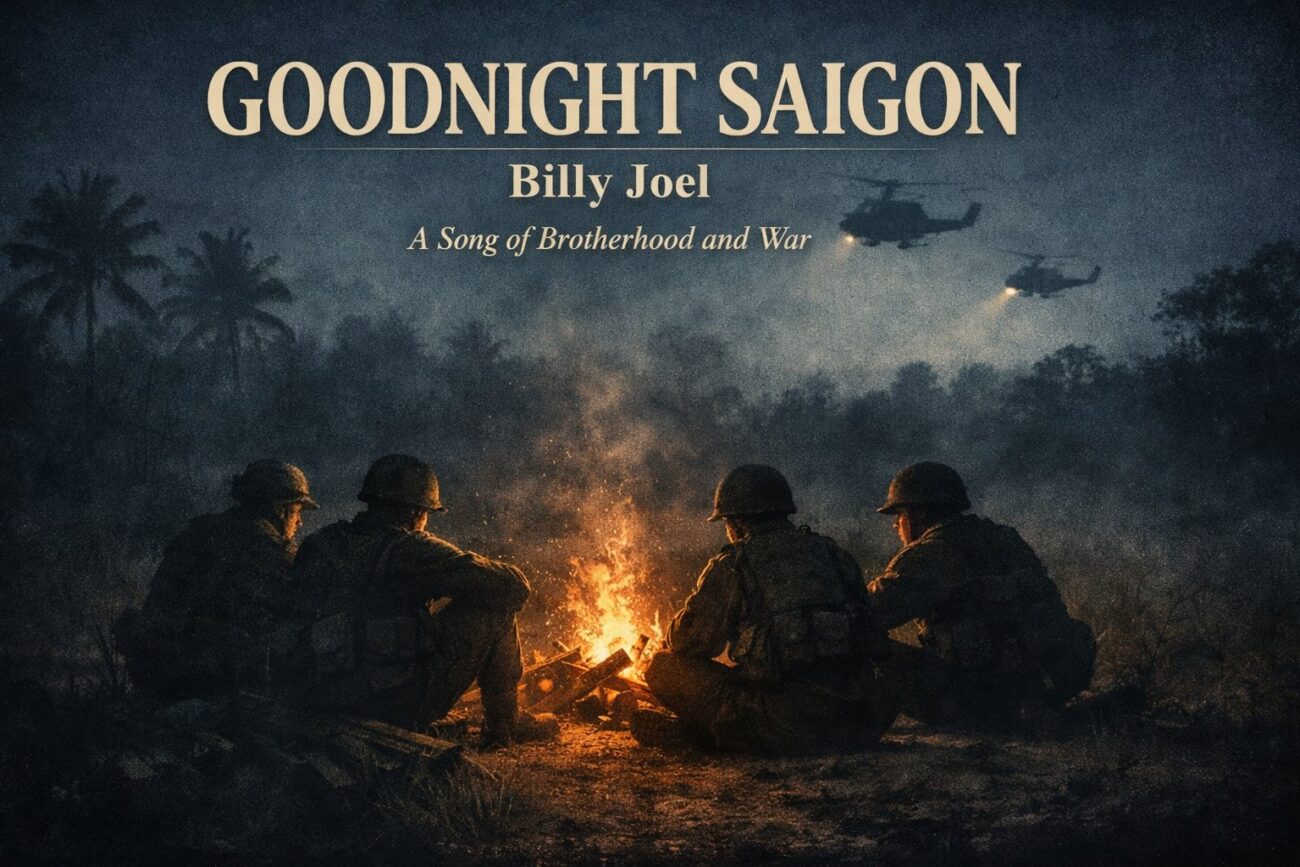
“Goodnight Saigon” is a 1982 song by Billy Joel, released on his socially ambitious album The Nylon Curtain. The song tells the story of American soldiers who served in the Vietnam War, focusing not on politics or military strategy, but on the emotional bond formed between young men placed in life-and-death circumstances. Rather than arguing whether the war was right or wrong, Joel centers the experience of the soldiers themselves — their fear, loyalty, brotherhood, and shared trauma.
Set against the backdrop of the Vietnam War (1955–1975), the song arrived at a time when America was still processing the cultural and psychological aftermath of that conflict. By 1982, the war had been over for years, but its impact remained unresolved for many veterans and their families. That same year marked the dedication of the Vietnam Veterans Memorial in Washington, D.C., reflecting a broader shift toward acknowledging the sacrifices of those who served. “Goodnight Saigon” entered that conversation not as protest music and not as patriotic anthem, but as remembrance.
People search for the meaning of “Goodnight Saigon” because the song feels unusually solemn within Billy Joel’s catalog. Listeners want to understand whether Joel served in Vietnam, what inspired him to write it, and what the repeated line “We would all go down together” truly signifies. The track stands apart from his piano-driven radio hits, both musically and thematically, and over four decades later it continues to resonate with veterans, historians, and fans seeking a deeper understanding of the Vietnam War’s human dimension.
Howard Dee’s Personal Take
I first heard “Goodnight Saigon” in 1982 — the same year The Nylon Curtain was released — when I was a freshman in college. That year I wrote a paper about the song, and I approached it from a simple but powerful angle: this was not a debate about foreign policy. It was a reminder that real human beings served in Vietnam, suffered there, and came home to a country that did not always treat them well. I earned an A on that paper, but the grade is not what stayed with me. What stayed with me was the realization that history is not abstract. It is lived.
Until then, Vietnam had mostly existed in textbooks, news footage, and adult conversations. Joel’s song changed that for me. When I heard lines about young men arriving eager and leaving altered, it humanized the war in a way no classroom lecture ever had. The song stripped away slogans and forced me to imagine the interior life of soldiers who were barely older than I was at the time.
Now, decades later, the song feels heavier. At eighteen, it opened my eyes. In my sixties, it feels like testimony. I have lived long enough to understand brotherhood, mortality, and the quiet bond that forms when people endure something difficult together. That perspective deepens the song rather than dulling it. “Goodnight Saigon” is not nostalgia. It is memory preserved in melody.
Background on The Nylon Curtain and Why Joel Wrote It
By 1982, Billy Joel had already cemented his status as a commercial force. Albums like The Stranger and 52nd Street had established him as a master of melody and character-driven storytelling. With The Nylon Curtain, however, he took a creative risk. The album embraced denser production, layered arrangements, and broader social themes.
Joel did not serve in Vietnam, a fact that sometimes surprises listeners who assume the song must be autobiographical. Instead, he immersed himself in the stories of veterans. He listened carefully to their accounts, particularly the way they described the bond among soldiers. What struck him was not ideology but fraternity. The sense of shared fate became the emotional center of the song.
Throughout The Nylon Curtain, Joel explored tension within American life. Economic strain, Cold War anxiety, and social pressure all surface on the record. “Goodnight Saigon” fits within that framework as a meditation on one of the most defining conflicts of the twentieth century. It was not an attempt to reopen political wounds. It was an attempt to preserve the voices of those who carried them.
Vietnam War Cultural Context in Early 1980s America
When “Goodnight Saigon” was released, the Vietnam War had been over for nearly a decade, yet its cultural aftershocks persisted. Many veterans struggled with reintegration into civilian life, and the national conversation remained fragmented. The early 1980s saw a gradual shift toward recognition of veterans’ sacrifices, culminating in the dedication of the Vietnam Veterans Memorial in 1982.
The country was also entering a period of renewed Cold War tension. Conversations about patriotism, service, and national identity were evolving. In that climate, a song that acknowledged soldiers without moralizing about the war itself occupied a unique space. It neither glorified combat nor condemned those who served.
By centering the shared humanity of soldiers, Joel sidestepped partisan framing. He did not instruct the listener how to feel about the war. He invited the listener to consider the men who fought it.
Song Structure and Production
“Goodnight Saigon” opens with ambient sounds that evoke helicopters and distant movement, immediately placing the listener inside an atmosphere rather than on a stage. The arrangement is restrained, with minimal piano presence compared to Joel’s earlier hits. The production leans heavily on layered vocals that create the illusion of a group speaking in unison.
The percussion mimics a marching cadence without becoming militaristic. This subtlety matters. The song does not try to dramatize battle scenes with bombast. Instead, it sustains a steady, almost solemn tempo. The restraint in Joel’s vocal delivery reinforces the authenticity of the narrative voice.
The repeated refrain functions as both chorus and thesis. When the voices join together on “We would all go down together,” the production swells slightly, underscoring unity rather than spectacle. The effect is communal rather than theatrical.
Full Thematic Breakdown of the Lyrics
The opening lines describe young men arriving at Parris Island full of energy and naïve conviction. The imagery of transformation from eager recruits to altered veterans establishes the emotional trajectory of the song. The metaphor comparing departure to leaving an asylum suggests psychological strain without needing graphic detail.
As the song progresses, references to shared experiences in the field emphasize solidarity. The soldiers “held on to each other like brother to brother,” a line that encapsulates the central theme. The lyric about promising their mothers they would write reinforces their youth and vulnerability. These are not hardened caricatures. They are sons.
The mention of cultural touchstones — magazines, entertainers, music — anchors the experience in a specific era. Those details remind the listener that these soldiers carried fragments of home with them, even as they navigated unfamiliar terrain. The darkness described in the night sequences conveys isolation and uncertainty more than action.
The song also includes acknowledgment of loss. References to fallen comrades are handled with restraint, avoiding melodrama. The absence of overt moral judgment about who was right or wrong underscores the soldiers’ perspective. In the “thick of the fight,” ideological debates recede. Survival and loyalty take precedence.
The Meaning of “We Would All Go Down Together”
This refrain encapsulates the emotional contract among soldiers. It does not celebrate death. It affirms unity. The phrase reflects an understanding that their fates are intertwined. In combat, individuality narrows, and dependence on others intensifies.
The power of the line lies in its calm certainty. It is delivered as a statement of fact rather than a rallying cry. That distinction prevents the song from sliding into romanticism. The soldiers are not seeking martyrdom. They are acknowledging shared risk.
This sentiment resonates beyond military contexts. Anyone who has experienced profound shared hardship understands the instinct to stand together, regardless of outcome. That universality contributes to the song’s endurance.
Reception and Legacy
Although not one of Joel’s biggest chart-topping singles, “Goodnight Saigon” earned critical respect and long-term cultural significance. It demonstrated his capacity to engage serious subject matter without abandoning melodic discipline.
Over the years, the song has become associated with remembrance ceremonies and veteran tributes. Its reputation rests less on commercial metrics and more on emotional credibility. Within Joel’s catalog, it stands as one of his most solemn and disciplined works.
Why Veterans Connect to This Song
Many veterans have expressed appreciation for the song’s portrayal of camaraderie. The collective voice avoids singling out a heroic protagonist. Instead, it reflects the shared identity that emerges under extreme conditions.
The absence of overt political commentary allows veterans from varying viewpoints to connect with it. The song validates their bond without reducing their experience to talking points. That neutrality strengthens its authenticity.
Cultural Impact and Performances
Joel has performed “Goodnight Saigon” at significant events, reinforcing its association with reflection and commemoration. The song has also been embraced in military communities, further embedding it in cultural memory.
Its longevity stems from emotional truth rather than topical urgency. As long as societies send young people into dangerous situations, the themes of loyalty and shared fate will remain relevant.
Howard Dee’s Closing Reflection
When I revisit “Goodnight Saigon” today, I hear more than a well-crafted song. I hear the younger version of myself wrestling with the idea that history is made of individuals. Writing that college paper in 1982 marked the first time I saw Vietnam not as a headline, but as a human story.
Decades later, the song still carries weight because it refuses to simplify. It does not declare heroes or villains. It presents brotherhood under pressure and allows the listener to sit with it. That restraint is precisely what gives it power.
🔗 Explore More Billy Joel
- Top 10 Billy Joel Songs
- 10 Interesting Facts About Billy Joel
- We Didn’t Start the Fire Meaning: Every Reference Explained
- Inside Billy Joel’s Most Politically Powerful Songs — And Why He Rejected the Label
- Leningrad by Billy Joel: Meaning, Background, and Why It Still Matters
- Billy Joel Artist Profile
- Explore the Complete Billy Joel Guide
- The 15 Most Career-Defining Early Songs of Billy Joel (1971–1976)
- Billy Joel – 10 Billy Joel Lyrics That Hit Harder After 50
- Billy Joel and the Singer-Songwriter Era: Same Stage, Different Wiring
🎯 Test Your Billy Joel Knowledge
Think you know Billy Joel inside and out? Try these quizzes and prove your Piano Man mastery!
💬 Share Your Billy Joel Memories
Which Billy Joel song means the most to you? Was it a first concert, a breakup anthem, or the soundtrack to a long road trip?
Drop your memories in the comments—we’d love to hear them!
🎧 Artist Resources
Looking to dive deeper into the world of Billy Joel? Here are some trusted places to explore more of his music, history, and current happenings:
- 🌐 Official Website –👉 Tour dates, merch, news, and the full bio
- 🎵 Billy Joel on Spotify –👉 Stream his essential songs and full discography
- 📺 Billy Joel on YouTube –👉 Live performances, official music videos, and interviews
- 📘 Billy Joel Biography Book –👉 Billy Joel: The Definitive Biography by Fred Schruers
FAQ — Goodnight Saigon by Billy Joel
Did Billy Joel serve in the Vietnam War, and how did he write “Goodnight Saigon” without firsthand experience?
Billy Joel did not serve in Vietnam. Born in 1949, he was of draft age during the late 1960s, but he did not enter military service. That reality makes “Goodnight Saigon” even more interesting, because the song sounds as though it comes from inside the experience rather than outside observation.
Joel has explained that he wrote the song after listening to veterans tell their stories. He was struck not by political ideology but by the intensity of their brotherhood. Instead of attempting to write a protest song or a patriotic anthem, he focused on the emotional core of what they described: fear, loyalty, and shared survival. The decision to use collective pronouns — “we,” “us,” “our” — reflects that intention. He was not impersonating one soldier; he was channeling a shared voice.
The authenticity of the song comes from restraint. Joel avoided dramatic flourishes and graphic detail. He concentrated on the psychological atmosphere of service, which is why many veterans have said the song feels accurate even though it was written by someone who did not serve.
What does “We would all go down together” actually mean in the context of the song?
At first glance, the line sounds like a declaration of heroic defiance. However, within the context of the song, it carries a quieter and more complex meaning. It reflects the understanding among soldiers that their fates are intertwined. In combat situations, individual survival depends heavily on collective cohesion.
The phrase does not romanticize death. Instead, it expresses a psychological contract. The soldiers are acknowledging that if one falls, the group is affected as a whole. The line speaks to unity under extreme pressure, not to a desire for martyrdom. It is delivered calmly rather than shouted, which reinforces that it is a statement of solidarity rather than bravado.
That distinction is critical. The power of the refrain lies in its steadiness. It captures the emotional reality of relying on one another in circumstances where fear is constant and outcomes are uncertain.
Why did “Goodnight Saigon” resonate in 1982 when the Vietnam War had already ended?
By 1982, the Vietnam War had been over for nearly a decade, but public reconciliation was still incomplete. Many veterans struggled with reintegration, and national conversations about Vietnam remained polarized. The dedication of the Vietnam Veterans Memorial that same year symbolized a broader cultural shift toward acknowledgment and remembrance.
“Goodnight Saigon” arrived during that transitional moment. It did not argue about whether the war was justified. It did not criticize policymakers or glorify military action. Instead, it focused on the men who served. That emphasis allowed the song to function as a bridge between divided perspectives.
Because it centered human experience rather than ideology, the song felt appropriate for a country trying to separate political debate from personal sacrifice. That is one reason it gained long-term cultural respect rather than fading as a topical commentary.
Is “Goodnight Saigon” considered a protest song?
“Goodnight Saigon” is not a protest song in the traditional sense. Unlike many Vietnam-era tracks that explicitly criticized government policy or military strategy, Joel’s composition avoids direct political argument. It does not assign blame or advocate a position on the war itself.
However, the song does contain subtle commentary through omission. By refusing to focus on strategy or victory, it highlights the human cost of conflict. That choice shifts attention from abstract debate to lived experience. The absence of overt protest rhetoric actually strengthens its credibility across different audiences.
For that reason, the song occupies a unique space. It is neither anti-war anthem nor patriotic rally. It is a reflective narrative about brotherhood under fire.
How does the production of “Goodnight Saigon” contribute to its emotional impact?
The production of “Goodnight Saigon” is intentionally restrained and atmospheric. The opening ambient sounds evoke helicopters, placing the listener in a specific environment before any lyrics are sung. This cinematic introduction establishes mood rather than melody.
Throughout the track, layered backing vocals simulate the sound of multiple soldiers singing together. This reinforces the collective perspective embedded in the lyrics. The percussion resembles a marching cadence without becoming militaristic or triumphant. The absence of a flashy piano solo — unusual for Joel — underscores the seriousness of the subject matter.
The restrained arrangement mirrors the emotional tone of the song. Instead of dramatizing events with orchestral swell or explosive crescendos, the production maintains steady tension. That discipline allows the lyrics to carry the weight.
Why do so many veterans connect deeply with this song?
Veterans often respond to the song’s focus on camaraderie rather than combat spectacle. The lyrics emphasize holding on “brother to brother,” promising mothers to write, and navigating darkness together. These details align closely with personal accounts of service.
The collective voice is also significant. By avoiding a single heroic narrator, the song reflects the shared identity that develops within units. Veterans frequently describe that bond as one of the most defining aspects of their experience.
Additionally, the lack of overt political messaging allows veterans from different viewpoints to see themselves in the song. It validates the emotional reality of service without simplifying it into a slogan.
How does “Goodnight Saigon” compare to other war-themed songs?
Many war-themed songs fall into one of two categories: protest or patriotism. “Goodnight Saigon” sits in a narrower middle ground. It neither condemns nor celebrates war. Instead, it documents the emotional landscape of those who served.
Compared to more confrontational protest songs of the late 1960s and early 1970s, Joel’s approach is quieter and more reflective. The song feels closer to oral history than rallying cry. That subtlety contributes to its longevity, as it avoids becoming tied to a specific political moment.
Because of this balance, the song continues to feel relevant decades after its release. Its focus on loyalty and shared hardship transcends the specific conflict it references.
Why is “Goodnight Saigon” considered one of Billy Joel’s most serious songs?
Within Billy Joel’s catalog, many songs are driven by melody, wit, or character sketches. “Goodnight Saigon” stands apart because of its thematic gravity and disciplined tone. The humor and sharp satire present in other works are intentionally absent.
The song demonstrates Joel’s capacity to step outside personal narrative and inhabit a collective voice. That creative risk elevated his reputation among critics who questioned whether he could sustain deeper social commentary.
Over time, the track has become a benchmark for evaluating Joel’s range as a songwriter. It proves that he could write beyond pop craftsmanship and into cultural memory.