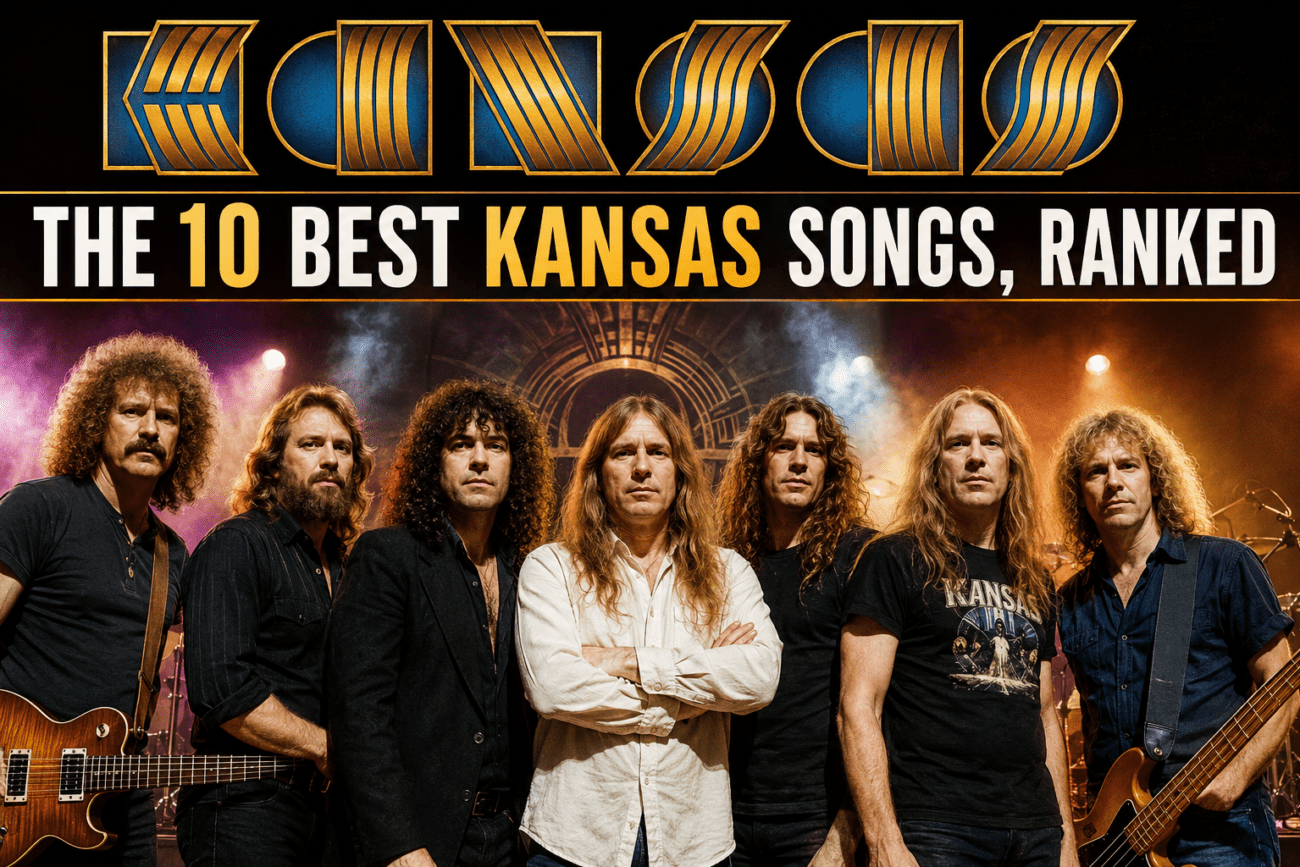
Kansas occupies a unique place in American classic rock. The band had the technical ambition of progressive rock, but unlike many prog groups, Kansas could also write choruses that filled arenas and songs that worked perfectly on FM radio.
The classic lineup brought together Steve Walsh’s powerful voice and keyboards, Kerry Livgren’s writing and guitar, Robby Steinhardt’s violin and vocals, Richard Williams’ guitar, Dave Hope’s bass and Phil Ehart’s drumming. That combination gave Kansas a sound that was instantly recognizable: sweeping keyboards, stacked vocals, unusually prominent violin and arrangements that could shift directions several times without losing the song.
Their commercial breakthrough came with Leftoverture in 1976, powered by “Carry On Wayward Son.” The follow-up, Point of Know Return, became the band’s best-selling studio album and included “Dust in the Wind,” “Portrait (He Knew)” and the title track. Kansas says Point of Know Return reached No. 4 on the Billboard album chart and ultimately went sextuple platinum.
Yet the hits only tell part of the story. Kansas was always strongest when melody and complexity worked together.
Here are the 10 best Kansas songs, ranked.
10. Hold On
Album: Audio-Visions | Released: 1980 | Songwriter: Kerry Livgren
“Hold On” arrived during a period when Kansas was changing both musically and personally. Kerry Livgren’s spiritual awakening had begun influencing his songwriting more directly, and the lyric reflects that new perspective.
What keeps the song from becoming heavy-handed is the melody. Steve Walsh gives it a warm, emotional vocal, while the band surrounds him with keyboards, guitars and harmonies that feel polished without becoming generic.
The track also represents Kansas moving toward a more concise early-’80s sound. The longer progressive structures were becoming less dominant, but the musicianship remained intact.
It isn’t the band’s most famous song, yet it shows how Kansas could evolve without completely abandoning the qualities that made the ’70s records distinctive.
9. Portrait (He Knew)
Album: Point of Know Return | Released: 1977 | Songwriters: Kerry Livgren, Steve Walsh
“Portrait (He Knew)” is Kansas doing what it did best: taking an intellectual idea and turning it into a rock song with real momentum.
The song is inspired by Albert Einstein, but it never feels like a classroom exercise. The keyboards and guitars create tension while the rhythm section keeps the track moving through its shifts in tempo and mood.
Steve Walsh sounds especially strong, navigating the changing arrangement without losing the emotional thread.
The song also demonstrates the depth of Point of Know Return. Kansas’ own retrospective on the album singles out “Portrait (He Knew)” alongside “Closet Chronicles” and “Paradox” as enduring fan favorites.
It’s exactly the kind of track that separates Kansas from conventional arena rock.
8. The Wall
Album: Leftoverture | Released: 1976 | Songwriters: Kerry Livgren, Steve Walsh
“The Wall” begins almost delicately, then gradually expands into one of the most dramatic songs on Leftoverture.
The lyric is philosophical, centered on obstacles, self-discovery and the idea that the thing standing between us and understanding may be something we created ourselves. Livgren returned to themes like this repeatedly, but “The Wall” is one of his most accessible examples.
Robby Steinhardt’s violin adds color without overwhelming the arrangement, and Walsh delivers the lyric with enough conviction to make the abstract imagery feel personal.
Kansas still highlights “The Wall” among the songs audiences can expect in its live repertoire, which says something about how well it has endured beyond the band’s radio hits.
Continue the Countdown
More Top 10 Progressive & Arena Rock Rankings
Explore more rankings from the melodic, progressive and arena-rock side of classic rock.
7. Play the Game Tonight
Album: Vinyl Confessions | Released: 1982 | Songwriters: Phil Ehart, Danny Flower, Rob Frazier, Kerry Livgren, Rich Williams
“Play the Game Tonight” represents a very different Kansas.
Steve Walsh had left the band, John Elefante had taken over lead vocals, and the progressive complexity of the 1970s had increasingly given way to a more polished arena-rock approach.
Yet the song works.
The keyboard opening immediately establishes the early-’80s setting, while the chorus is among the most direct and radio-friendly Kansas ever recorded. Elefante doesn’t try to imitate Walsh exactly, which helps the record establish its own identity.
Kansas’ current concert promotion still lists “Play the Game Tonight” alongside “Carry On Wayward Son,” “Dust in the Wind,” “Point of Know Return” and “The Wall” as part of the band’s familiar live catalog.
That longevity earns it a spot.
6. Point of Know Return
Album: Point of Know Return | Released: 1977 | Songwriters: Steve Walsh, Phil Ehart, Robby Steinhardt
“Point of Know Return” wastes almost no time announcing itself.
The keyboards move quickly, the rhythm section pushes forward and Walsh delivers the title with the kind of urgency that turns a complicated phrase into a memorable hook.
The song works because Kansas compresses its progressive instincts into a relatively concise form. There are plenty of musical changes, but none of them feel like detours.
The title itself is clever, playing on “point of no return” while giving the phrase a more philosophical edge. That combination of wordplay and musical complexity is very Kansas.
The band’s official history continues to place the song alongside its most recognizable classics, and it became one of three Hot 100 singles from the Point of Know Return album.
5. Miracles Out of Nowhere
Album: Leftoverture | Released: 1976 | Songwriter: Kerry Livgren
“Miracles Out of Nowhere” may be one of the best examples of Kansas as a true progressive-rock band.
The song constantly evolves. Keyboards, violin and guitars trade focus, the arrangement changes shape and the dynamics rise and fall, yet there is still a strong melodic center underneath everything.
Kerry Livgren’s lyric reflects the spiritual and philosophical searching that defined much of his writing during this period. Walsh and Steinhardt give those ideas emotional weight through the vocal arrangement.
Kansas itself has repeatedly treated “Miracles Out of Nowhere” as one of its signature progressive epics, even using the title for the band’s 2015 documentary.
For listeners who know Kansas only through the giant singles, this is one of the first deeper tracks they should hear.
4. Song for America
Album: Song for America | Released: 1975 | Songwriter: Kerry Livgren
Before Kansas figured out how to turn progressive rock into radio hits, the band was already producing ambitious music like “Song for America.”
At nearly ten minutes, the track has room to develop slowly. The keyboards establish a sweeping atmosphere, Robby Steinhardt’s violin becomes a major voice inside the arrangement and the band moves through multiple sections without sounding disconnected.
The lyric reflects on the American landscape and the changes brought by expansion and development, giving the song a scale that matches the music.
Kansas still refers to “Song for America” as one of its defining progressive epics, which is appropriate because it captures the band before commercial pressure encouraged shorter songs.
It’s Kansas at its most ambitious.
3. Dust in the Wind
Album: Point of Know Return | Released: 1977 | Songwriter: Kerry Livgren
“Dust in the Wind” sounds almost nothing like the Kansas most people knew before it.
There is no massive electric-guitar riff, no complicated keyboard introduction and very little of the prog-rock muscle associated with the band. Instead, Kerry Livgren built the song around a delicate acoustic-guitar pattern and one of the simplest ideas in the Kansas catalog.
Everything is temporary.
That message could easily become depressing, but the arrangement gives the song a strange beauty. Robby Steinhardt’s violin adds an emotional counterpoint while Steve Walsh keeps the vocal restrained.
It became Kansas’ biggest pop hit, peaking at No. 6 on the Billboard Hot 100. The band also notes that the song became a million-selling single and has accumulated more than three million radio plays.
The irony is perfect: a song about impermanence became one of the band’s most permanent achievements.
2. Leftoverture / Magnum Opus
Album: Leftoverture | Released: 1976 | Songwriters: Kerry Livgren and Kansas
“Magnum Opus” is where Kansas lets the musicians take over.
The closing suite of Leftoverture moves through multiple sections, changing moods and rhythms while showcasing nearly every part of the classic lineup. Guitars, keyboards, violin and rhythm section all get opportunities to reshape the piece.
This is not Kansas trying to write a radio single. It is Kansas embracing the progressive-rock instincts that existed before the commercial breakthrough.
That makes it important because Leftoverture could easily be remembered only for “Carry On Wayward Son.” In reality, the album became a defining record because the band could place a compact rock anthem beside something as ambitious as “Magnum Opus” and make both belong.
Kansas has described Leftoverture as one of the band’s landmark albums, and the anniversary tour built around it reinforced how central the record remains to the band’s identity.
Still, one song changed everything.
1. Carry On Wayward Son
Album: Leftoverture | Released: 1976 | Songwriter: Kerry Livgren
“Carry On Wayward Son” is one of those songs where almost every section could have been the centerpiece of another record.
The opening a cappella harmonies grab attention immediately. Then the guitar riff arrives, the rhythm shifts, keyboards enter and the song keeps moving through distinct sections without ever losing its sense of direction.
That is what makes the record so important.
Kansas managed to take progressive-rock complexity and turn it into something millions of people could sing along with. The song doesn’t simplify the band’s identity; it concentrates it.
Lyrically, Kerry Livgren was still writing about searching, struggle and meaning. The idea of carrying on through confusion fit the band’s own situation surprisingly well, because Leftoverture was the album that finally turned years of touring and modest sales into a genuine breakthrough.
“Carry On Wayward Son” reached No. 11 on the Billboard Hot 100. Decades later, Kansas says it remains among the most-played songs on classic-rock radio, and the band’s 2026 materials list it as a quadruple-platinum single.
“Dust in the Wind” charted higher. “Song for America” may be more progressive. “Miracles Out of Nowhere” may better satisfy hardcore fans.
But no other Kansas song combines musicianship, melody, complexity and staying power this completely.
That’s why “Carry On Wayward Son” is No. 1.
What Did We Leave Out?
The toughest omission is “Closet Chronicles.” It is one of the strongest deep cuts on Point of Know Return, with the kind of shifting arrangement and philosophical lyric that longtime Kansas fans often value as much as the radio hits. The band itself continues to identify it as one of the album’s enduring fan favorites.
“Paradox” deserves the same consideration. It is harder, faster and more guitar-driven, showing another side of an album most casual listeners associate primarily with “Dust in the Wind.”
Other serious contenders include “People of the South Wind,” “Lightning’s Hand,” “Cheyenne Anthem,” “Icarus – Borne on Wings of Steel,” “Journey from Mariabronn” and “Fight Fire with Fire.” Fans of the John Elefante era might also argue for more material from Vinyl Confessions and Drastic Measures.
That is the challenge with Kansas. The two enormous songs dominate public memory, but the album catalog is where much of the band’s real personality lives.
Why Kansas’ Best Songs Still Work
Kansas succeeded because the band never completely chose between progressive rock and mainstream rock.
Kerry Livgren could write complicated arrangements and philosophical lyrics. Steve Walsh could turn those ideas into powerful melodies. Robby Steinhardt’s violin provided a color that immediately distinguished Kansas from Boston, Journey, Styx and the other American arena-rock bands that emerged around the same era.
The rhythm section mattered just as much. Phil Ehart and Dave Hope gave the complicated sections enough stability that the songs rarely felt technical for the sake of being technical.
That combination is why Kansas could produce “Song for America,” “Dust in the Wind” and “Carry On Wayward Son” without sounding like three unrelated bands.
The band’s longevity reflects that balance. Kansas says it has sold more than 30 million albums worldwide, with Leftoverture and Point of Know Return among its multi-platinum landmarks.
The songs were sophisticated, but they still connected.
Want to See Kansas Live?
Kansas remains very active on the road in 2026.
The band is currently touring with Deep Purple and Jefferson Starship on selected dates, with additional Kansas and Deep Purple shows continuing through August and September. The official Kansas tour page lists shows across the United States and Canada, including Mansfield, Halifax, Toronto, Detroit-area Clarkston and other stops.
That pairing also makes sense musically. Kansas and Deep Purple both built classic-rock identities around musicianship, keyboards and songs that become significantly bigger in a concert setting.
Concert Ticket Source currently lists several Deep Purple/Kansas dates on its Deep Purple ticket page, including the August 25 show at Ravinia near Chicago.
Check Kansas and Deep Purple concert dates and tickets at Concert Ticket Source
70s Music Wisdoms may receive compensation from partners featured on this site.