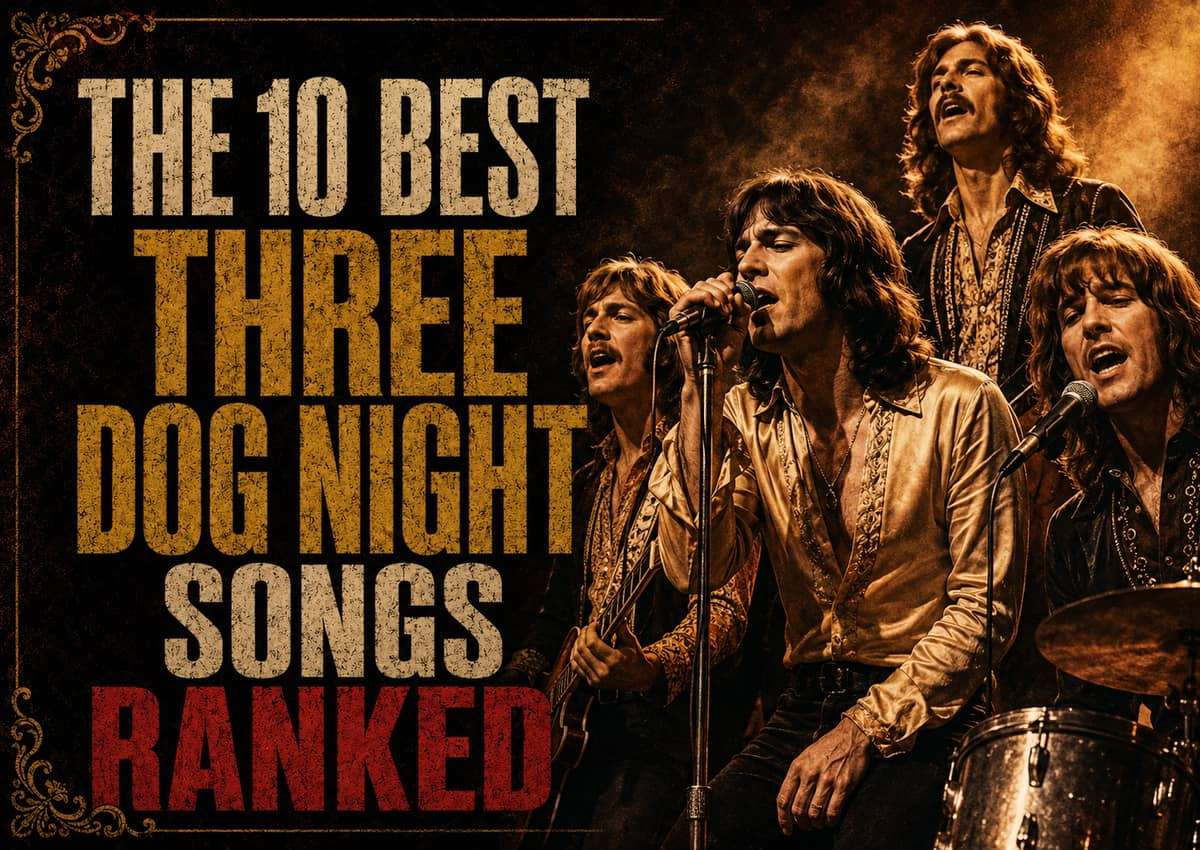
Three Dog Night were one of the most dependable hit-making bands of the late 1960s and early 1970s, but their success came from an unusual model. Rather than relying on one principal songwriter, the group built its identity around three strong lead singers – Danny Hutton, Chuck Negron, and Cory Wells – and an exceptional instinct for finding songs that other writers had not yet turned into major hits.
That approach brought material from Randy Newman, Harry Nilsson, Laura Nyro, Hoyt Axton, Paul Williams, and others into the mainstream. The band did not simply cover those songs. Their arrangements, harmonies, and rotating lead voices gave the material a recognizable Three Dog Night sound: big choruses, muscular rhythm sections, and enough soul and gospel influence to keep the records from feeling like generic pop.
A ranking of their best songs therefore has to judge both the source material and what the band did with it. The strongest Three Dog Night records are not interesting because they were covers; they are interesting because the group knew how to identify a song’s dramatic center and build a performance around it. These ten tracks show why their run of hits was so remarkable.
Here are the 10 best Three Dog Night songs, ranked.
10. Eli’s Coming
Album: Suitable for Framing | Released: 1969 | Songwriter: Laura Nyro
Laura Nyro’s writing gave Three Dog Night a perfect vehicle for drama. “Eli’s Coming” moves with nervous energy, and the band treats the warning in the lyric as something urgent rather than abstract. The arrangement keeps tightening, while the vocal attack makes the chorus feel larger each time it returns. The record is an early example of the group’s ability to take sophisticated songwriting and give it a harder, more radio-ready edge. It opens our countdown because it captures the excitement of the band’s first great period and shows how much personality they could bring to someone else’s composition.
Within this countdown, the song also matters because it widens the picture of Three Dog Night. It is not simply another familiar title from 1969; it shows how carefully melody and texture were being used to create identity. Listen beyond the hook and the details in the arrangement explain why the record holds together so well decades later.
9. Easy to Be Hard
Album: Suitable for Framing | Released: 1969 | Songwriters: Gerome Ragni, James Rado, and Galt MacDermot
Taken from the musical Hair, “Easy to Be Hard” becomes a very different experience in Three Dog Night’s hands. Chuck Negron’s lead vocal is controlled but wounded, emphasizing the contradiction at the heart of the song: people who speak about broad causes can still be careless with the person directly in front of them. The arrangement is restrained enough to let that idea land. Rather than turn the song into theatrical material, the band makes it sound intimate and contemporary. It remains one of their most emotionally direct performances and one of the clearest examples of how their vocalists could reshape a song around a distinctive point of view.
Another reason it earns its position is replay value. The first impression comes from the obvious hook, but repeated listens reveal how much of the character lives in smaller choices: pacing, phrasing, instrumental response, and the way the arrangement creates space around the vocal. Those choices keep the track from becoming a period piece.
8. Shambala
Album: Cyan | Released: 1973 | Songwriter: Daniel Moore
By 1973, Three Dog Night had already accumulated an extraordinary number of hits, yet “Shambala” sounds anything but tired. The song has a rolling, uplifting groove and a chorus built for group singing, but its appeal is not only celebratory. The lyric’s search for a better, more peaceful place fit the period while also giving the record a spiritual undercurrent. The band balances rock, gospel, and pop without forcing any one element. “Shambala” earns a high place because it shows the group late in its peak commercial run still sounding engaged, rhythmic, and completely at home with material that could easily have become sentimental in less capable hands.
The song also rewards being heard in the context of Cyan. On the album, it helps define the larger musical world around it; as a standalone track, it is focused enough to make its point quickly. That ability to work on both levels is one mark of the strongest material in Three Dog Night’s catalog.
Continue the Countdown
More Top 10 Rock / Pop Favorites
Explore more rankings from artists and bands that belong beside this countdown.
7. Never Been to Spain
Album: Harmony | Released: 1971 | Songwriter: Hoyt Axton
Hoyt Axton gave the band several important songs, and “Never Been to Spain” may be the coolest of them. The lyric is built on travel, imagination, and contradiction: the narrator has strong feelings about places he has never actually seen. Three Dog Night leans into the looseness of the idea with a groove that feels relaxed but never lazy. The performance grows in force as it moves, turning a conversational lyric into a full-band declaration. It is one of those records that sounds simple until you notice how carefully the dynamics are controlled. That combination of humor, swagger, and musical lift keeps it among the group’s most replayable tracks.
For a group or artist with so many recognizable records, distinctiveness matters. This track has its own shape and atmosphere from the opening moments, and it never needs to borrow importance from nostalgia. The performance creates its own reason to keep listening, which is why it belongs above several bigger or more obvious hits.
6. Liar
Album: Naturally | Released: 1970 | Songwriter: Russ Ballard
“Liar” gives Three Dog Night a darker, tougher setting than many of their best-known singles. Written by Russ Ballard, the song is built around accusation and tension, and the band responds with one of its most forceful arrangements. The drums and guitars create a hard rock edge while the vocals keep the song theatrical without becoming exaggerated. What makes the recording work is escalation: each section feels as if the argument is becoming more intense. The result demonstrates that the group could do more than cheerful singalongs and polished ballads. At number six, “Liar” represents the muscular side of their catalog and the band’s ability to make a compact pop single feel almost confrontational.
There is also a useful contrast between the song’s immediate accessibility and the craft underneath it. Nothing about the record feels like homework, yet the writing and arrangement are full of deliberate decisions. That is often the sign of mature pop and rock craftsmanship: sophistication is present, but the listener experiences it first as pleasure.
5. Out in the Country
Album: It Ain’t Easy | Released: 1970 | Songwriters: Paul Williams and Roger Nichols
“Out in the Country” is one of the warmest records in the Three Dog Night catalog. Paul Williams and Roger Nichols supplied a song about escape from pressure and noise, and the band gives it an easy, open arrangement that matches the theme. The harmonies are central, but the rhythm never disappears beneath them. It is polished pop with enough organic texture to make the imagined retreat feel believable. The song’s appeal has actually grown with time because the desire to get away from schedules, traffic, and constant demands hardly feels dated. It ranks fifth as a reminder that the band’s softer material could be just as distinctive as its harder-edged hits.
Seen from today, the recording also avoids one of the common problems of vintage rock: it does not rely entirely on the sound of its era for impact. The production may date the session to 1970, but the emotional logic of the track remains easy to understand. That gives the song a life beyond oldies radio.
4. Black and White
Album: Seven Separate Fools | Released: 1972 | Songwriters: David I. Arkin and Earl Robinson
“Black and White” had existed in other forms before Three Dog Night recorded it, but their version turned its message into a buoyant pop hit. The arrangement is bright and rhythmic, and the group’s easy vocal blend makes the idealism of the lyric feel celebratory rather than heavy-handed. That accessibility was part of Three Dog Night’s talent: they could take a song carrying a social message and make it feel natural on Top 40 radio. The record belongs near the top because it captures the band’s commercial instincts without reducing the song to a novelty. It is concise, memorable, and representative of the optimistic side of early-1970s pop.
The placement here is not based only on chart success. A best-songs list should also reward tracks that explain something essential about an artist’s musical personality. This one does exactly that, whether through the writing, the instrumental character, or the way the performance turns a relatively compact idea into something immediately recognizable.
3. One
Album: Three Dog Night | Released: 1968 | Songwriter: Harry Nilsson
“One” is where Three Dog Night’s interpretive identity first became impossible to ignore. Harry Nilsson wrote a compact song about loneliness, and the band transformed it into a dramatic record built around space, repetition, and a vocal that grows more desperate as the arrangement develops. The famous central idea is almost childlike in its simplicity, but the performance gives it real emotional weight. The band’s version helped introduce Nilsson’s songwriting to a much larger audience while also establishing Three Dog Night as more than a conventional covers act. It ranks third because it contains the formula they would use repeatedly: find a strong song, understand its emotional engine, and amplify it without losing what made it special.
One of the pleasures of revisiting the track is hearing how disciplined the performance is. Even when the music sounds loose or spontaneous, the musicians are serving a clear structure. The record knows when to build, when to hold back, and when to deliver the hook. That sense of timing is a major part of its durability.
2. Mama Told Me (Not to Come)
Album: It Ain’t Easy | Released: 1970 | Songwriter: Randy Newman
“Mama Told Me (Not to Come)” is one of the funniest and most sharply observed songs Three Dog Night ever recorded. Randy Newman’s lyric describes a party through the eyes of someone completely overwhelmed by it, and Cory Wells’ vocal makes that discomfort vivid. The band surrounds him with a funky, slightly claustrophobic arrangement that turns the scene into a miniature comic nightmare. What could have been a novelty became a number-one hit because the performance is so precise. Every strange detail adds to the narrator’s panic. It ranks second because it is both unmistakably a Randy Newman song and unmistakably a Three Dog Night record – the ideal outcome of the band’s interpretive approach.
The song’s staying power also comes from proportion. It gives the listener enough musical detail to remain interesting without burying the central idea. That balance is harder to achieve than it sounds, particularly in an era when studio possibilities were expanding quickly. Here, the production supports the song rather than becoming the story.
1. Joy to the World
Album: Naturally | Released: 1970 | Songwriter: Hoyt Axton
“Joy to the World” is so familiar that it is easy to overlook how unusual it is. Hoyt Axton supplied an opening image that should not have made sense as the foundation of a massive pop hit, yet Three Dog Night embraced the song’s absurdity and turned it into pure communal energy. Chuck Negron’s lead vocal is exuberant, the band sounds loose without losing control, and the chorus invites everyone within earshot to join in. The record became one of the defining singles of 1971 and remains the song most closely associated with the group. It takes number one because it captures Three Dog Night at their best: excellent material, a commanding lead vocal, strong ensemble playing, and an instinctive understanding of what makes people want to sing along.
At this point in the ranking, the differences are small. Every remaining song can make a reasonable claim to being a signature track. This one rises because the performance, composition, and recording all reinforce the same mood. There is very little wasted motion, and the identity of Three Dog Night is audible almost immediately.
What Did We Leave Out?
The biggest argument will probably be over “An Old Fashioned Love Song,” a Paul Williams composition that became one of Three Dog Night’s most recognizable records. “Celebrate,” “One Man Band,” “The Show Must Go On,” and “Pieces of April” were also serious contenders. A list centered strictly on chart performance would look somewhat different from this one, but our ranking gives extra weight to performances that best demonstrate the group’s unusual gift for finding excellent outside material and turning it into records that sounded unmistakably like Three Dog Night.
Why Three Dog Night’s Best Songs Still Work
Three Dog Night’s best records still work because the band understood a truth that rock history sometimes undervalues: interpretation is an art. Writing a great song and recognizing one are different talents. Hutton, Negron, Wells, and the musicians around them repeatedly found material with strong bones and then made choices about tempo, vocal personality, harmony, dynamics, and arrangement that could turn those songs into hits.
Their catalog is also a map of an extraordinary songwriting era. Listening through these records leads directly to Nilsson, Newman, Nyro, Axton, Williams, Nichols, and others. Yet the connective tissue is always the band itself. Three Dog Night could sound soulful, funny, dramatic, tender, or celebratory without losing its identity.
That versatility explains why the singles remain such durable oldies. They are carefully built records with memorable voices at the center. The hits may have come from many writers, but the sound and the performances belonged to Three Dog Night.