
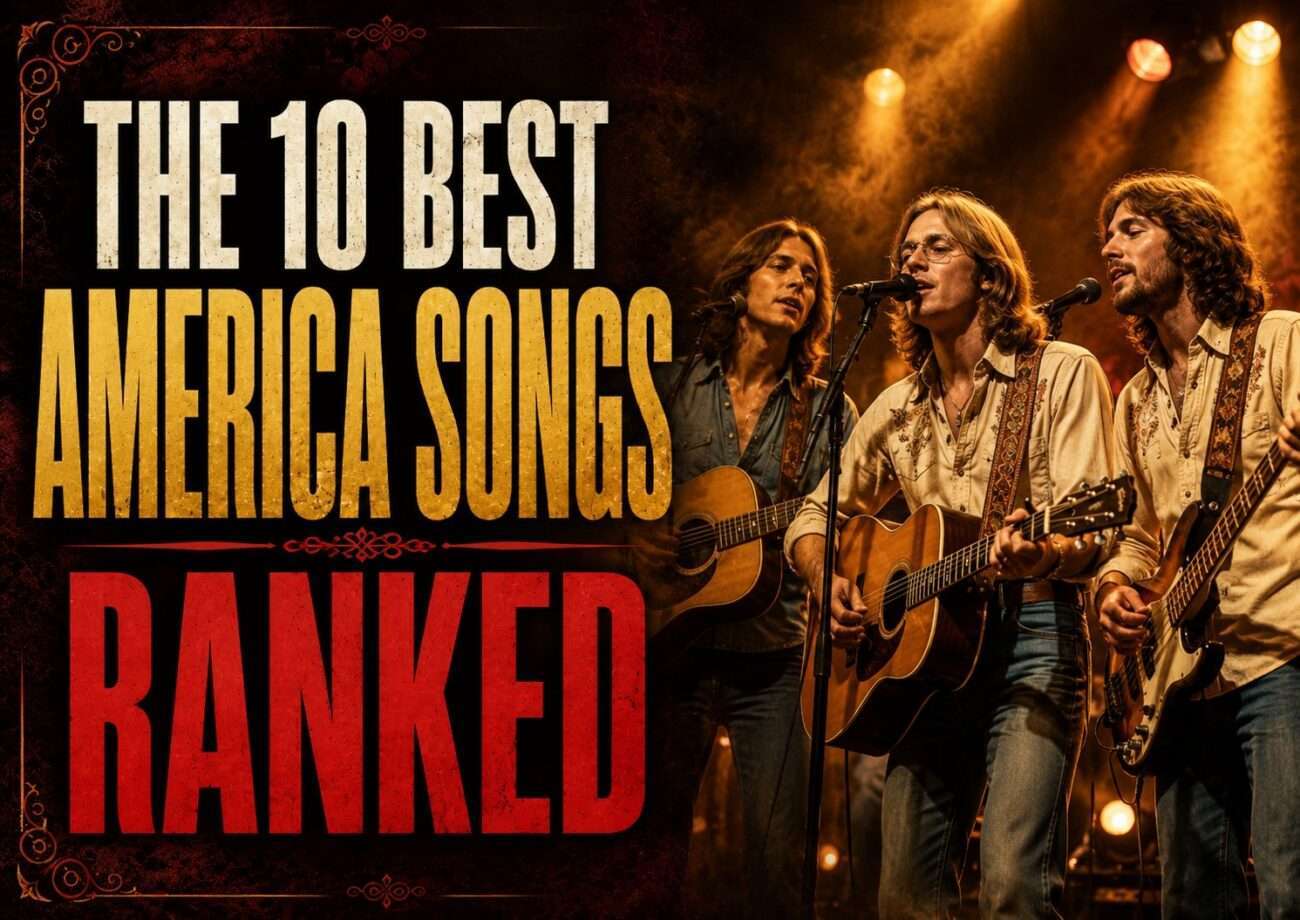
America sounded like California even though the band was formed thousands of miles away in London.
Gerry Beckley, Dewey Bunnell and Dan Peek were sons of American servicemen stationed overseas, and the three musicians found each other while attending school in England. By the beginning of the 1970s, they had developed a sound built around acoustic guitars, close harmonies and melodies that seemed perfectly suited to long highways, open landscapes and FM radio.
Success came almost immediately. “A Horse with No Name” became a No. 1 hit, America won the Grammy Award for Best New Artist, and the group soon began working with legendary Beatles producer George Martin. That partnership produced another run of major songs including “Tin Man,” “Lonely People” and “Sister Golden Hair.”
What makes America’s catalog interesting is that the hits don’t all sound the same. Some are almost dreamlike, others are romantic, and a few are much darker than the band’s soft-rock reputation suggests.
This ranking considers popularity, songwriting, originality, staying power and how well each recording represents the sound of America.
Here are the 10 best America songs, ranked.

10. Don’t Cross the River
Album: Homecoming | Released: 1972 | Songwriter: Dan Peek
“Don’t Cross the River” gives Dan Peek one of his strongest moments in America’s early catalog. The country influence is stronger here than on many of the band’s best-known songs, but the vocal harmonies and acoustic foundation make it unmistakably America.
The song also demonstrates how broad the group’s sound already was by its second album. America could move from the hazy atmosphere of “Ventura Highway” to something considerably more rooted in country-rock without sounding like a different band.
“Don’t Cross the River” wasn’t one of America’s biggest chart records, but Top 10 lists shouldn’t simply reproduce Billboard rankings. It earns the opening spot because it represents an important side of the original trio that sometimes gets overlooked when the familiar radio songs dominate the conversation.
9. Sandman
Album: America | Released: 1971/72 | Songwriter: Dewey Bunnell
“Sandman” is considerably darker than the breezy image that would eventually become attached to America. The acoustic guitars are still there, but the song carries an uneasy, almost threatening quality that separates it from the group’s more comforting hits.
Dewey Bunnell’s writing often relied on images and phrases that created a feeling without explaining everything literally. “Sandman” is one of the best examples of that approach, allowing the atmosphere to do as much work as the narrative.
The song never became a giant American single, yet it endured as one of the important tracks from America’s debut album. Rhino included it prominently on the band’s 50th-anniversary collection alongside the obvious hits, which says something about how central it became to the catalog.
8. Daisy Jane
Album: Hearts | Released: 1975 | Songwriter: Gerry Beckley
America could create songs about movement and open spaces, but Gerry Beckley was just as effective when he slowed everything down. “Daisy Jane” is one of the band’s loveliest ballads, built around longing rather than the mysterious imagery associated with many Dewey Bunnell songs.
The arrangement is deliberately restrained, allowing Beckley’s melody and vocal to carry the song. George Martin’s production gives the recording polish without smothering the vulnerability that makes it work.
Released after “Sister Golden Hair,” “Daisy Jane” reached the Top 20 on the Billboard Hot 100. That made Hearts more than the album containing one enormous single; it demonstrated how deep America’s melodic songwriting had become by 1975.
Continue the Countdown
More Top 10 Classic Rock Song Rankings
Explore more rankings featuring the artists who helped define classic rock radio.
7. I Need You
Album: America | Released: 1972 | Songwriter: Gerry Beckley
After “A Horse with No Name” turned America into an overnight success, “I Need You” proved the band wasn’t going to disappear when the novelty of that first hit faded. Gerry Beckley’s ballad reached the Top 10 and gave listeners a much clearer look at the softer, more romantic side of the trio.
The melody is simple and the sentiment is direct, but neither feels disposable. The strength comes from the vocal blend and the way the arrangement allows the emotional uncertainty to remain front and center.
“I Need You” also established something important about America very early. This wasn’t going to be a band dependent on one songwriter or one specific sound, because Beckley, Bunnell and Peek could each contribute songs with distinct personalities.
6. Lonely People
Album: Holiday | Released: 1974 | Songwriters: Dan Peek and Catherine Peek
“Lonely People” could easily have become depressing. Instead, Dan Peek and his wife Catherine wrote a song that acknowledges loneliness while refusing to treat it as permanent.
Peek later described the song as an optimistic response to the bleak loneliness portrayed in the Beatles’ “Eleanor Rigby.” That makes the hopeful tone more meaningful, because the song isn’t pretending isolation doesn’t exist; it is arguing that people should keep looking for something beyond it.
The record became another major hit from the George Martin-produced Holiday, following “Tin Man” into the American Top 10. Its combination of melancholy and encouragement remains one of the clearest examples of what Dan Peek contributed to the original three-man version of America.
5. You Can Do Magic
Album: View from the Ground | Released: 1982 | Songwriter: Russ Ballard
A song from 1982 probably isn’t the first thing most readers expect to see near the top of a 70s Music Wisdoms America ranking. Leaving “You Can Do Magic” out simply because it arrived after the band’s classic decade, however, would ignore one of the most successful comebacks of America’s career.
Russ Ballard wrote and produced the song, giving America a cleaner early-80s sound while preserving the harmonies that made Gerry Beckley and Dewey Bunnell recognizable. The result sounded contemporary without pretending America had suddenly become a completely different group.
“You Can Do Magic” reached No. 8 on the Billboard Hot 100 in 1982, returning America to the Top 10 years after its previous run of major singles.
That comeback matters, but the ranking isn’t based on chart position alone. The song is here because more than four decades later, it still sounds like one of the records that belongs in any serious America greatest-hits collection.
4. Tin Man
Album: Holiday | Released: 1974 | Songwriter: Dewey Bunnell
“Tin Man” contains nearly everything that made Dewey Bunnell’s writing distinctive. The lyrics are strange without being alienating, the melody feels effortless, and the acoustic foundation creates a relaxed atmosphere even when the words are difficult to pin down.
The title borrows an image everyone knows from The Wizard of Oz, but Bunnell doesn’t turn the song into a simple retelling. Instead, he uses familiar imagery as part of the surreal language that had already made “A Horse with No Name” and “Ventura Highway” stand apart.
“Tin Man” reached No. 4 on the Billboard Hot 100 and became the first major hit from America’s collaboration with George Martin.
More than its chart success, the song marked an important transition. America had survived the initial burst of fame and had found a producer who could refine the band’s sound without sanding away what made it unusual.
3. Ventura Highway
Album: Homecoming | Released: 1972 | Songwriter: Dewey Bunnell
“Ventura Highway” may be the record that best captures the image people have of America. The guitars shimmer, the harmonies seem to float, and the entire song feels like movement even when you’re sitting still.
Ironically, the title wasn’t based on an actual highway named Ventura Highway. What mattered was the image Bunnell created: sunshine, freedom and the possibility that somewhere ahead might be better than wherever you are now.
The song reached No. 8 on the Billboard Hot 100, continuing America’s remarkable early streak after “A Horse with No Name” and “I Need You.”
Its influence extends beyond the chart position because that opening guitar pattern immediately establishes a mood. Few songs can make a listener think of an entire landscape within the first few seconds, and “Ventura Highway” does exactly that.
2. A Horse with No Name
Album: America | Released: 1971/72 | Songwriter: Dewey Bunnell
For a lot of listeners, “A Horse with No Name” is America. It was the breakthrough, the No. 1 hit and the strange desert song that introduced the group’s harmonies and acoustic sound to millions of people.
The arrangement is famously spare. Acoustic guitars, bass, percussion and Bunnell’s distinctive vocal create a hypnotic repetition that would have collapsed if the atmosphere weren’t so convincing.
The song reached No. 1 on the Billboard Hot 100 and became America’s first defining record. It has remained one of the most recognizable soft-rock recordings of the early 1970s, even as generations of listeners have debated exactly what Bunnell’s desert imagery means.
Putting it second will irritate some America fans, and that’s understandable. Historically, it may be the band’s most important recording, but one song edges it out when melody, songwriting, performance and sheer replay value are considered together.
1. Sister Golden Hair
Album: Hearts | Released: 1975 | Songwriter: Gerry Beckley
“Sister Golden Hair” is where everything America did well comes together. The guitar opening grabs you immediately, Beckley’s melody is nearly impossible to forget, and the harmonies arrive exactly where the song needs them without overwhelming the lead vocal.
Beckley was influenced by the sound of George Harrison’s guitar work, while his writing drew on the candid singer-songwriter style associated with artists such as Jackson Browne. The result doesn’t sound derivative, because those influences are filtered through America’s established vocal and production identity.
Released in 1975, “Sister Golden Hair” became America’s second No. 1 single on the Billboard Hot 100. It reached the top on June 14, 1975, three years after “A Horse with No Name” had given the band its first chart-topper.
The record also represents America’s evolution. “A Horse with No Name” introduced a young group with an unusual acoustic sound, while “Sister Golden Hair” sounds like a band that had learned how to turn that identity into exceptionally polished pop-rock.
That’s why it gets our No. 1 spot.
What Did We Leave Out?
America has more legitimate Top 10 candidates than the band’s reputation as a soft-rock hitmaker sometimes suggests. “Muskrat Love” is certainly famous, although Captain & Tennille’s later version may now be equally associated with the song.
“Today’s the Day” was another successful mid-70s single, while “Woman Tonight,” “Only in Your Heart” and “Don’t Cross the River” all demonstrate how much depth existed beyond the handful of songs that dominate classic-rock and oldies radio. The later catalog also produced records such as “The Border” that could make a broader Top 15 or Top 20.
The toughest exclusion for me is probably “Today’s the Day.” It has the melodic qualities that made America’s ballads work, but the ten songs above either had greater impact or reveal something more distinctive about the band’s sound.
Why America’s Best Songs Still Work
America arrived during a period when acoustic music, singer-songwriters, country-rock and harder forms of rock were all competing for space on the same radio dial. Rather than choosing one lane, the group created a sound that borrowed from several of them while remaining instantly identifiable.
The original trio also had an advantage many bands didn’t have: three writers and three voices capable of contributing meaningful material. Bunnell supplied much of the mysterious imagery, Beckley had an extraordinary instinct for melody and romantic songwriting, and Peek brought another emotional and stylistic dimension to the group.
George Martin’s arrival in 1974 didn’t reinvent America so much as sharpen what was already working. The band’s official biography credits that partnership with seven albums and a run of Top 10 hits that included “Tin Man,” “Lonely People” and “Sister Golden Hair.”
That catalog is why America remains more than a nostalgia act. Put on “Ventura Highway,” “A Horse with No Name” or “Sister Golden Hair,” and the records still create the same thing they created decades ago: a place you can disappear into for three or four minutes.
Want to See America Live?
Songs like “Ventura Highway,” “Tin Man,” “Sister Golden Hair” and “A Horse with No Name” have been part of the soundtrack of the 1970s for more than five decades. Hearing those songs performed live gives longtime fans a chance to experience the catalog in a completely different way.
Check America concert dates and tickets at Concert Ticket Source
70s Music Wisdoms may receive compensation from partners featured on this site.


