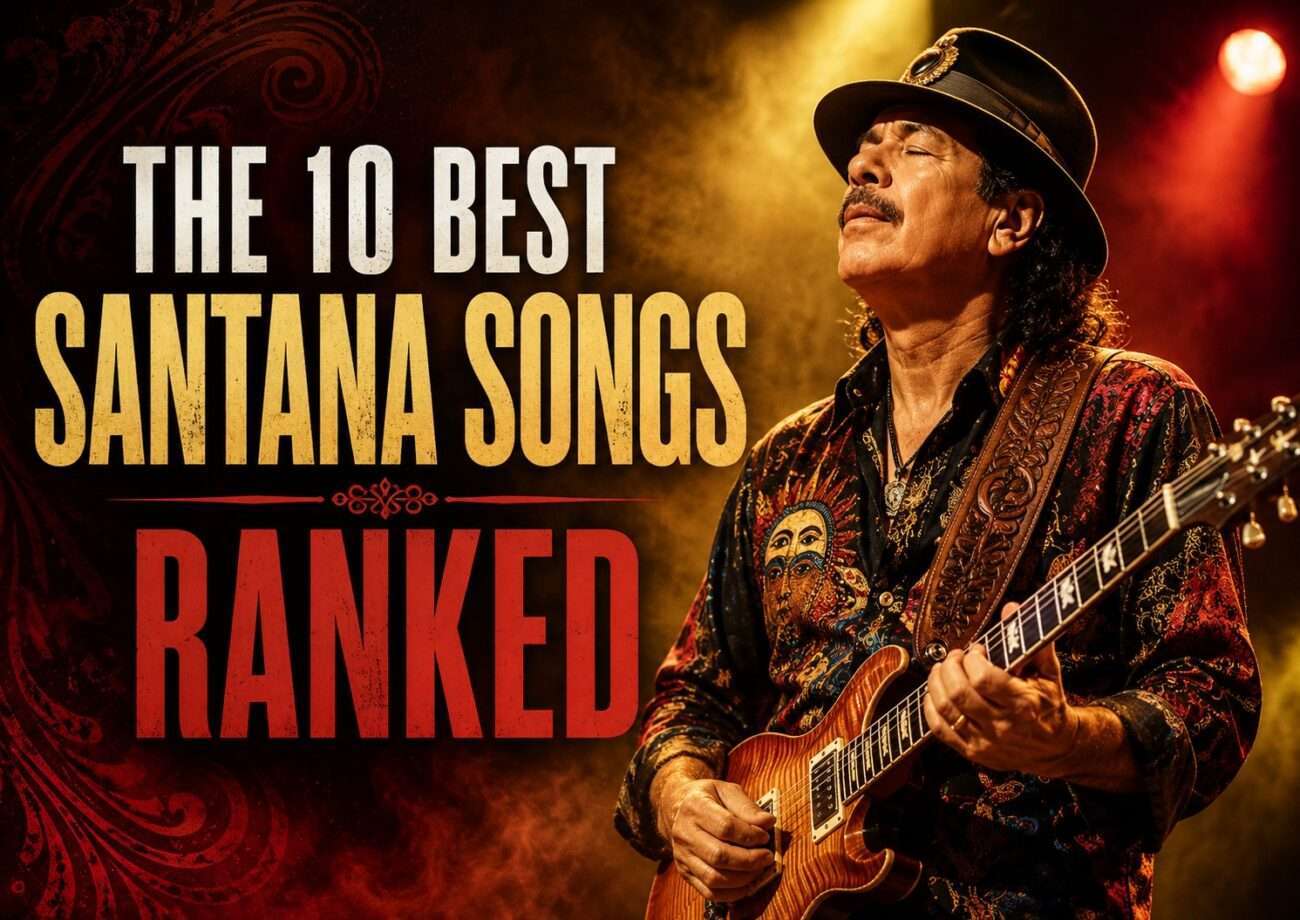
Few guitarists in rock history are as instantly recognizable as Carlos Santana. You can hear just a few sustained notes and know exactly who is playing.
But Santana was never simply about guitar solos. The band’s best music blended rock, blues, jazz, Latin percussion and soul into something almost no other major rock act sounded like. That was already apparent on the early records, and by Abraxas in 1970, Santana had created one of the defining sounds of the era.
Santana’s career has also been unusually long. The group had major songs at the beginning of the 1970s, continued producing memorable records throughout the decade, and then staged one of rock’s most remarkable comebacks with Supernatural nearly 30 years later.
So which Santana songs stand above the rest?
Here are our 10 best Santana songs, ranked.
10. Everybody’s Everything
Santana III, 1971
“Everybody’s Everything” captures Santana when the band was still operating as a genuine ensemble rather than simply a vehicle for Carlos Santana’s guitar.
The horns hit hard, the percussion never stops moving, and the entire track has the loose, explosive feeling that made the early Santana records so exciting.
Carlos gets plenty of room to play, but what makes the song work is how much is happening around him. This was a band built on rhythm.
It may not have the instant recognition of the songs higher on this list, but “Everybody’s Everything” deserves to be remembered as one of Santana’s strongest early tracks. It’s also included among the key recordings on Santana’s own Essential Santana collection.
9. She’s Not There
Moonflower, 1977
Santana had a remarkable ability to take someone else’s song and make it sound like it had always belonged to them.
“She’s Not There,” originally recorded by the Zombies, is a perfect example.
The familiar melody remains, but Santana surrounds it with percussion, keyboards and Carlos Santana’s soaring guitar. Instead of feeling like a straightforward cover, it becomes a Santana record.
The song also helped introduce the band to another wave of listeners during the late 1970s.
More importantly, it showed that Santana didn’t need to abandon its identity to create accessible rock music.
8. Samba Pa Ti
Abraxas, 1970
Some guitarists play fast. Carlos Santana makes the guitar sound like it’s speaking.
“Samba Pa Ti” may be the clearest example.
There are no lyrics and there don’t need to be any. Santana’s guitar carries the entire emotional weight of the song, moving from quiet, reflective passages into something warmer and more celebratory.
It’s one of those instrumental tracks where you stop thinking about technique and simply listen to the melody.
That’s the difference between a great guitarist and a great musician.
“Samba Pa Ti” appeared alongside “Black Magic Woman” and “Oye Como Va” on Abraxas, giving the album an almost absurd concentration of classic Santana recordings.
7. No One to Depend On
Santana III, 1971
If you want to understand why Santana was such a different kind of rock band, listen to the opening of “No One to Depend On.”
The percussion immediately establishes the groove before the guitars, vocals and keyboards start fighting for space.
And somehow it all works.
The song has urgency that many of Santana’s smoother recordings don’t. The rhythm section pushes constantly while Carlos Santana attacks the guitar instead of simply letting notes float.
It’s Santana at its most muscular.
“No One to Depend On” sometimes gets lost behind the massive hits, but it belongs in any serious discussion of the band’s best 1970s work.
More Great 70s Rock
If Santana is your kind of music, you’ll probably enjoy these rankings too:
Continue the Countdown
More Top 10 Classic Rock Song Rankings
Explore more rankings featuring the artists who helped define classic rock radio.
6. Soul Sacrifice
Santana, 1969
Before many people knew who Santana was, there was Woodstock.
“Soul Sacrifice” became one of the performances most closely associated with Santana’s arrival on the national stage.
And more than half a century later, it’s easy to understand why.
This isn’t polished pop-rock. It’s a band going for broke.
The guitar is ferocious, the percussion is relentless and drummer Michael Shrieve’s performance became one of the most memorable moments of Santana’s early history.
What makes “Soul Sacrifice” especially important is that the elements that would define Santana were already there: blues guitar, Latin rhythms, improvisation and an almost spiritual intensity.
The hits would come.
The identity was already complete.
5. Europa (Earth’s Cry Heaven’s Smile)
Amigos, 1976
“Europa” contains one of Carlos Santana’s greatest guitar performances.
There isn’t much more that needs to be said.
The melody is slow, simple and incredibly expressive. Santana allows notes to hang in the air rather than filling every available second with guitar.
That’s what makes the performance so effective.
Plenty of technically gifted guitarists could play the notes. Very few could make them sound like Carlos Santana.
“Europa” became one of Santana’s signature instrumentals and remained prominent enough to appear on the band’s later career-spanning collections.
For anyone who thinks Santana’s music begins and ends with “Black Magic Woman,” this is the song to play next.
4. Evil Ways
Santana, 1969
“Evil Ways” was the song that proved Santana’s unusual musical formula could also produce a hit.
Gregg Rolie’s keyboards and vocals give the song its foundation, while Carlos Santana’s guitar slips in and out of the arrangement instead of dominating every second.
Then there’s the percussion.
That rhythmic layer is what separates Santana from virtually every other major rock band of the period.
“Evil Ways” remains one of the most recognizable songs from Santana’s debut album and helped establish the band before Abraxas pushed them even further.
It still sounds unmistakably Santana.
3. Smooth
Supernatural, 1999
Yes, this is 70s Music Wisdoms.
And yes, we’re putting a 1999 song in the Top 3.
Leaving “Smooth” off an all-career Santana ranking simply because it arrived three decades after the band’s classic period wouldn’t make much sense.
Featuring Rob Thomas on vocals, “Smooth” introduced Santana to an entirely new generation and became an enormous hit. It spent 12 weeks at No. 1 on the Billboard Hot 100 and won Record of the Year at the Grammy Awards.
But chart success alone isn’t why it ranks this high.
Listen underneath the pop production and it’s still Santana. The percussion, the Latin groove and especially Carlos Santana’s guitar make the record immediately identifiable.
Very few artists have produced one of their defining records roughly 30 years after their first major breakthrough.
Santana did.
2. Oye Como Va
Abraxas, 1970
Tito Puente wrote “Oye Como Va.”
Santana turned it into one of the most famous Latin-rock recordings ever made.
The organ establishes the groove. The percussion makes it almost impossible to sit still. Then Carlos Santana enters with that unmistakable guitar tone.
Nothing feels rushed.
Nothing feels unnecessary.
The brilliance of Santana’s version is how naturally rock guitar fits alongside Latin rhythms. Today that combination feels familiar partly because Santana helped make it familiar.
The band’s official discography places “Oye Como Va” right beside “Black Magic Woman/Gypsy Queen” on Abraxas.
Ranking the two is difficult.
But one song still edges it out.
1. Black Magic Woman / Gypsy Queen
Abraxas, 1970
If you could play someone only one recording to explain Santana, this would probably be it.
“Black Magic Woman” wasn’t originally a Santana song. Peter Green wrote it and Fleetwood Mac recorded it first.
But Santana’s version became something entirely different.
The hypnotic rhythm, Gregg Rolie’s organ, the restrained vocal and Carlos Santana’s guitar create an atmosphere that almost no other rock record sounds like.
Then the track moves into “Gypsy Queen,” and the percussion takes over.
That transition is part of what makes the full album version so special. This isn’t merely a great cover. It’s a complete reinterpretation built around the musical identity Santana had developed.
“Black Magic Woman/Gypsy Queen” sits near the beginning of Abraxas, immediately followed by “Oye Como Va.”
That’s one of the greatest back-to-back combinations on any rock album of the era.
For us, “Black Magic Woman” remains the definitive Santana recording.
And that’s why it’s No. 1.
What Did We Leave Out?
Any Santana Top 10 is going to leave out songs that somebody considers essential.
“Maria Maria” was one of the biggest hits of Santana’s second commercial peak and spent 10 weeks at No. 1 on the Billboard Hot 100. It narrowly misses because this list leans toward recordings that best represent the classic Santana sound.
“Jingo” could easily make a list focused exclusively on early Santana.
“Winning” and “Hold On” represent another successful chapter of the band’s career, but neither feels quite as essential as our Top 10.
And we seriously considered “Hope You’re Feeling Better,” “Dance Sister Dance,” “Open Invitation” and “Love, Devotion & Surrender.”
That’s the problem with ranking a band whose recording career stretches across more than five decades.
The Santana Sound Is Still Unlike Anything Else
Plenty of bands from the late 1960s and early 1970s combined blues and rock.
Santana added something different.
The percussion mattered as much as the guitar. Latin rhythms sat beside psychedelic rock. Jazz improvisation could suddenly appear inside songs accessible enough for mainstream radio.
And floating above everything was Carlos Santana’s guitar.
You don’t need to see the album cover.
You rarely even need to hear an entire measure.
A couple of notes are usually enough.
That’s a musical identity.
Want to See Santana Live?
Songs like “Black Magic Woman,” “Oye Como Va” and “Europa” were built to be heard live.
Carlos Santana is still performing, including 2026 dates on the Oneness Tour and additional An Intimate Evening with Santana: Greatest Hits Live performances in Las Vegas.
Check Santana concert dates and tickets at Concert Ticket Source
70s Music Wisdoms may receive compensation from partners featured on this site.