Some songs are remembered because they aged well. Others endure because they captured something precisely as it happened. “Ohio” belongs firmly in the second category.
Released in 1970 by Crosby, Stills, Nash & Young, “Ohio” is one of the most immediate and direct protest songs of the decade. It was not written years later with reflection or historical distance. It was composed, recorded, and released while the event that inspired it was still dominating headlines and public conversation.
The song was written in response to the Kent State shootings, where four students were killed by National Guard troops during a protest at Kent State University. Rather than interpreting the tragedy or offering commentary, “Ohio” documented the shock of the moment as it was being felt across the country.
Because of this, the song functions less like a traditional single and more like a historical record — a piece of music that preserves how it felt to encounter that moment before it had been processed, contextualized, or softened by time.
Historical Context: What Happened at Kent State
In the spring of 1970, the Vietnam War had already been ongoing for more than a decade, and public opposition to it had steadily grown. When President Nixon announced the expansion of the war into Cambodia at the end of April, protests erupted on college campuses nationwide.
At Kent State University in Ohio, demonstrations escalated over several days. Buildings were damaged, and tensions between students and authorities increased. The Ohio National Guard was called in, and armed troops were deployed on campus.
On May 4, during a daytime protest, National Guard members fired into a crowd of students. Four were killed: Allison Krause, Jeffrey Miller, Sandra Scheuer, and William Schroeder. Nine others were wounded, including one student who was permanently paralyzed.
The shootings were immediately shocking because of who the victims were. These were not combatants or rioters in a distant place. They were American students, many simply walking between classes. Some of those shot were not actively participating in the protest at all.
News coverage spread rapidly. Photographs taken moments after the shootings appeared in major publications and on television broadcasts. One image in particular — a young woman kneeling over the body of Jeffrey Miller — became emblematic of the event and of the era as a whole.
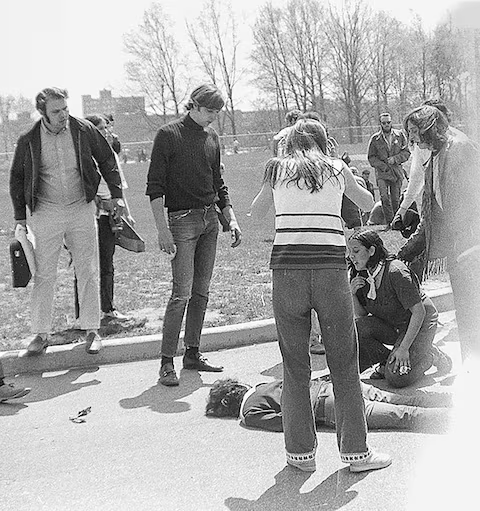
For many Americans, Kent State marked a psychological breaking point. It blurred the line between foreign conflict and domestic life, making the consequences of national decisions feel immediate and personal.
Why Musicians Responded So Quickly
By 1970, popular musicians were already deeply intertwined with cultural and political life. Folk and rock artists were often seen as voices of their generation, whether they sought that role or not.
But “Ohio” was different from many protest songs that preceded it. It was not built on ideology, symbolism, or sweeping statements. It was a reaction — visceral, unfinished, and emotionally raw.
Neil Young encountered the Kent State photographs shortly after they were published. According to multiple accounts, the images disturbed him deeply, particularly the sense of helplessness and sudden loss they conveyed. Within hours, he had written “Ohio.”
The rest of Crosby, Stills, Nash & Young recognized the urgency immediately. Rather than refining or reworking the song, they moved quickly to record it. This urgency was intentional. Waiting, even briefly, would have changed the song’s role from response to reflection.
In an era before digital media, this kind of speed was rare. Recording sessions, pressing plants, and distribution channels moved at a slower pace than modern audiences might expect. Releasing a song within weeks of a major news event required coordination, influence, and a willingness to bypass normal industry caution.
The Speed and Urgency of the Release
“Ohio” was recorded on May 21, 1970 — just 17 days after the shootings. It was released as a single in early June.
That timing was critical. The event was still unresolved in the public mind. Investigations were ongoing. Campuses across the country were experiencing strikes and shutdowns. The emotional temperature had not cooled.
Because of this, “Ohio” did not enter the culture as commentary. It arrived as part of the moment itself. Radio listeners did not hear it as a history lesson; they heard it alongside news updates and public debate.
This immediacy also explains the song’s directness. There was no attempt to universalize the message or distance it from the specifics of Kent State. The song assumed listeners already knew the context — because they did.
Key Lyrics and Their Meaning
“Ohio” is notable for how little explanation it provides. Its power lies in what it does not spell out.
The repeated line “Four dead in Ohio” is the song’s emotional center. It is neither metaphor nor slogan. It is a statement of fact. The repetition reinforces the disbelief many felt — as if saying the words aloud was the only way to make them real.
Listeners in 1970 did not need clarification. The phrase immediately conjured images, names, and unanswered questions. Its bluntness reflected the shock of the event itself.
Another line, “Tin soldiers and Nixon coming,” referenced the presence of armed National Guard troops and the federal authority that authorized their deployment. The phrase “tin soldiers” evoked uniformed force, stripped of individuality, standing in contrast to the students they confronted.
Importantly, the song does not describe the shooting in detail. There is no narrative reconstruction, no attempt to assign motives or conclusions. The lyrics operate as fragments — the way breaking news often feels in real time.
Public Reaction and Radio Response
“Ohio” received significant attention upon release, but not without resistance. Some radio stations refused to play it, citing its subject matter and perceived political content. Others played it heavily, recognizing its relevance and emotional resonance.
Despite the controversy, the song reached the Top 20 on the Billboard Hot 100. This was notable given its lack of traditional pop structure and its somber tone. It was not designed for casual listening or broad appeal.
The mixed radio response actually reinforced the song’s reputation. It became associated not with entertainment, but with conscience — something listeners encountered intentionally rather than passively.
Over time, “Ohio” came to symbolize a particular kind of protest song: one that did not rely on abstraction or timeless slogans, but instead tied itself to a single, unmistakable moment.
From Song to Historical Marker
As the years passed, “Ohio” became more than a single release. It became a reference point — a shorthand for how music once responded to national trauma.
Unlike many songs that are absorbed into nostalgia, “Ohio” retained a certain weight. It was not easily separated from its context. Hearing it often prompted listeners to revisit the event itself, rather than simply enjoy the music.
This quality has helped preserve the song’s relevance. It is frequently cited in discussions of protest music not because it is musically complex, but because it is historically precise.
Why “Ohio” Still Matters
People continue to search for the meaning of “Ohio” because it represents something rare: a song that captured history before it settled.
It shows how music can function as documentation — not of facts alone, but of emotional reality. The song preserves how it felt to encounter the Kent State shootings when they were still unfolding, before interpretations hardened and narratives formed.
“Ohio” also established a template for protest songs rooted in specificity. Rather than addressing broad themes, it focused on a single place, a single event, and a single, devastating outcome.
That clarity is why the song still resonates. It does not ask listeners to agree with a viewpoint or adopt a position. It asks them to remember a moment when certainty disappeared and shock took its place.
More than fifty years later, “Ohio” remains less a statement than a record — a reminder that sometimes the most enduring songs are not those written to last, but those written because they could not wait.
Explore More Protest Songs
Further reading on protest songs, focusing on historical context, lyrical meaning, and cultural impact.