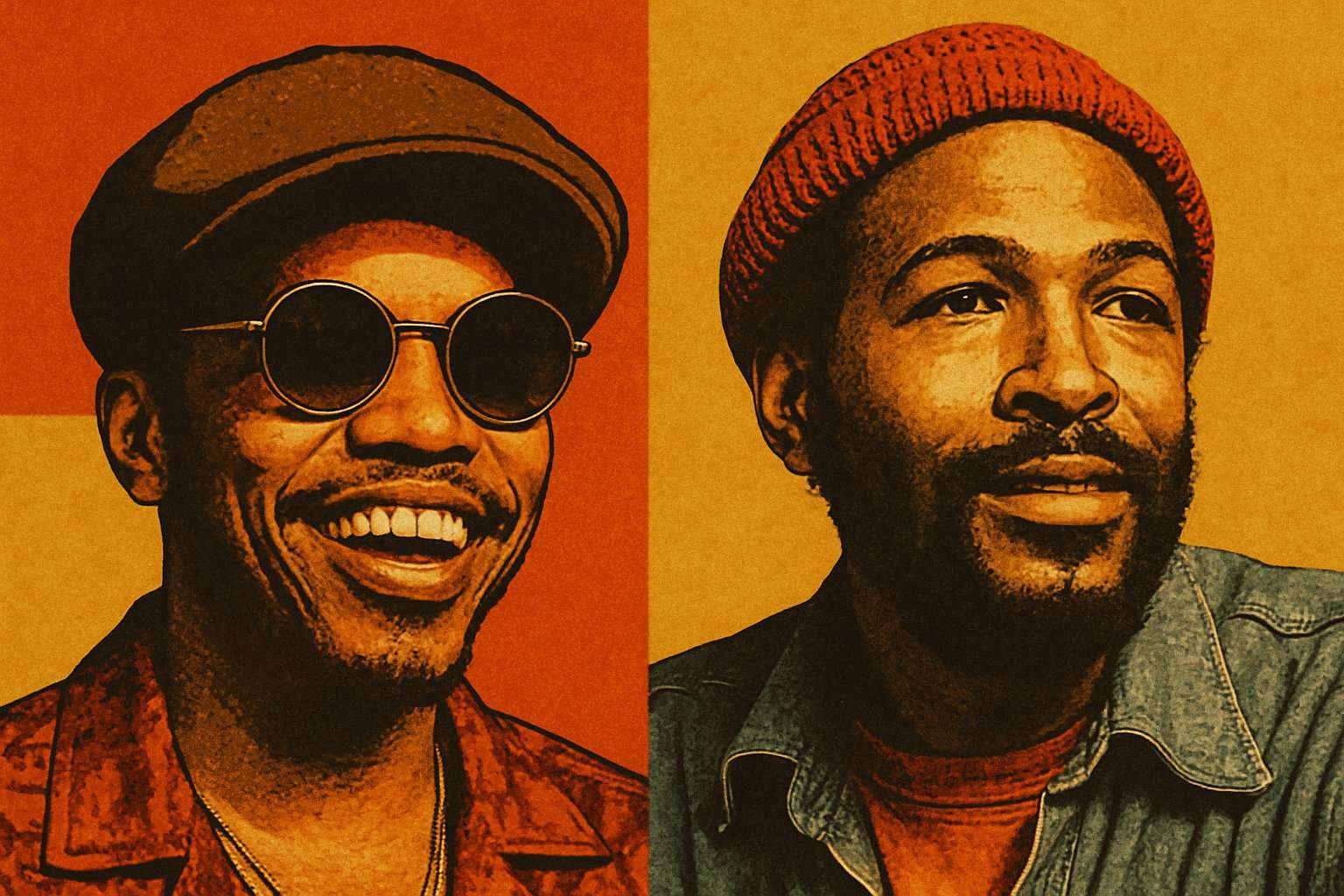
Stevie Wonder stands as one of the most innovative and influential musicians in American history. Born a child prodigy and raised within the creative engine of Motown, he transformed soul, pop, R&B, funk, and electronic music through groundbreaking songwriting and production. This biography explores his early life, rise to fame, legendary 1970s recording run, and the extraordinary cultural impact that continues to define his legacy.
Howard Dee’s Take
When you grow up in the ’70s, Stevie Wonder isn’t just a musician — he’s part of the atmosphere. I still remember the first time “Superstition” blasted out of a radio. That clavinet riff felt like a jolt of electricity. I couldn’t explain why it sounded so fresh, so alive. I just knew that whenever Stevie Wonder came on, the room felt different — brighter, warmer, somehow more hopeful. His music didn’t just get you moving; it made you feel something.
As an adult, I went back to those same songs and realized the genius behind them. The harmonies, the chord voicings, the rhythmic choices, the layers of sound — all built with a sophistication you don’t fully appreciate until you really listen. Stevie didn’t just write hits; he crafted entire soundscapes. And the deeper you go into his catalog, the more you discover. His songs grow with you, speaking to you differently at 15, 30, and 60. That’s why Stevie Wonder isn’t just a star of the ’70s — he’s one of the greatest artists to ever set foot in a studio.
Early Life and Musical Beginnings
Stevland Hardaway Judkins was born on May 13, 1950, in Saginaw, Michigan. Born prematurely, he developed retinopathy of prematurity, a condition that caused permanent blindness shortly after birth. His mother moved the family to Detroit when he was four, and in that city — filled with gospel churches, rhythm-and-blues bars, and Motown’s emerging presence — Stevie’s musical world began to blossom.
By age eight, he was playing harmonica, piano, and drums with confidence well beyond his years. His perfect pitch allowed him to pick out melodies instantly, and his rhythmic sense came naturally. Teachers, neighbors, and family members were astonished by how quickly he absorbed musical ideas.
His big break came at age 11, when Ronnie White of The Miracles arranged an audition for Motown. Berry Gordy watched this small, smiling kid play harmonica, drums, and piano — and immediately signed him to Tamla Records. Motown branded him Little Stevie Wonder, a nickname meant to capture the awe surrounding his talent.
In 1963, at just 13 years old, he recorded “Fingertips (Part 2)”, a live track full of youthful energy and improvisation. It shot to #1 on the Billboard Hot 100, making him the youngest artist ever to top the chart — a record he still holds. What could have been a novelty act eventually transformed into one of the greatest creative evolutions in modern music.
Rise to Fame
During the mid-to-late 1960s, Stevie Wonder matured rapidly as an artist, releasing hits such as:
- “Uptight (Everything’s Alright)”
- “A Place in the Sun”
- “I Was Made to Love Her”
- “For Once in My Life”
He learned studio production techniques, expanded his vocal range, and sharpened his songwriting skills. But as he grew older, Stevie became increasingly frustrated with Motown’s tightly controlled system. Like most Motown acts, he had little creative autonomy. Producers chose the songs, arrangements, studio musicians, and even the track order.
But Stevie had bigger ideas.
In 1971, when his Motown contract expired, he did something revolutionary — he walked away. For months, he studied music theory, explored synthesizer technology, and recorded privately. When he returned to Motown, he demanded — and received — full artistic control, including ownership of his publishing rights and freedom to produce his own albums.
This decision led directly to one of the greatest creative streaks the music world has ever seen.
Peak Years and Signature Sound
From 1972 to 1976, Stevie Wonder released a run of five albums widely regarded as one of the greatest artistic achievements in recording history. These albums combined funk, soul, jazz, electronic innovation, introspection, and social commentary — all performed and arranged by a multi-instrumental genius at his creative peak.
Music of My Mind (1972)
Stevie’s first fully autonomous album, built around synthesizers and introspective themes. He played almost every instrument himself, setting the tone for the next five years.
Talking Book (1972)
The album that made Stevie a global star. Featuring “Superstition” and “You Are the Sunshine of My Life,” it blended funk, pop, and soul with confidence and sophistication.
Innervisions (1973)
A monumental album tackling racism, drug abuse, political corruption, and spiritual resilience. The track “Living for the City” stands as one of the strongest narrative songs of the century. Released three days before his near-fatal car accident, the album became a symbol of artistic defiance.
Fulfillingness’ First Finale (1974)
A more reflective album that leaned into spirituality, personal struggle, and emotional warmth. It won Stevie the Grammy for Album of the Year.
Songs in the Key of Life (1976)
One of the most celebrated albums in music history. This double LP + bonus EP includes:
- “Sir Duke”
- “I Wish”
- “Knocks Me Off My Feet”
- “As”
- “Isn’t She Lovely”
The album debuted at #1 — a rare achievement — and remains one of the most fully realized artistic statements ever recorded.
This five-album run revolutionized R&B, shaped pop music, elevated the synthesizer as a lead instrument, and established Wonder as a once-in-a-century creator.
Challenges, Transitions, and Later Career
On August 6, 1973, Stevie Wonder’s life nearly ended when a logging truck struck his vehicle in North Carolina. He was in a coma for several days and lost his sense of smell and taste temporarily. His recovery took months, but he returned with renewed artistic fire — a testament to his resilience.
During the 1980s, Stevie embraced pop balladry and cinematic songwriting. “Part-Time Lover,” “Ribbon in the Sky,” “Overjoyed,” and “I Just Called to Say I Love You” expanded his global audience. The latter earned him the Academy Award for Best Original Song.
Outside of music, Stevie became a major advocate for social causes. His campaign for a national Martin Luther King Jr. Day was instrumental in achieving the holiday’s establishment in 1983.
Through the 1990s, 2000s, and 2010s, he focused on touring, collaborations, and humanitarian efforts. His influence across R&B, soul, hip-hop, pop, and electronic music remains enormous.
Stevie Wonder’s legacy is defined not only by his musical innovation but by his optimism, generosity, and unwavering belief in the power of art to uplift humanity.
Awards, Honors & Cultural Impact
Stevie Wonder’s achievements span decades and genres:
- 25 Grammy Awards, including three Album of the Year awards
- Grammy Lifetime Achievement Award
- Academy Award (1984)
- Rock & Roll Hall of Fame induction (1989)
- Kennedy Center Honors (1999)
- Presidential Medal of Freedom (2014)
He helped:
- Advance synthesizer integration in R&B and pop
- Bridge social activism with mainstream music
- Influence generations of musicians from Prince to Alicia Keys
- Shape the sound of American popular music across five decades
Stevie Wonder’s cultural imprint is vast, enduring, and immeasurable.
Final Thoughts from Howard Dee
What sets Stevie Wonder apart is his ability to make joy feel profound. His songs sparkle with positivity, but they’re not blind to the world’s imperfections — they’re filled with empathy. Whether he was writing about racism, love, childhood memories, or the thrill of music itself, Stevie brought a sincerity that made millions of people feel seen.
To me, Stevie is the heartbeat of the 1970s — colorful, inventive, hopeful, and soulful. His melodies still soar, his grooves still move, and his lyrics still resonate. Great music lasts because it speaks truth wrapped in beauty — and that’s exactly what Stevie Wonder gave us.
Stevie Wonder Frequently Asked Questions
1. When was Stevie Wonder born?
Stevie Wonder was born on May 13, 1950, in Saginaw, Michigan. His family moved to Detroit when he was four, placing him near the center of Motown’s thriving music scene. Being born premature resulted in blindness, a condition that influenced how he developed his extraordinary musical abilities.
2. How did Stevie Wonder become blind?
Wonder became blind shortly after birth due to retinopathy of prematurity, a condition affecting premature infants whose eyes are exposed to high oxygen levels in early neonatal care. Stevie has often explained that while blindness limited his sight, it heightened his hearing and shaped his musical instincts.
3. How was Stevie Wonder discovered?
At age 11, Stevie Wonder was discovered by Ronnie White of The Miracles, who introduced him to Motown founder Berry Gordy. Gordy recognized his perfect pitch, multi-instrumental skill, and stage charisma, signing him to Tamla Records in 1961. Within two years, he became a national sensation.
4. What was Stevie Wonder’s first #1 hit?
His first #1 hit was “Fingertips (Part 2)”, recorded live in 1962 at the Regal Theater in Chicago. Released when he was only 13 years old, the track hit #1 on both the Billboard Hot 100 and R&B charts — making him the youngest artist ever to top the Hot 100.
5. What are Stevie Wonder’s most influential albums?
His most influential albums come from his 1970s “classic period,” especially Talking Book (1972), Innervisions (1973), Fulfillingness’ First Finale (1974), and Songs in the Key of Life (1976). These albums revolutionized modern music by incorporating synthesizers, complex harmonies, social storytelling, and genre fusion.
6. What happened during Stevie Wonder’s 1973 car accident?
On August 6, 1973, Stevie Wonder was severely injured when a logging truck struck the car he was riding in near Salisbury, North Carolina. A flying log hit him in the head, leaving him in a coma for several days. He eventually recovered and resumed recording later that year, finishing work on Fulfillingness’ First Finale.
7. How many Grammy Awards has Stevie Wonder won?
Stevie Wonder has won 25 Grammy Awards, making him one of the most awarded artists in history. Notably, he is one of only three artists ever to win Album of the Year three times — all within a four-year span during his peak creative period.
8. Is Stevie Wonder still performing today?
Yes. Stevie Wonder continues to appear at major concerts, special events, and televised performances. While he releases new music less frequently, he remains an active cultural figure and continues to perform beloved classics for audiences around the world.
Explore More Stevie Wonder
Artist Resources
Continue Your ’70s Journey
Discover more legendary artists who shaped the greatest decade in music.
Explore their stories, top songs, fun facts, and deep dives into the tracks that defined a generation.
👉 Explore the Complete 1970s Rock Artists Guide