By Howard Dee
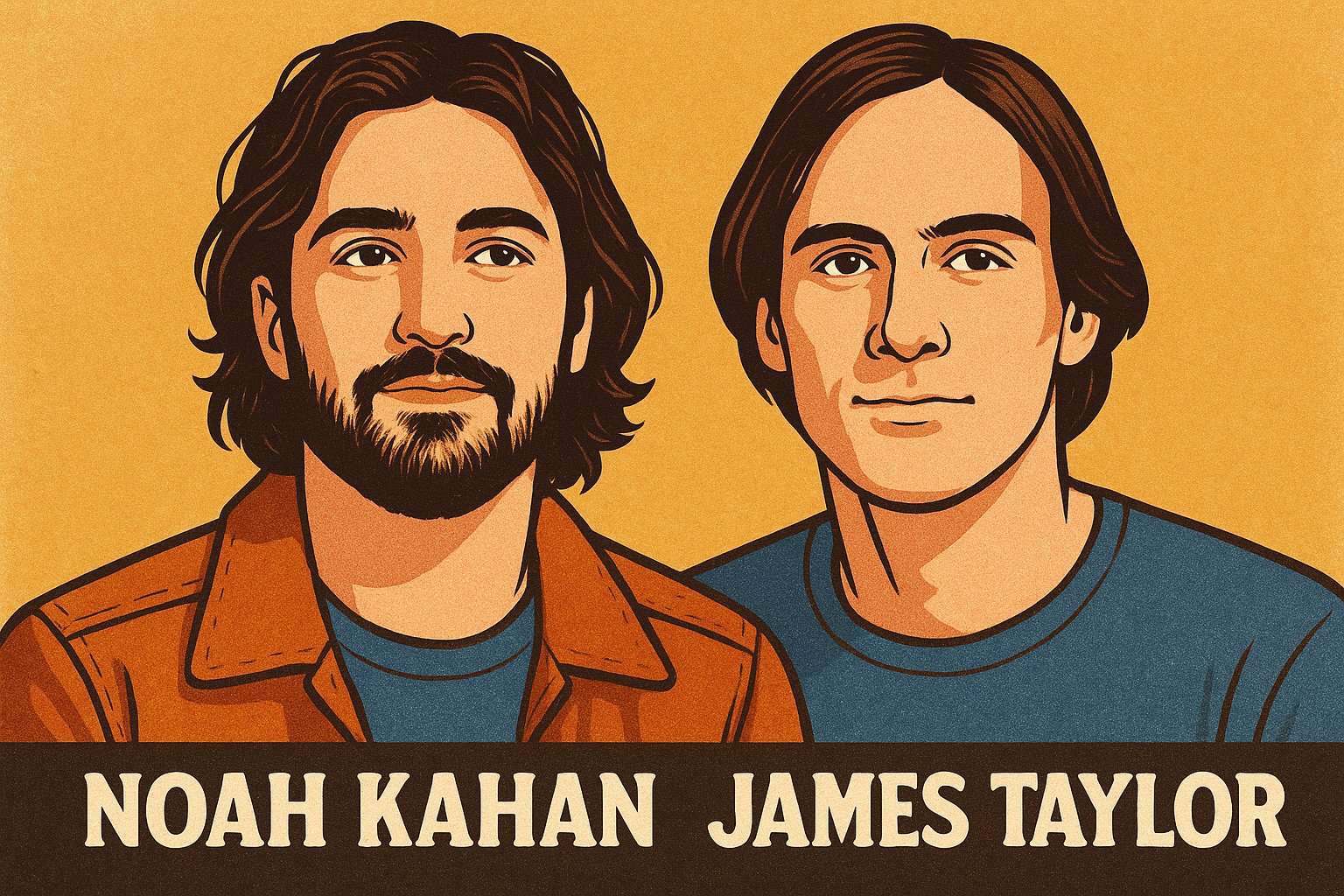
Every generation produces one artist who turns quiet confessions into anthems. Someone who doesn’t rely on shock value, image, or spectacle — just a guitar, a voice, and the courage to speak truthfully about what it means to be human. In the 1970s, that voice was James Taylor. Today, it belongs to Noah Kahan.
They are not identical. They didn’t grow up in the same world. But the emotional DNA is unmistakable: two New England storytellers who make music that feels less like performance and more like a conversation you’ve needed for years.
This is not a gimmick comparison. This is lineage — clean, direct, and undeniable.
Let’s dig into why.
The New England Thread
James Taylor didn’t just come from New England — he carried it into every song he wrote. His music felt like autumn leaves, quiet roads, old barns, and memories you only revisit once the weather turns cold. Even when he sang about universal themes, the place was always there.
Noah Kahan does the same thing, but with a modern vocabulary.
Stick Season. Vermont. Rural loneliness. New Hampshire ache. Cold mornings. Small-town gravity. Front-porch nostalgia. Family wounds that never thaw out.
New England shapes both of their writing — not metaphorically, but literally. You can hear geography in their chords, see the landscape in their lyrics, and feel the environment in their emotional pacing.
There’s a reason both artists resonate:
People don’t just hear their songs — they step into the world they built.
Confessional Songwriting — Not Diary Entry Songwriting
James Taylor popularized a kind of songwriting that wasn’t loud, theatrical, or romanticized. It was gentle. Personal. Honest. You didn’t feel like he was performing at you — you felt like he was talking to you.
Noah Kahan writes with the same intimacy.
Not:
- “Look at my pain.”
But: - “If you’ve felt this too, you’re not alone.”
It’s the difference between confession and catharsis.
James Taylor’s “Fire and Rain” isn’t about drama — it’s about quiet devastation.
Noah’s “Orange Juice” isn’t about spectacle — it’s about redemption and regret.
Both men write with a restraint that somehow makes the emotion hit harder.
Sadness Without Hopelessness
A lot of modern writers mistake emotional honesty for bleakness. James Taylor never did. His songs hurt, but they always left the window cracked open for a little light to come in.
Noah Kahan is built from that exact emotional blueprint.
He writes about:
- family fractures
- mental health
- longing
- mistakes
- rural isolation
- self-doubt
But there’s always warmth in the delivery. Always compassion. Always a flicker of hope, even if the narrator can’t quite reach it yet.
That mixture — sadness blended with comfort — defined James Taylor in the 70s. It defines Noah Kahan now.
Folk Music With Pop Instincts
James Taylor was never a strict “folk” artist.
He took the storytelling of folk, the warmth of pop, the structure of singer-songwriters, and created a sound that had mass appeal without sacrificing personal truth.
Noah Kahan is doing the same thing in the 2020s.
He’s not an indie act.
He’s not a pure folk artist.
He’s not trying to live in the shadow of Bon Iver.
He’s building folk-pop built on:
- clean melodies
- memorable hooks
- clear emotional pacing
- honest delivery
It’s the James Taylor lane — modernized, amplified, but unmistakably familiar.
Mental Health as a Core Theme, Not a PR Strategy
James Taylor spoke openly about his struggles in an era when doing so was practically forbidden. Depression. Addiction. Anxiety. Emotional fragility. He wrote about all of it with clarity and humility.
Noah Kahan is the first mainstream modern artist to take that same “tell the truth even when it’s messy” approach and make it deeply relatable.
The difference?
James Taylor wrote about mental health in a world that didn’t have the language for it.
Noah writes about mental health in a world that has the language but not the patience.
Both artists end up doing the same thing:
Showing people they don’t have to be okay to be worthy.
Voices That Feel Human, Not Engineered
James Taylor did not have a conventionally powerful voice — he had a comforting one. Warm. Gentle. Honest. When he sang, you felt like he was letting you into his living room.
Noah Kahan has that same “imperfect perfection” — the slight cracks, the conversational phrasing, the vulnerability in every line. His voice isn’t dramatic. It’s relatable.
Modern production likes to smooth everything out.
Noah’s voice intentionally keeps the rough edges — the part that makes you feel the story.
James Taylor made honesty sound beautiful.
Noah Kahan makes honesty feel necessary.
Writing About Home — Even When You’re Running From It
James Taylor wrote endlessly about leaving home, returning home, missing home, and searching for a home inside himself. He was always halfway between belonging and escaping.
Noah Kahan writes about that same emotional tug-of-war — the love-hate relationship with the towns that raised you, the people who shaped you, and the memories you can’t outrun.
Both artists understand something simple but universal:
Home isn’t a location. It’s an ache.
No one writes that ache better than James Taylor did in the 70s.
No one writes it better today than Noah Kahan.
The Emotional Archetype: The Sensitive Young Man
James Taylor represented an entire generation of emotionally open young men who didn’t fit the rock-star mold of swagger and bravado.
Noah Kahan represents that archetype today in the age of authenticity, anxiety, and self-analysis. He is the voice for sensitive men who have been told their emotions make them weak — and the fans who grew up around them.
They create space for softness in a world that undervalues it.
That’s not just artistry.
That’s courage.
They Turn Quiet Pain Into Collective Healing
James Taylor’s brilliance wasn’t in his melodies — though they were impeccable — but in the way he turned personal wounds into universal experiences.
Noah Kahan does the exact same thing.
He sings about specific experiences — real towns, real stories, real details — yet somehow they hit millions of listeners who’ve never been to New England or lived in a town with one blinking stoplight.
It’s not the scenery.
It’s the humanity.
That’s the James Taylor magic, alive again in Noah.
Final Thoughts from Howard Dee
I grew up with James Taylor playing like a lighthouse in the background of life — a voice that made the world feel calmer, even when things were far from perfect. Today, when I listen to Noah Kahan, I hear that same anchor. Not imitation. Not nostalgia. Just a shared belief that honesty matters, that stories heal, and that quiet songwriting can still punch you right in the chest.
James Taylor gave the 1970s a voice for the sensitive, searching soul.
Noah Kahan gives the 2020s that same reflection — just with modern language, modern wounds, and modern courage.
Two different decades.
One emotional lineage.
Same mission.
To tell the truth — softly, but with impact.