
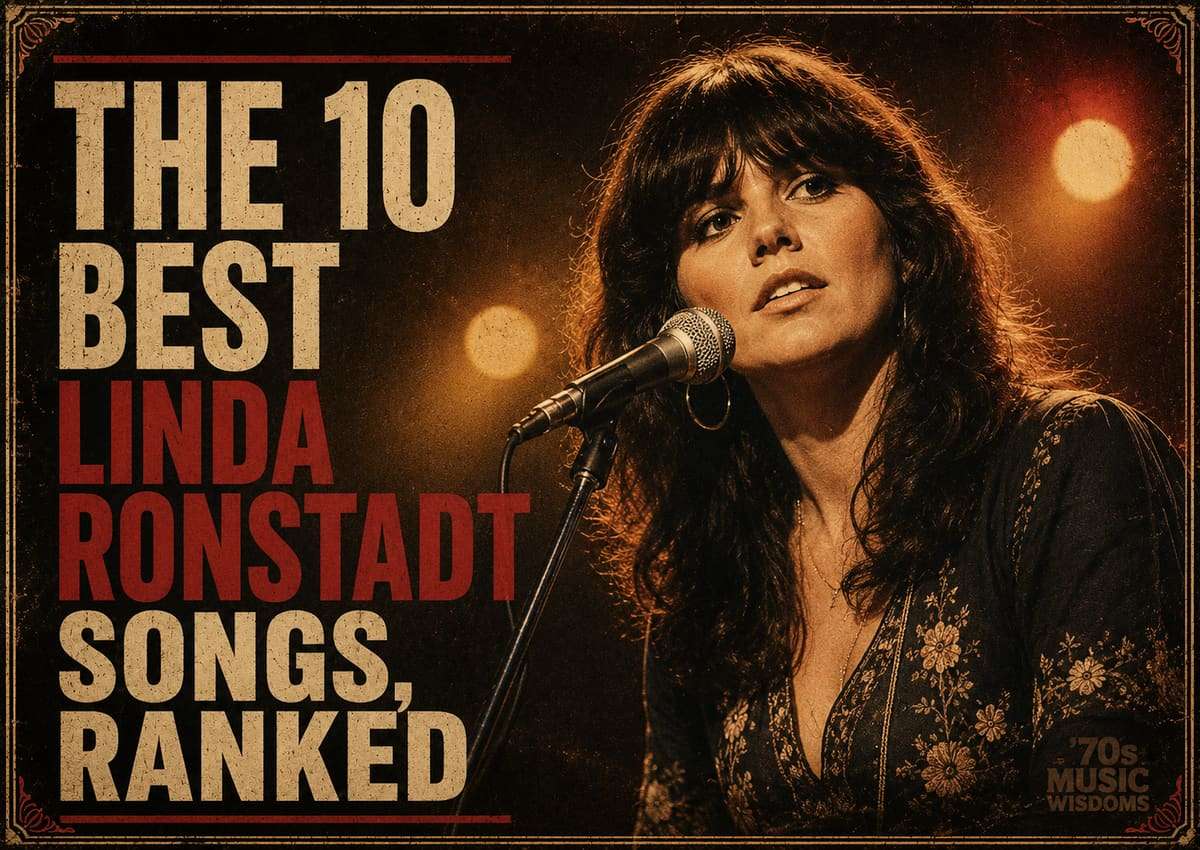
Linda Ronstadt never needed to write a song to make it sound completely her own.
That may be the single most important thing to understand about her career. Ronstadt was one of popular music’s great interpreters, a singer with the unusual ability to move from country to rock, pop, soul, traditional standards and Mexican music without sounding like she was simply trying on different styles.
Her commercial breakthrough came with Heart Like a Wheel in 1974, but Ronstadt had already been building toward that moment for years. She first reached a national audience with the Stone Poneys and “Different Drum,” then began a solo career that helped shape the California country-rock sound of the early 1970s. Members of her touring band would eventually help form the Eagles, while producer Peter Asher became one of the central partners in her extraordinary run of albums.
From the middle of the 1970s through the end of the decade, Ronstadt was nearly unavoidable. Heart Like a Wheel, Prisoner in Disguise, Hasten Down the Wind, Simple Dreams and Living in the USA gave her hit after hit, while her voice made songs associated with the Everly Brothers, Roy Orbison, Smokey Robinson, Buddy Holly and others feel newly alive.
The difficulty in ranking Linda Ronstadt is that the catalog is deeper than the hit singles. She could make a rock song sound tougher, a country song more vulnerable and a soul standard feel completely natural. The best recordings are not simply demonstrations of vocal power. They are examples of judgment: choosing the right song, the right arrangement and the right emotional temperature.
Here are the 10 best Linda Ronstadt songs, ranked.

10. Long Long Time
Album: Silk Purse | Released: 1970 | Songwriter: Gary White
“Long Long Time” arrived before Linda Ronstadt became a superstar, but almost everything that would make her great is already present.
The arrangement leaves plenty of space around her voice, which matters because this is not a song that benefits from overproduction. Ronstadt begins with restraint, almost as if she is trying to keep the emotion under control, then gradually allows the hurt to become more visible.
The song is about loving someone who does not return that love, a subject that could easily become sentimental. Ronstadt avoids that by singing with dignity rather than self-pity.
“Long Long Time” became her first major solo hit and earned her an early Grammy nomination. More importantly, it proved that the voice was already there years before Heart Like a Wheel turned her into one of the defining singers of the decade.
9. Heat Wave
Album: Prisoner in Disguise | Released: 1975 | Songwriters: Brian Holland, Lamont Dozier, Eddie Holland
Covering a Motown classic is dangerous because the original already has so much personality.
Ronstadt did not try to imitate Martha Reeves. Instead, she turned “Heat Wave” into a fast, bright rock-and-roll performance built around her own vocal attack.
The rhythm is tighter and more aggressive than much of her country-rock material, and Ronstadt sounds completely comfortable pushing the song forward. She is not singing delicately here. She is having fun with the sheer force of the record.
The result became a Top 5 pop hit in the United States and showed how broad her musical instincts had become. By this point, the idea that Linda Ronstadt belonged to one genre was already becoming impossible to defend.
8. It’s So Easy
Album: Simple Dreams | Released: 1977 | Songwriters: Buddy Holly, Norman Petty
Buddy Holly’s original recording was compact and charming. Linda Ronstadt made “It’s So Easy” sound bigger without losing the simplicity that made the song work.
The guitars have more weight, the drums hit harder and Ronstadt sings with a confidence that turns the record into straightforward rock radio.
What makes the performance effective is how little she overthinks it. There is no need for a dramatic reinterpretation. The melody is strong, the hook is immediate and the arrangement gives her exactly enough room to lift the chorus.
“It’s So Easy” reached the Top 5 on the Billboard Hot 100 and became one of the major hits from Simple Dreams, the album that confirmed Ronstadt was not simply having a brief commercial moment.
She was becoming one of the biggest stars in American music.
Continue the Countdown
More Top 10 Country Rock & Singer-Songwriter Rankings
Explore more rankings from the country-rock, soft-rock and singer-songwriter side of the 1970s.
Continue the Countdown
More Top 10 Country Rock & Singer-Songwriter Favorites
Explore more rankings from the country-rock, soft-rock and singer-songwriter side of the era.
7. Ooh Baby Baby
Album: Living in the USA | Released: 1978 | Songwriters: Smokey Robinson, Warren “Pete” Moore
“Ooh Baby Baby” is a completely different kind of Linda Ronstadt performance.
There is less force and more control. Instead of attacking the song, she allows it to float, holding back just enough to make the regret inside the lyric more powerful.
That restraint is important because Smokey Robinson’s composition is already emotionally rich. Ronstadt does not need to add drama. She needs to make the melody breathe.
Her version reached the Top 10 on the Billboard Hot 100 and became the biggest single from Living in the USA. It also showed how naturally she could move into soul material without turning the performance into an imitation of Motown.
The voice remained unmistakably hers.
6. Poor Poor Pitiful Me
Album: Simple Dreams | Released: 1977 | Songwriter: Warren Zevon
Warren Zevon’s writing was often dark, sarcastic and slightly dangerous. Linda Ronstadt understood that the humor in “Poor Poor Pitiful Me” worked best if she did not soften it.
Her version is faster and more polished than Zevon’s, but the attitude remains intact.
Ronstadt sounds amused, frustrated and defiant at the same time. The guitars give the song enough bite to keep it from drifting toward soft rock, while the vocal proves she could handle material with a little nastiness in it.
The single was not one of her very biggest chart records, but it became an important part of the Simple Dreams era.
It also did something Ronstadt frequently did for songwriters: it introduced a wider audience to a great song and sent listeners back toward the person who wrote it.
5. The Tracks of My Tears
Album: Prisoner in Disguise | Released: 1975 | Songwriters: Smokey Robinson, Warren “Pete” Moore, Marv Tarplin
“The Tracks of My Tears” is one of Smokey Robinson’s masterpieces, which means any cover version begins at a disadvantage.
Ronstadt’s solution was not to compete with the Miracles. She changed the emotional scale.
Her recording feels more spacious and country-influenced, allowing the sadness to sit closer to the surface. The famous image in the lyric — someone smiling in public while privately falling apart — is perfectly suited to a singer who could communicate strength and vulnerability at the same time.
Ronstadt’s version became a Top 40 pop hit and also crossed into country and adult contemporary audiences.
That crossover is important. Linda Ronstadt’s career was built on the idea that a great song did not have to stay inside the category where it began.
4. Different Drum
Album: Evergreen, Volume 2 — The Stone Poneys | Released: 1967 | Songwriter: Michael Nesmith
“Different Drum” technically predates Linda Ronstadt’s solo career, but leaving it off a list of her best songs would make no sense.
This is the record that introduced her voice to a national audience.
Michael Nesmith wrote the song, but Ronstadt’s performance gives it its identity. The narrator is ending a relationship because she refuses to pretend she wants the conventional future the other person wants.
That independence feels especially striking coming from a young female singer in 1967.
The arrangement, with strings and harpsichord, is much more elaborate than the folk-rock setting the Stone Poneys initially imagined, yet Ronstadt cuts through everything.
“Different Drum” reached the Top 20 and became her first real hit. It sounds like the beginning of a career because it is.
3. When Will I Be Loved
Album: Heart Like a Wheel | Released: 1974 | Songwriter: Phil Everly
“When Will I Be Loved” may be the most perfect example of Linda Ronstadt turning an older song into something that belonged completely to the 1970s.
The Everly Brothers had already made it a hit, but Ronstadt gives the record more muscle.
The guitars, drums and harmonies create a country-rock drive, while her vocal turns the question in the title into something bigger than simple heartbreak. She sounds tired of being disappointed, but not defeated by it.
The record reached No. 2 on the Billboard Hot 100 and also topped the country chart.
That combination explains much of Ronstadt’s appeal during this period. Rock listeners heard a strong pop record. Country listeners heard a singer who understood the material. Everyone heard that voice.
2. Blue Bayou
Album: Simple Dreams | Released: 1977 | Songwriters: Roy Orbison, Joe Melson
“Blue Bayou” may be the most beautiful record Linda Ronstadt ever made.
Roy Orbison had already recorded the song, but Ronstadt’s version feels almost suspended in air.
The tempo is unhurried, the arrangement stays out of the way and the entire record depends on her ability to move from quiet longing to a final vocal release without making the transition feel forced.
The lyric is about wanting to return to a place where life feels simpler and more complete. Ronstadt makes that longing physical. You can hear distance in the performance.
“Blue Bayou” became one of her signature songs and a major Top 5 hit.
For many listeners, this is the Linda Ronstadt recording: elegant, emotional and technically extraordinary without ever sounding like a technical exercise.
It could easily be No. 1.
One record changed the scale of her career even more.
1. You’re No Good
Album: Heart Like a Wheel | Released: 1974 | Songwriter: Clint Ballard Jr.
“You’re No Good” is where everything came together.
Linda Ronstadt had the song, Peter Asher had the production, the musicians had the arrangement and the entire record sounds like an artist suddenly arriving at the center of popular music.
The opening is controlled and almost cool. Then the performance keeps building.
Ronstadt does not sing the lyric as someone devastated by a bad relationship. She sings it as someone who has already figured the situation out and is ready to move on. That change in attitude gives the song its power.
The arrangement is equally important. Andrew Gold’s instrumental contributions, the layered production and the dramatic ending turn what could have been a straightforward cover into a genuine rock record.
“You’re No Good” reached No. 1 on the Billboard Hot 100, becoming Ronstadt’s only chart-topping solo single on that chart.
More importantly, it helped transform Heart Like a Wheel into the breakthrough album that made her one of the biggest stars of the 1970s.
“When Will I Be Loved” may be more joyful. “Blue Bayou” may be more beautiful. “Long Long Time” may reveal more vulnerability.
But no Linda Ronstadt recording combines attitude, vocal authority, production and historical importance more completely.
“You’re No Good” is No. 1.
What Did We Leave Out?
The hardest omission is “Heart Like a Wheel.” Linda Ronstadt cared deeply about Anna McGarrigle’s song, and the title track is one of the emotional centers of the album that changed her career. Listeners who value interpretation over hit status could easily argue that it belongs in the Top 10.
“Desperado” is another major contender. Ronstadt recorded the Eagles song before it had fully become a classic, and her version helped demonstrate how closely connected she was to the musicians and songwriters who built the Southern California country-rock sound.
“Hurt So Bad” deserves consideration as well. Released in 1980 on Mad Love, it gave Ronstadt another major pop hit and showed that she could adapt to a harder, more contemporary sound as the decade changed.
Other serious contenders include “That’ll Be the Day,” “Love Is a Rose,” “Crazy,” “I Can’t Help It (If I’m Still in Love with You),” “Back in the U.S.A.,” “Tumbling Dice” and “Love Has No Pride.”
Then there are the later-career recordings.
“Don’t Know Much” with Aaron Neville became a huge hit in 1989. Her albums with Nelson Riddle proved she could sing traditional pop standards. Canciones de Mi Padre connected her to Mexican musical traditions that had been part of her family life long before she became a rock star.
That is the difficulty with ranking Linda Ronstadt.
The 1970s made her famous, but the rest of the career proved the fame was only one part of the story.
Why Linda Ronstadt’s Best Songs Still Work
Linda Ronstadt’s greatest strength was judgment.
She knew a great song when she heard one.
She also understood that interpreting a song was not the same as copying the person who recorded it first. Her versions of “When Will I Be Loved,” “Blue Bayou,” “Heat Wave,” “It’s So Easy” and “The Tracks of My Tears” respect the original compositions while creating new identities for them.
The voice made that possible.
Ronstadt could sing with enormous power, but the best performances are often defined by restraint. “Long Long Time” works because she does not oversing it. “Ooh Baby Baby” works because she lets the melody breathe. “Blue Bayou” works because the final vocal lift has been earned by everything that comes before it.
She also helped erase some of the walls between genres.
Country, rock, pop and soul were not separate territories in her catalog. They were simply different kinds of songs worth singing.
That musical openness is one reason her work has aged so well.
Linda Ronstadt did not need to sound like anyone else.
She only needed the right song.


