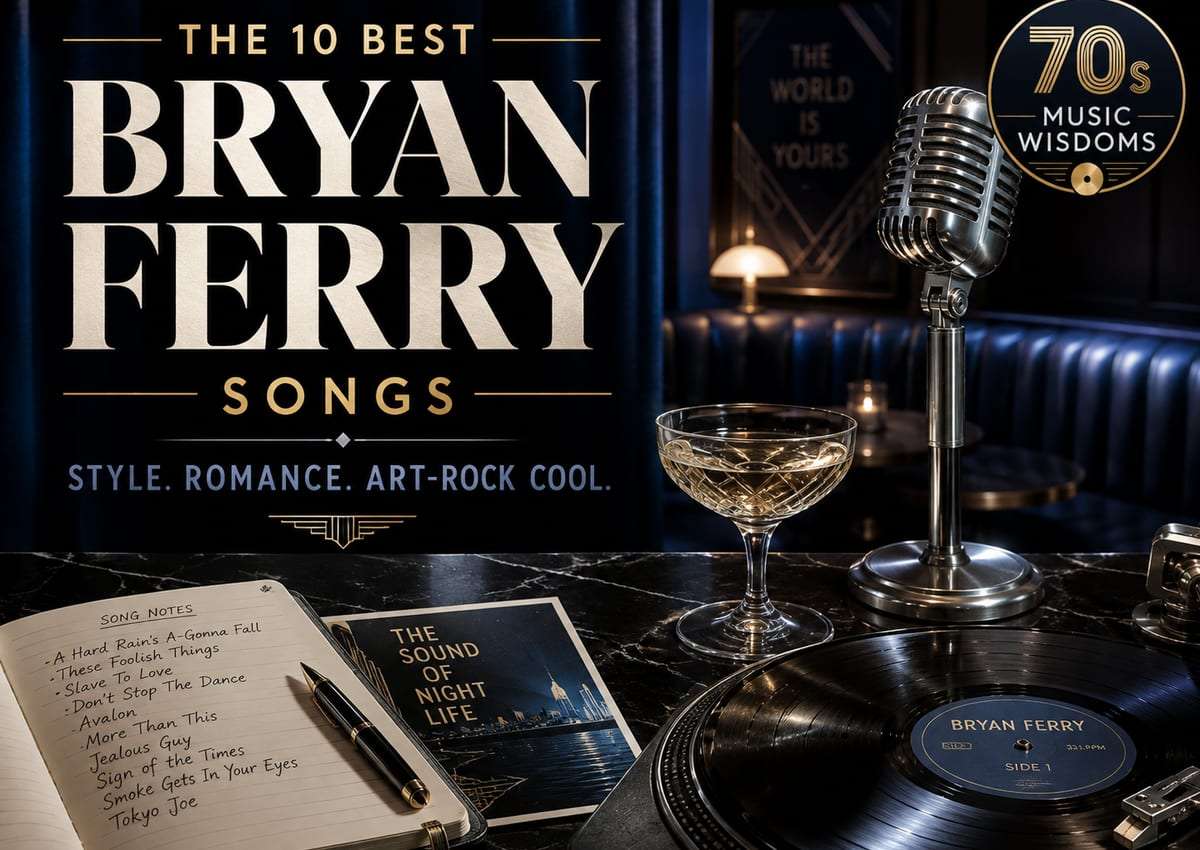
Bryan Ferry belongs on a 70s music site for a simple reason: before the solo records, the voice was already part of the soundtrack. As the lead singer and visual center of Roxy Music, Bryan Ferry helped define the stylish, art-rock side of the 1970s. That connection matters because the solo career did not arrive from nowhere. Listeners brought years of familiarity with them, and the best post-band recordings often work because they carry recognizable instincts into a different decade.
Ferry began making solo records while Roxy Music was still active, so the two careers often run beside each other rather than in a clean sequence. His own albums gave him space for standards, Dylan covers, old R&B, lounge music, sophisticated pop, and increasingly sleek original songwriting. By the mid-1980s, the solo sound had become the natural continuation of the atmosphere Roxy created on Avalon.
This ranking focuses on Bryan Ferry as a solo artist. Band recordings are left out so the list can show what changed once the name on the record was his alone. The production, collaborators, and radio landscape may have shifted, but the personality that made the earlier work memorable is still there. These are the 10 best Bryan Ferry songs, ranked.
#10 A Hard Rain’s a-Gonna Fall
Album: These Foolish Things
Release year: 1973
Songwriters: Bob Dylan
Ferry’s version of Bob Dylan’s “A Hard Rain’s a-Gonna Fall” announced immediately that his solo career would not be predictable. Instead of treating the song as solemn folk, he turns it into extravagant art-pop, full of theatrical gestures and bright arrangement choices.
The reinvention is the point. Ferry was not interested in respectful museum-piece covers; he wanted to drag familiar songs into his own world.
It earns the opening spot because a Top 10 should do more than stack the obvious hits. This is the kind of recording that helps explain the shape of the catalog: where the artist was going, what he was willing to leave behind, and why the solo years deserve to be heard as more than an appendix to the band.
#9 Smoke Gets in Your Eyes
Album: Another Time, Another Place
Release year: 1974
Songwriters: Jerome Kern, Otto Harbach
“Smoke Gets in Your Eyes” lets Ferry indulge his fascination with pre-rock standards and romantic melodrama. His croon sits somewhere between sincerity and stylization, which makes the old song feel strangely compatible with the art-rock era.
The track is a reminder that Ferry’s elegance was never purely modern. Much of his persona came from older ideas of glamour, tailoring, and nightclub romance.
Placed here, the song also shows how quickly a solo identity can become recognizable. The production belongs to its era, but the phrasing and melodic instincts connect it to the singer listeners already knew. That tension between familiarity and change is one of the pleasures of revisiting these records now.
#8 Sign of the Times
Album: The Bride Stripped Bare
Release year: 1978
Songwriters: Bryan Ferry
“Sign of the Times” is a brisk original from The Bride Stripped Bare, an album made during a turbulent period in Ferry’s personal life. The song has more bite than the smoother records that would follow, with guitars and rhythm pushing harder against his controlled vocal.
It captures a transitional Ferry: still connected to 1970s rock, but already moving toward the refined solo pop that would dominate the next decade.
This is also the sort of track that benefits from distance. Without the pressure of being the biggest single, it can be heard as part of a larger body of work, and the details in the arrangement become easier to appreciate. It is a strong reminder that the solo catalog has more depth than a greatest-hits playlist suggests.
#7 This Is Tomorrow
Album: In Your Mind
Release year: 1977
Songwriters: Bryan Ferry
“This Is Tomorrow” is one of Ferry’s strongest 1970s solo originals. The title suggests futurism, but the record is really a mix of rock drive, sophisticated arrangement, and the detached romantic cool that had become his signature.
The single demonstrated that his solo career did not need to rely on covers. Ferry could write material every bit as distinctive as the songs he interpreted.
At this point in the ranking, the separation between band history and solo identity becomes especially clear. The song does not need to reference the past directly. The connection comes through the voice, the melodic choices, and the confidence of a performer who already knew how to command a record.
#6 I Put a Spell on You
Album: Taxi
Release year: 1993
Songwriters: Screamin’ Jay Hawkins
Ferry’s version of “I Put a Spell on You” is restrained compared with Screamin’ Jay Hawkins’ original, but that restraint becomes its own form of menace. The groove is sleek, the vocal low-key, and the atmosphere more seductive than explosive.
By the 1990s Ferry had mastered the art of turning almost any song into something recognizably his. This cover is one of the clearest examples.
What pushes it into the upper half is durability. Plenty of records from the same period were built around fashionable sounds that aged badly; this one still has a musical center strong enough to survive the production choices around it. The song remains satisfying even after the era-specific gloss becomes part of the nostalgia.
#5 Kiss and Tell
Album: Bête Noire
Release year: 1987
Songwriters: Bryan Ferry
“Kiss and Tell” brings a harder rhythmic edge to Ferry’s late-1980s sophistication. The production is dense and glossy, but the vocal remains cool and controlled, letting the beat carry much of the tension.
The song was one of his stronger U.S. solo hits and proved that the Avalon-era aesthetic could be pushed into a more contemporary pop-rock setting.
The No. 5 position is where the catalog’s strongest themes start to concentrate. This track combines a memorable hook with a performance that reveals something about the singer beyond simple technique. It is the point where the solo career stops feeling merely successful and starts feeling essential to the artist’s larger story.
#4 Don’t Stop the Dance
Album: Boys and Girls
Release year: 1985
Songwriters: Bryan Ferry
“Don’t Stop the Dance” may be the purest expression of Ferry’s nocturnal 1980s sound. The saxophone, percussion, keyboards, and backing vocals create a slow-moving atmosphere where the groove matters as much as the melody.
It is music for after midnight: polished, romantic, slightly distant, and completely confident in the power of mood.
A song this high has to do more than trigger recognition. It needs to represent a distinct piece of the solo identity, and this one does. The writing, arrangement, and vocal all point in the same direction, giving the record a sense of purpose that has held up long after its original radio moment.
#3 The ‘In’ Crowd
Album: Another Time, Another Place
Release year: 1974
Songwriters: Billy Page
Ferry transforms Dobie Gray’s “The ‘In’ Crowd” into a swaggering piece of glam sophistication. The song’s obsession with style and social belonging fits his persona so naturally that it feels almost like an original.
The cover also captures the humor in Ferry’s early solo records. He could be elegant and knowingly excessive at the same time.
By No. 3, the argument is less about whether the song belongs and more about how high it should go. This is one of the recordings that can stand beside the best-known band material without needing the comparison to justify it. It has its own atmosphere, its own emotional logic, and its own reason to last.
#2 Let’s Stick Together
Album: Let’s Stick Together
Release year: 1976
Songwriters: Wilbert Harrison
“Let’s Stick Together” is Ferry’s most instantly recognizable 1970s solo hit. The old Wilbert Harrison song becomes a stomping, sax-driven record with a chorus that is impossible to separate from Ferry’s clipped delivery.
The track balances roots and style perfectly. It is an R&B song filtered through a British art-rock sensibility, and the result sounds timeless rather than retro.
The runner-up spot goes to a song that could easily be No. 1 on a different day. It captures nearly everything that made the solo career worthwhile: a distinctive voice, a strong melodic idea, and enough personality to separate the record from the artist’s earlier band identity. Only one song edges it out.
#1 Slave to Love
Album: Boys and Girls
Release year: 1985
Songwriters: Bryan Ferry
“Slave to Love” is Ferry’s definitive solo recording. The song moves slowly, almost luxuriously, with guitar, keyboards, and rhythm creating a backdrop that lets every vocal phrase feel deliberate.
It became a Top 10 hit in Britain and one of the signature songs of sophisticated 1980s pop. More importantly, it distills Ferry’s entire aesthetic—romance, danger, elegance, distance, and desire—into a single record.
That is why it finishes at No. 1. The best solo song is not necessarily the loudest, the most technically impressive, or even the biggest chart hit. It is the recording that most completely explains why the artist needed a solo career in the first place. This one does exactly that.
What Did We Leave Out?
Strong omissions include “Price of Love,” “You Go to My Head,” “Don’t Want to Know,” “Limbo,” “Your Painted Smile,” “Windswept,” and later songs such as “You Can Dance.” Ferry’s catalog is unusually rich in covers that could completely alter the ranking.
Roxy Music songs are left out on purpose. “Love Is the Drug,” “More Than This,” and “Avalon” belong to the band even though the musical border between Roxy and Ferry’s solo work can sometimes feel very thin.
Why Bryan Ferry’s Best Solo Songs Still Work
Ferry’s solo music lasts because style is never merely decoration. The arrangements create emotional distance, and that distance is part of the subject. He sings about desire as something beautiful, destabilizing, and often just out of reach.
For a 70s audience, his solo career is not a later add-on. It began during Roxy Music’s original run and became one of the era’s most fascinating parallel careers, eventually carrying the same sensibility into the 1980s and beyond.
Ferry’s solo catalog also demonstrates how productive the border between interpretation and authorship can be. He has never treated cover songs as filler. An old standard, a Dylan composition, or an R&B favorite becomes raw material for arrangement, persona, and mood, often revealing as much about Ferry as one of his originals. That approach helped him build a body of work in which decades of songwriting history can coexist inside the same elegant sound world. It is one reason the records remain rewarding after the fashion details have aged: Ferry’s music is always in conversation with older records, older styles of romance, and older ideas of performance. The modern surface sits on top of a deep record collection.
More Classic Rock Favorites
If Bryan Ferry is part of your soundtrack, keep going with these rankings from artists and bands who shared the same classic-rock world.