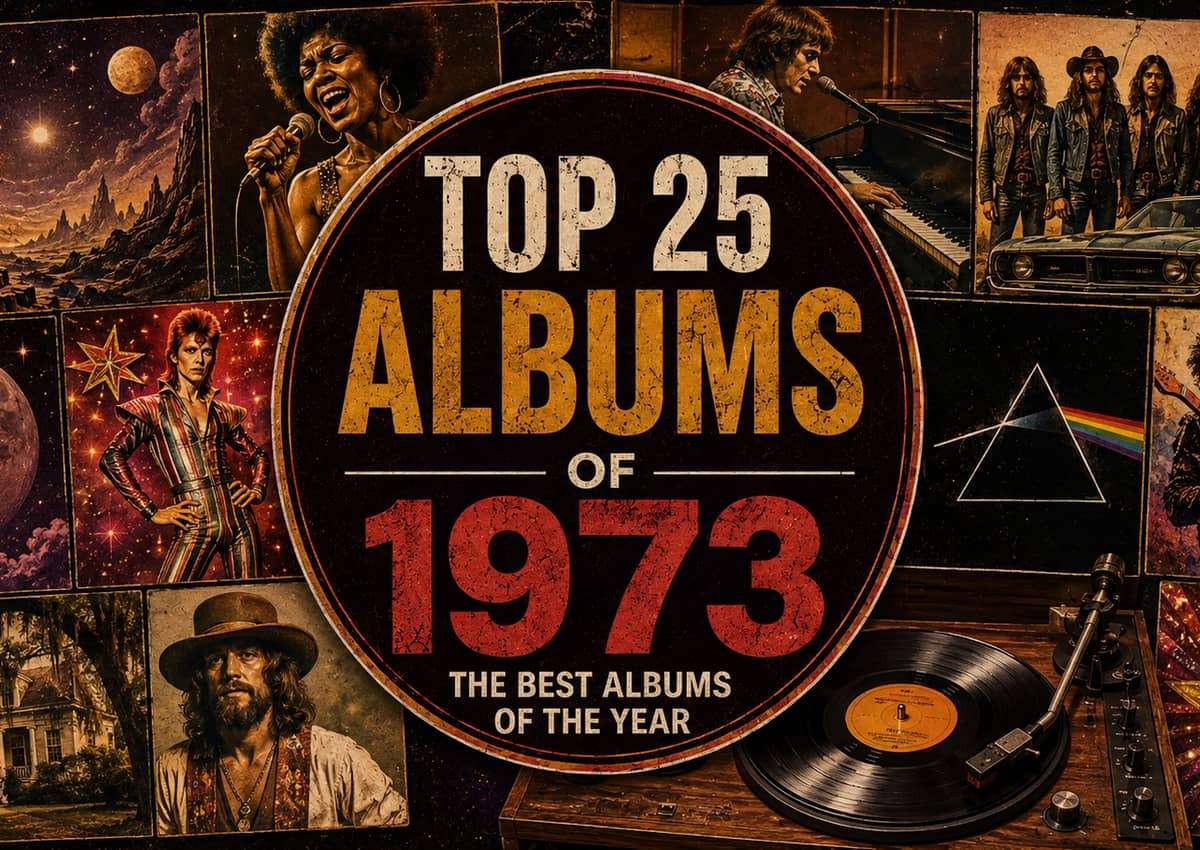
The best albums of 1973 show just how quickly popular music was changing in the 1970s. Rock was stretching in several directions at once, soul and funk were becoming more sophisticated, singer-songwriters were turning private reflection into mainstream music, and studio technology was giving artists new ways to build entire worlds on record.
This ranking is not based on sales alone. We considered musical quality, influence, cultural impact, longevity, and how clearly each album helps explain what 1973 sounded and felt like. Some of these records were immediate blockbusters. Others became more important with time. Together, they form a snapshot of a year when the album was still one of music’s most important artistic statements.
Howard Dee’s Take
One of the joys of going back through a single year is realizing how many different kinds of records were competing for our attention at the same time. You could hear a huge rock album, a thoughtful singer-songwriter record, a soul masterpiece, and something completely experimental without ever leaving the same record store. That variety is what makes these year-by-year lists so much fun.
I also don’t think a great album has to be flawless. What matters is whether it has a point of view, whether the songs still pull you back, and whether it tells us something about the artist and the moment. Those are the records that rise on this list.
#25. The Wild, the Innocent & the E Street Shuffle — Bruce Springsteen
The Wild, the Innocent & the E Street Shuffle earns its place because it is a sprawling, romantic portrait of street life before Springsteen’s breakthrough. More importantly, it works as an album rather than merely a container for singles. The sequencing, performances, and overall mood give it an identity that still comes through decades later.
Key Songs: “Rosalita (Come Out Tonight)”; “4th of July, Asbury Park (Sandy)”; “Incident on 57th Street”
Explore more of his catalog in our Bruce Springsteen Top Songs.
Why it matters: In 1973, that mattered because listeners were increasingly expecting albums to make a complete statement. This record helped define its corner of the musical landscape while giving later artists a model they could borrow from, react against, or try to surpass.
#24. Catch a Fire — The Wailers
Catch a Fire deserves attention because it is the album that introduced Bob Marley and Jamaican reggae to a much wider international audience. Even when individual tracks became better known than others, the full record provided the context that made those songs feel bigger and more complete.
Key Songs: “Stir It Up”; “Concrete Jungle”; “Kinky Reggae”
Why it matters: For a year packed with major releases, that cohesion is important. The album helped shape the sound of 1973 while building a legacy that lasted after fashions, formats, and radio playlists changed.
#23. Sabbath Bloody Sabbath — Black Sabbath
There is a reason Sabbath Bloody Sabbath keeps returning to conversations about 1973: it is heavy metal growing more ambitious without losing its crushing core. The record has enough personality to be recognized within a few tracks, and enough depth that longtime listeners can still find details that were easy to miss the first time around.
Key Songs: “Sabbath Bloody Sabbath”; “A National Acrobat”; “Killing Yourself to Live”
Why it matters: That combination of identity and staying power is what moves it into this Top 25. It represents more than nostalgia; it shows an artist using the album format to say something larger than a single radio hit could manage.
#22. New York Dolls — New York Dolls
New York Dolls stands out as glam, garage rock, and streetwise swagger pointing directly toward punk. What keeps the record alive is the sense that the artist knew exactly what kind of world the album should create, whether that meant tightening the songwriting, expanding the arrangements, or simply trusting a distinctive sound.
Key Songs: “Personality Crisis”; “Trash”; “Jet Boy”
Why it matters: Its importance goes beyond whatever it sold at the time. Heard now, the album captures one of the musical directions that made 1973 so varied, and its best ideas continued to echo in the music that followed.
#21. Raw Power — Iggy and the Stooges
Raw Power earns its place because it is a volatile proto-punk landmark whose impact exploded after its initial release. More importantly, it works as an album rather than merely a container for singles. The sequencing, performances, and overall mood give it an identity that still comes through decades later.
Key Songs: “Search and Destroy”; “Gimme Danger”; “Raw Power”
Why it matters: In 1973, that mattered because listeners were increasingly expecting albums to make a complete statement. This record helped define its corner of the musical landscape while giving later artists a model they could borrow from, react against, or try to surpass.
#20. Tres Hombres — ZZ Top
Tres Hombres deserves attention because it is Texas blues-rock stripped down to riffs, groove, and attitude. Even when individual tracks became better known than others, the full record provided the context that made those songs feel bigger and more complete.
Key Songs: “La Grange”; “Waitin’ for the Bus”; “Jesus Just Left Chicago”
Why it matters: For a year packed with major releases, that cohesion is important. The album helped shape the sound of 1973 while building a legacy that lasted after fashions, formats, and radio playlists changed.
#19. Desperado — Eagles
There is a reason Desperado keeps returning to conversations about 1973: it is a concept-leaning Western album that deepened the Eagles’ identity. The record has enough personality to be recognized within a few tracks, and enough depth that longtime listeners can still find details that were easy to miss the first time around.
Key Songs: “Desperado”; “Tequila Sunrise”; “Doolin-Dalton”
Why it matters: That combination of identity and staying power is what moves it into this Top 25. It represents more than nostalgia; it shows an artist using the album format to say something larger than a single radio hit could manage.
#18. Abandoned Luncheonette — Daryl Hall & John Oates
Abandoned Luncheonette stands out as an early showcase of the duo’s soul-pop chemistry and songwriting instincts. What keeps the record alive is the sense that the artist knew exactly what kind of world the album should create, whether that meant tightening the songwriting, expanding the arrangements, or simply trusting a distinctive sound.
Key Songs: “She’s Gone”; “Abandoned Luncheonette”; “Las Vegas Turnaround”
Why it matters: Its importance goes beyond whatever it sold at the time. Heard now, the album captures one of the musical directions that made 1973 so varied, and its best ideas continued to echo in the music that followed.
#17. Over-Nite Sensation — Frank Zappa and the Mothers
Over-Nite Sensation earns its place because it is virtuosic, irreverent rock with unusually accessible grooves. More importantly, it works as an album rather than merely a container for singles. The sequencing, performances, and overall mood give it an identity that still comes through decades later.
Key Songs: “I’m the Slime”; “Camarillo Brillo”; “Montana”
Why it matters: In 1973, that mattered because listeners were increasingly expecting albums to make a complete statement. This record helped define its corner of the musical landscape while giving later artists a model they could borrow from, react against, or try to surpass.
#16. Fresh — Sly and the Family Stone
Fresh deserves attention because it is lean, eccentric funk that influenced generations of rhythm-driven music. Even when individual tracks became better known than others, the full record provided the context that made those songs feel bigger and more complete.
Key Songs: “If You Want Me to Stay”; “Que Sera, Sera (Whatever Will Be, Will Be)”; “In Time”
Why it matters: For a year packed with major releases, that cohesion is important. The album helped shape the sound of 1973 while building a legacy that lasted after fashions, formats, and radio playlists changed.
#15. Berlin — Lou Reed
There is a reason Berlin keeps returning to conversations about 1973: it is a bleak, cinematic song cycle whose reputation grew dramatically over time. The record has enough personality to be recognized within a few tracks, and enough depth that longtime listeners can still find details that were easy to miss the first time around.
Key Songs: “Caroline Says II”; “Sad Song”; “Berlin”
Why it matters: That combination of identity and staying power is what moves it into this Top 25. It represents more than nostalgia; it shows an artist using the album format to say something larger than a single radio hit could manage.
#14. Selling England by the Pound — Genesis
Selling England by the Pound stands out as British progressive rock marrying technical ambition with memorable melodies. What keeps the record alive is the sense that the artist knew exactly what kind of world the album should create, whether that meant tightening the songwriting, expanding the arrangements, or simply trusting a distinctive sound.
Key Songs: “Firth of Fifth”; “I Know What I Like (In Your Wardrobe)”; “Dancing with the Moonlit Knight”
Why it matters: Its importance goes beyond whatever it sold at the time. Heard now, the album captures one of the musical directions that made 1973 so varied, and its best ideas continued to echo in the music that followed.
#13. Head Hunters — Herbie Hancock
Head Hunters earns its place because it is jazz-funk innovation with grooves strong enough to reach well beyond jazz audiences. More importantly, it works as an album rather than merely a container for singles. The sequencing, performances, and overall mood give it an identity that still comes through decades later.
Key Songs: “Chameleon”; “Watermelon Man”; “Sly”
Why it matters: In 1973, that mattered because listeners were increasingly expecting albums to make a complete statement. This record helped define its corner of the musical landscape while giving later artists a model they could borrow from, react against, or try to surpass.
#12. For Everyman — Jackson Browne
For Everyman deserves attention because it is introspective California songwriting becoming more assured and expansive. Even when individual tracks became better known than others, the full record provided the context that made those songs feel bigger and more complete.
Key Songs: “These Days”; “For Everyman”; “Take It Easy”
Why it matters: For a year packed with major releases, that cohesion is important. The album helped shape the sound of 1973 while building a legacy that lasted after fashions, formats, and radio playlists changed.
#11. The Captain and Me — The Doobie Brothers
There is a reason The Captain and Me keeps returning to conversations about 1973: it is a polished blend of rock, boogie, and harmony that produced enduring radio staples. The record has enough personality to be recognized within a few tracks, and enough depth that longtime listeners can still find details that were easy to miss the first time around.
Key Songs: “Long Train Runnin’”; “China Grove”; “South City Midnight Lady”
Why it matters: That combination of identity and staying power is what moves it into this Top 25. It represents more than nostalgia; it shows an artist using the album format to say something larger than a single radio hit could manage.
#10. Piano Man — Billy Joel
Piano Man stands out as the album that introduced Billy Joel’s character-driven songwriting to a national audience. What keeps the record alive is the sense that the artist knew exactly what kind of world the album should create, whether that meant tightening the songwriting, expanding the arrangements, or simply trusting a distinctive sound.
Key Songs: “Piano Man”; “Captain Jack”; “The Ballad of Billy the Kid”
Continue with our Billy Joel Top Songs for more of his catalog.
Why it matters: Its importance goes beyond whatever it sold at the time. Heard now, the album captures one of the musical directions that made 1973 so varied, and its best ideas continued to echo in the music that followed.
#9. Countdown to Ecstasy — Steely Dan
Countdown to Ecstasy earns its place because it is jazzier, stranger, and more musically adventurous than the band’s debut. More importantly, it works as an album rather than merely a container for singles. The sequencing, performances, and overall mood give it an identity that still comes through decades later.
Key Songs: “My Old School”; “Bodhisattva”; “Show Biz Kids”
Why it matters: In 1973, that mattered because listeners were increasingly expecting albums to make a complete statement. This record helped define its corner of the musical landscape while giving later artists a model they could borrow from, react against, or try to surpass.
#8. Pronounced ‘Lĕh-‘nérd ‘Skin-‘nérd — Lynyrd Skynyrd
Pronounced ‘Lĕh-‘nérd ‘Skin-‘nérd deserves attention because it is a debut that announced Southern rock’s most enduring band. Even when individual tracks became better known than others, the full record provided the context that made those songs feel bigger and more complete.
Key Songs: “Free Bird”; “Simple Man”; “Tuesday’s Gone”
Why it matters: For a year packed with major releases, that cohesion is important. The album helped shape the sound of 1973 while building a legacy that lasted after fashions, formats, and radio playlists changed.
#7. Let’s Get It On — Marvin Gaye
There is a reason Let’s Get It On keeps returning to conversations about 1973: it is sensual soul delivered with sophistication, restraint, and extraordinary vocal control. The record has enough personality to be recognized within a few tracks, and enough depth that longtime listeners can still find details that were easy to miss the first time around.
Key Songs: “Let’s Get It On”; “Come Get to This”; “Distant Lover”
Why it matters: That combination of identity and staying power is what moves it into this Top 25. It represents more than nostalgia; it shows an artist using the album format to say something larger than a single radio hit could manage.
#6. Quadrophenia — The Who
Quadrophenia stands out as a dense rock opera about identity, youth culture, and alienation. What keeps the record alive is the sense that the artist knew exactly what kind of world the album should create, whether that meant tightening the songwriting, expanding the arrangements, or simply trusting a distinctive sound.
Key Songs: “Love, Reign o’er Me”; “5:15”; “The Real Me”
Why it matters: Its importance goes beyond whatever it sold at the time. Heard now, the album captures one of the musical directions that made 1973 so varied, and its best ideas continued to echo in the music that followed.
#5. Band on the Run — Paul McCartney & Wings
Band on the Run earns its place because it is a polished, melodic triumph that re-established McCartney as a dominant album artist. More importantly, it works as an album rather than merely a container for singles. The sequencing, performances, and overall mood give it an identity that still comes through decades later.
Key Songs: “Band on the Run”; “Jet”; “Let Me Roll It”
Why it matters: In 1973, that mattered because listeners were increasingly expecting albums to make a complete statement. This record helped define its corner of the musical landscape while giving later artists a model they could borrow from, react against, or try to surpass.
#4. Houses of the Holy — Led Zeppelin
Houses of the Holy deserves attention because it is Led Zeppelin broadening its palette without sacrificing power. Even when individual tracks became better known than others, the full record provided the context that made those songs feel bigger and more complete.
Key Songs: “The Song Remains the Same”; “The Rain Song”; “Over the Hills and Far Away”
Why it matters: For a year packed with major releases, that cohesion is important. The album helped shape the sound of 1973 while building a legacy that lasted after fashions, formats, and radio playlists changed.
#3. Innervisions — Stevie Wonder
There is a reason Innervisions keeps returning to conversations about 1973: it is social observation, melodic invention, and technological experimentation in perfect balance. The record has enough personality to be recognized within a few tracks, and enough depth that longtime listeners can still find details that were easy to miss the first time around.
Key Songs: “Higher Ground”; “Living for the City”; “Don’t You Worry ’bout a Thing”
Why it matters: That combination of identity and staying power is what moves it into this Top 25. It represents more than nostalgia; it shows an artist using the album format to say something larger than a single radio hit could manage.
#2. Goodbye Yellow Brick Road — Elton John
Goodbye Yellow Brick Road stands out as a double-album showcase of Elton John and Bernie Taupin at their most varied and confident. What keeps the record alive is the sense that the artist knew exactly what kind of world the album should create, whether that meant tightening the songwriting, expanding the arrangements, or simply trusting a distinctive sound.
Key Songs: “Goodbye Yellow Brick Road”; “Bennie and the Jets”; “Saturday Night’s Alright for Fighting”
Why it matters: Its importance goes beyond whatever it sold at the time. Heard now, the album captures one of the musical directions that made 1973 so varied, and its best ideas continued to echo in the music that followed.
#1. The Dark Side of the Moon — Pink Floyd
The Dark Side of the Moon earns its place because it is a seamless concept album that turned studio craft, philosophy, and rock into a mass-audience phenomenon. More importantly, it works as an album rather than merely a container for singles. The sequencing, performances, and overall mood give it an identity that still comes through decades later.
Key Songs: “Money”; “Time”; “Us and Them”
Continue with our Pink Floyd Top Songs.
Why it matters: In 1973, that mattered because listeners were increasingly expecting albums to make a complete statement. This record helped define its corner of the musical landscape while giving later artists a model they could borrow from, react against, or try to surpass.
What Did We Leave Out?
Any list of only 25 albums is going to leave out records that somebody considers essential, especially in a decade this deep. If your favorite 1973 album did not make the cut, that is part of the fun. The argument is almost as interesting as the ranking itself.
Why the Best Albums of 1973 Still Matter
These 25 records do more than give us a list of favorites. They show how much musical ground could be covered in a single year. Heard together, they document the ambitions, anxieties, pleasures, and changing tastes of the period. That is why building the story of the 1970s album by album matters: the decade becomes clearer when we stop looking only at the biggest hits and start looking at the records people lived with.