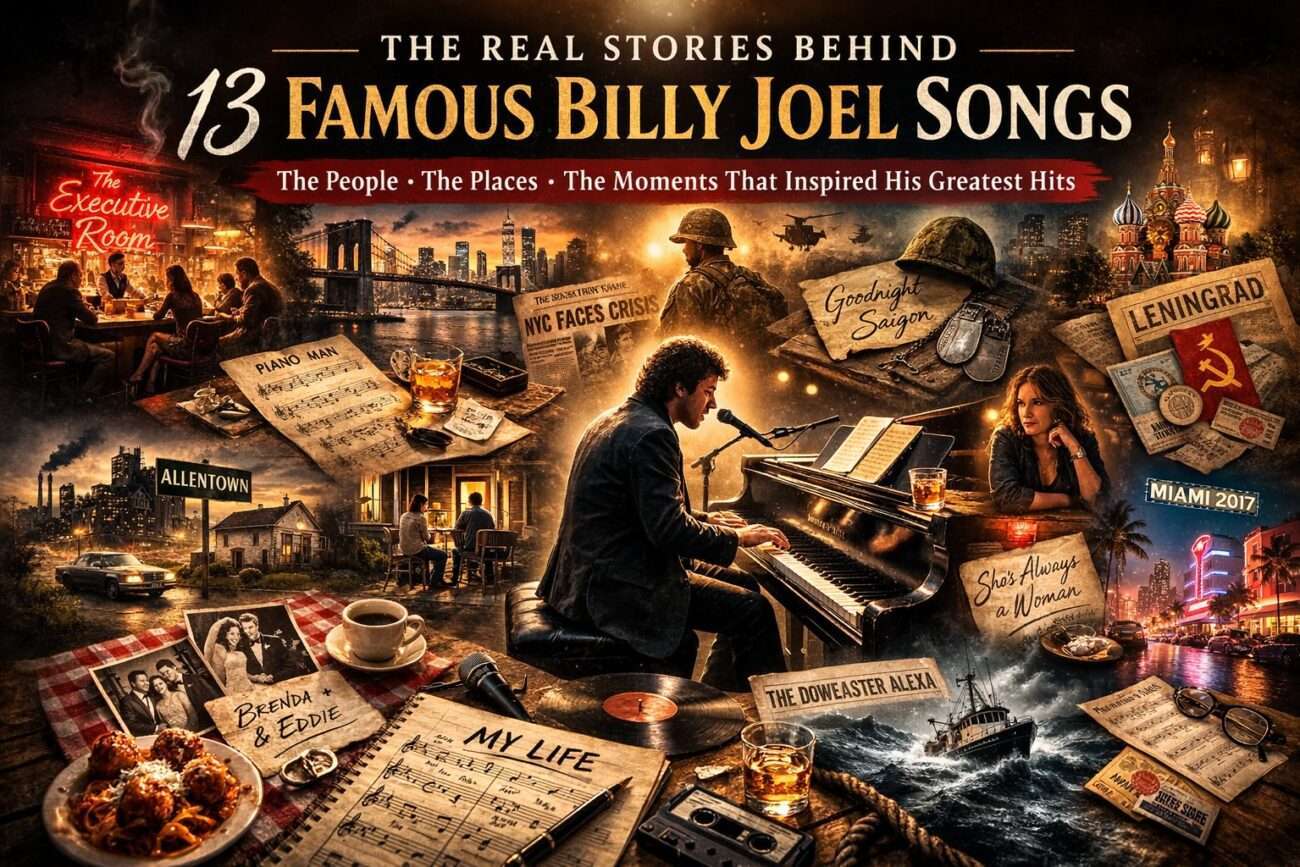
Few artists from the 1970s blended storytelling and songwriting as naturally as Billy Joel. While many rock stars built careers around image or sound, Joel built his catalog around characters, places, and moments that felt unmistakably real. His songs often sound like short stories set to music because they frequently grew out of actual experiences, conversations, and observations from his own life.
The deeper you explore Billy Joel’s catalog, the more you discover that many of his most famous songs were inspired by real people and real events. Some emerged from the struggles of his early career, when he was playing bars and trying to escape bad recording contracts. Others came from watching friends, neighbors, and strangers navigate ordinary life. Even when Joel blends multiple inspirations together, the emotional truth behind the songs almost always traces back to something he experienced directly.
Understanding the stories behind these songs often makes them even more meaningful. When you know about the Los Angeles bar that inspired “Piano Man,” the industrial decline behind “Allentown,” or the Cold War history that led to “Leningrad,” the songs begin to feel less like pop records and more like windows into real lives and real history.
If you’re exploring Billy Joel’s music in depth, you can also start with the Billy Joel Artist Hub, read the full Billy Joel Biography, or explore curated lists like The 15 Best Billy Joel Songs and The 15 Best Billy Joel Deep Cuts.
Howard Dee’s Take
When I first discovered Billy Joel as a teenager, I didn’t think much about where the songs came from. I was drawn to the piano, the melodies, and the sheer energy of records like The Stranger and 52nd Street. At that age, songs like “Scenes from an Italian Restaurant” felt cinematic, and “My Life” felt like a declaration of independence. I didn’t stop to wonder whether Brenda and Eddie were real people or whether the bartender in “Piano Man” actually existed.
Years later, once I started reading interviews and biographies, the stories behind those songs began to emerge. That’s when Billy Joel’s catalog started to feel different. These weren’t just clever lyrics or entertaining characters. Many of them were based on people Joel had actually met and moments he had actually lived through. Once you understand that, the songs take on an entirely new dimension. They stop feeling like fiction and start feeling like lived experience set to music.
1. Piano Man
Album: Piano Man (1973)
Few songs in Billy Joel’s catalog are as autobiographical as “Piano Man.” The song grew out of one of the strangest periods in Joel’s early career. In 1972 he was trapped in a difficult contract with Family Productions and was trying to buy time while his legal situation was sorted out.
To get away from the music industry for a while, Joel moved to Los Angeles and began playing piano in a bar called The Executive Room. He used the name Bill Martin so that people wouldn’t recognize him as a recording artist who had already released an album.
Joel played there for about six months. Every night he performed lounge standards and watched the regular crowd. Those nights became the inspiration for “Piano Man.” Many of the characters in the song were based on real people. The bartender John was a real bartender at the bar, and the waitress mentioned in the song was someone Joel worked alongside.
What struck Joel most about the experience was the emotional atmosphere in the room. Many of the regular customers seemed stuck in lives they hadn’t planned. They talked about dreams they once had and choices they wished they could undo. Joel later described the bar as a place where people gathered to temporarily escape the disappointments of their daily lives.
That observation is what makes the song endure. The bar in “Piano Man” feels like a place everyone has visited at some point in life. It might not literally be a bar, but it’s a moment when people gather, share stories, and quietly wonder how their lives turned out the way they did.
Watch the Video
Sources
Schruers, Fred. Billy Joel: The Definitive Biography. Crown Archetype, 2014
Bielen, Ken. The Words and Music of Billy Joel. Praeger, 2011
2. Scenes from an Italian Restaurant
Album: The Stranger (1977)
“Scenes from an Italian Restaurant” is often described as Billy Joel’s storytelling masterpiece. The song unfolds like a short film, moving through multiple musical sections and several different narrative perspectives.
The famous characters Brenda and Eddie were not based on one specific couple. Joel has explained in several interviews that they represent a composite of couples he knew growing up on Long Island. In suburban communities, there was always a couple everyone expected to stay together forever.
Many of those couples married young and later discovered that adulthood was more complicated than they imagined. Joel used that familiar pattern as the backbone of the story. Brenda and Eddie represent the universal experience of youthful certainty meeting adult reality.
The restaurant setting also reflects Joel’s Long Island upbringing. Italian restaurants were social hubs where friends and old acquaintances ran into each other. Joel wanted the song to feel like a conversation overheard at dinner where someone suddenly says, “Remember Brenda and Eddie?”
The brilliance of the song is that Joel never mocks the characters. Instead, he treats them with quiet sympathy. Life didn’t turn out the way they expected, but Joel suggests that this is simply how life works for many people.
The song resonates because listeners recognize the story. Everyone knows a couple whose relationship once seemed destined for greatness but eventually faded into ordinary life.
Read my deep dive into The Stranger album
Watch the Video
Sources
Schruers, Fred. Billy Joel: The Definitive Biography. Crown Archetype, 2014
Pollock, Bruce. Billy Joel FAQ. Backbeat Books, 2011
3. Captain Jack
Album: Piano Man (1973)
“Captain Jack” came from Billy Joel’s observations of suburban life on Long Island in the early 1970s. Joel was living in Oyster Bay at the time and noticed a pattern among some young people in affluent neighborhoods.
Many teenagers had access to money and comfort but lacked direction or purpose. Joel watched them spend their days drifting between boredom and experimentation with drugs.
The character “Captain Jack” refers to a drug dealer who supplied heroin to suburban teenagers. Joel used the name as a symbol for escapism. The narrator of the song describes a young man stuck in a repetitive routine of television, isolation, and dependency.
The song gained national attention when a Philadelphia radio station began playing a live recording of Joel performing it on air. The audience response was immediate and powerful. Listeners recognized the unsettling portrait of suburban aimlessness.
Joel later reflected that the song captured a side of suburban life that people didn’t often discuss publicly. Comfort and privilege did not necessarily lead to happiness or purpose.
Watch the Video
Sources
Bielen, Ken. The Words and Music of Billy Joel. Praeger, 2011
Schruers, Fred. Billy Joel: The Definitive Biography. Crown Archetype, 2014
4. Allentown
Album: The Nylon Curtain (1982)
“Allentown” was written during a period of major economic change in the United States. During the early 1980s, steel mills and manufacturing plants across the Northeast and Midwest were closing.
Entire towns that had depended on those industries for generations suddenly faced unemployment and uncertainty. Joel wanted to capture what that moment felt like from the perspective of the people living through it.
Despite the title, the song was never meant to describe only one town. Joel has said that Allentown represented the broader experience of industrial decline across America.
The narrator speaks from the perspective of a working-class family that believed hard work would guarantee stability. When the factories began closing, that belief suddenly seemed fragile.
The song resonated deeply with listeners in industrial communities. Many people felt Joel had captured the reality of their lives in a way few popular songs ever had.
Watch The Video
Read my Deep Dive into The Nylon Curtain
Sources
Pollock, Bruce. Billy Joel FAQ. Backbeat Books, 2011
Schruers, Fred. Billy Joel: The Definitive Biography. Crown Archetype, 2014
5. The Downeaster Alexa
Album: Storm Front (1989)
“The Downeaster Alexa” tells the story of a struggling commercial fisherman trying to survive in a changing industry.
Joel owned a boat called the Alexa, named after his daughter. While spending time on the water, he began talking with fishermen about the challenges they were facing.
Many described how government regulations, declining fish populations, and economic pressures were making it harder to maintain a livelihood. For families who had been fishing for generations, the uncertainty was particularly painful.
Joel decided to write the song from the perspective of a fisherman trying to preserve a way of life that seemed to be disappearing.
The lyrics capture the frustration and pride of someone who refuses to give up despite mounting obstacles.
The song stands out in Joel’s catalog because it highlights a community that rarely appeared in mainstream pop music.
Sources
Pollock, Bruce. Billy Joel FAQ. Backbeat Books, 2011
Schruers, Fred. Billy Joel: The Definitive Biography. Crown Archetype, 2014
6. She’s Always a Woman
Album: The Stranger (1977)
“She’s Always a Woman” was written about Billy Joel’s first wife and manager, Elizabeth Weber.
At the time, Weber had developed a reputation in the music industry for being extremely tough in negotiations. Some people saw her as manipulative or overly aggressive.
Joel saw her strength differently. From his perspective, she was protecting his career in an industry that often exploited young artists.
The song reflects that perspective. Joel acknowledges her complexity while expressing admiration for her intelligence and determination.
The lyrics suggest that love sometimes involves recognizing both the admirable and difficult aspects of another person.
Listeners have connected with the song because it portrays relationships with honesty rather than idealism.
Sources
Schruers, Fred. Billy Joel: The Definitive Biography. Crown Archetype, 2014
Bielen, Ken. The Words and Music of Billy Joel. Praeger, 2011
7. Miami 2017 (Seen the Lights Go Out on Broadway)
Album: Turnstiles (1976)
“Miami 2017” imagines a future where New York City collapses and residents flee south to Florida.
The song was inspired by the atmosphere surrounding New York during the mid-1970s financial crisis. Crime rates were rising, the city was struggling financially, and many people believed New York might never recover.
Joel wrote the song as speculative storytelling. The narrator looks back from the future and describes the collapse of the city.
While the story is fictional, the anxiety behind it was very real. Many New Yorkers feared the city was entering an irreversible decline.
After the September 11 attacks, the song took on a new emotional meaning. Joel performed it at benefit concerts, and audiences began hearing it as a reflection on the city’s resilience.
Sources
Schruers, Fred. Billy Joel: The Definitive Biography. Crown Archetype, 2014
Pollock, Bruce. Billy Joel FAQ. Backbeat Books, 2011
8. Goodnight Saigon
Album: The Nylon Curtain (1982)
“Goodnight Saigon” is Billy Joel’s tribute to soldiers who served in the Vietnam War.
Joel never served in Vietnam, but he knew many veterans and spent time listening to their stories.
Rather than writing about the politics of the war, Joel focused on the bond between soldiers. The lyrics emphasize how the men depended on each other during moments of fear and uncertainty.
The song’s vocal arrangement reinforces that idea. Multiple voices gradually join together, representing the shared experience of the soldiers.
Many Vietnam veterans have said the song captures the emotional truth of their experiences more accurately than most pop culture portrayals.
The song stands as one of Joel’s most respectful and powerful pieces of storytelling.
Read my Deep Dive into Goodnight Saigon
Sources
Schruers, Fred. Billy Joel: The Definitive Biography. Crown Archetype, 2014
Bielen, Ken. The Words and Music of Billy Joel. Praeger, 2011
9. Vienna
Album: The Stranger (1977)
“Vienna” was inspired by a trip Billy Joel took to visit his father in Vienna, Austria.
Joel’s father had returned to Europe after leaving the family years earlier. During the visit, Joel noticed something that changed his perspective.
The pace of life in Vienna felt slower and less obsessed with rapid success. Older people remained active in the community and seemed content with a gradual approach to life.
That contrast stood out to Joel, who had been racing to establish himself in the music industry.
The song reflects the lesson he took from that trip. Success and fulfillment do not need to happen immediately.
For many listeners, the song has become a reminder to slow down and appreciate life as it unfolds.
Read my Deep Dive into Vienna
Sources
Schruers, Fred. Billy Joel: The Definitive Biography. Crown Archetype, 2014
Pollock, Bruce. Billy Joel FAQ. Backbeat Books, 2011
10. Summer, Highland Falls
Album: Turnstiles (1976)
“Summer, Highland Falls” was written while Billy Joel was living in the Hudson Valley town of Highland Falls, New York.
The song reflects Joel’s emotional state during that time. He has spoken openly about struggling with depression earlier in his life.
The lyrics explore the tension between optimism and despair. Joel describes how emotional states can shift quickly and unexpectedly.
Rather than presenting a traditional story, the song captures the feeling of living inside those emotional swings.
Joel later described the song as one of the most personal pieces he had written.
Listeners often connect with the song because it speaks honestly about mental health without offering simple answers.
Sources
Bielen, Ken. The Words and Music of Billy Joel. Praeger, 2011
Schruers, Fred. Billy Joel: The Definitive Biography. Crown Archetype, 2014
11. Only the Good Die Young
Album: The Stranger (1977)
“Only the Good Die Young” grew out of Joel’s experiences growing up in a Catholic neighborhood on Long Island.
The song tells the story of a young man trying to persuade a Catholic girl named Virginia to loosen the strict moral expectations she has been raised with.
The tone of the song is playful rather than confrontational. Joel was reflecting the kind of teenage flirtation that often occurs in communities where religious traditions are strong.
When the song was released, several religious groups protested its lyrics. Ironically, the controversy increased radio airplay and boosted the song’s popularity.
Joel later explained that the song was never intended as an attack on religion.
Instead, it was a humorous reflection on teenage rebellion.
Sources
Pollock, Bruce. Billy Joel FAQ. Backbeat Books, 2011
Schruers, Fred. Billy Joel: The Definitive Biography. Crown Archetype, 2014
12. My Life
Album: 52nd Street (1978)
“My Life” was written during a time when Billy Joel was becoming a major star but also facing pressure from the music industry.
Joel had already experienced difficult relationships with record labels earlier in his career.
Those experiences made him determined to maintain control over his artistic direction.
The song expresses that determination. The narrator rejects outside expectations and insists on defining his own path.
For many listeners, the song became an anthem of independence.
The message that people have the right to shape their own lives remains just as powerful today.
Sources
Schruers, Fred. Billy Joel: The Definitive Biography. Crown Archetype, 2014
Bielen, Ken. The Words and Music of Billy Joel. Praeger, 2011
13. Leningrad
Album: Storm Front (1989)
“Leningrad” is one of Billy Joel’s most historically grounded songs.
The inspiration came from a tour Joel performed in the Soviet Union in 1987. During the trip he met a Russian clown named Viktor Razinov.
Razinov shared his life story with Joel. As a child he had lost his father during World War II and later served in the Soviet army during the Cold War.
Joel realized that although they grew up on opposite sides of the Cold War divide, their lives had surprising similarities.
Both had experienced divorce in their families, and both had grown up shaped by global political tensions.
Joel wrote the song to highlight the shared humanity between people who had been taught to see each other as enemies.
The song stands as a reminder that political divisions often hide the common experiences people share.
Read my Deep Dive into Leningrad
Sources
Schruers, Fred. Billy Joel: The Definitive Biography. Crown Archetype, 2014
Pollock, Bruce. Billy Joel FAQ. Backbeat Books, 2011
Why Billy Joel’s Storytelling Endures
Billy Joel’s songs continue to resonate because they feel grounded in real human experiences. Whether he is describing a bar full of strangers, a struggling industrial town, or a soldier remembering his comrades, the characters in his songs feel authentic.
At the same time, Joel rarely tells listeners how to interpret those stories. Instead, he presents situations with enough honesty and nuance that listeners can see their own lives reflected in the music.
That balance between observation and empathy is what makes his songwriting timeless.
Continue the Billy Joel Journey
If you enjoyed exploring the real stories behind these songs, there is much more Billy Joel content to explore on the site.
Continue the journey:
- Billy Joel: Start Here (Artist Hub)
- Billy Joel Biography
- The 15 Best Billy Joel Songs
- The 15 Best Billy Joel Deep Cuts
- The 15 Most Career-Defining Early Songs of Billy Joel (1971–1976)
- Cold Spring Harbor Album Review
- The Nylon Curtain Album Review
- Billy Joel – 10 Billy Joel Lyrics That Hit Harder After 50
- Billy Joel and the Singer-Songwriter Era: Same Stage, Different Wiring
Billy Joel’s catalog rewards listeners who take the time to look beyond the melodies and into the stories behind the music. Once you start tracing those stories back to their real-life origins, the songs begin to feel less like pop hits and more like chapters in a larger story about the era that shaped them.
FAQ – The Stories Behind Billy Joel Songs
What Billy Joel songs were based on real people?
Several Billy Joel songs were inspired by real individuals. “Piano Man” features characters based on patrons Joel met while working at The Executive Room bar in Los Angeles. “She’s Always a Woman” was written about his first wife and manager Elizabeth Weber. “Leningrad” was inspired by a Russian performer Joel met during his 1987 Soviet Union tour.
Is “Piano Man” a true story?
“Piano Man” is largely autobiographical. Billy Joel worked as a lounge pianist in Los Angeles in 1972 while trying to escape a bad record contract. Many of the characters in the song were based on people he encountered while playing at the bar.
What inspired Billy Joel to write “Allentown”?
“Allentown” was inspired by the economic decline of American industrial towns in the early 1980s. Although the song uses the Pennsylvania city as its setting, Joel intended it to represent the struggles of working-class communities across the United States.
Who was the real person in Billy Joel’s song “Leningrad”?
“Leningrad” was inspired by Viktor Razinov, a Russian circus clown Billy Joel met during his 1987 Soviet Union tour. Their conversation about their lives during the Cold War inspired Joel to write the song about shared humanity across political divides.