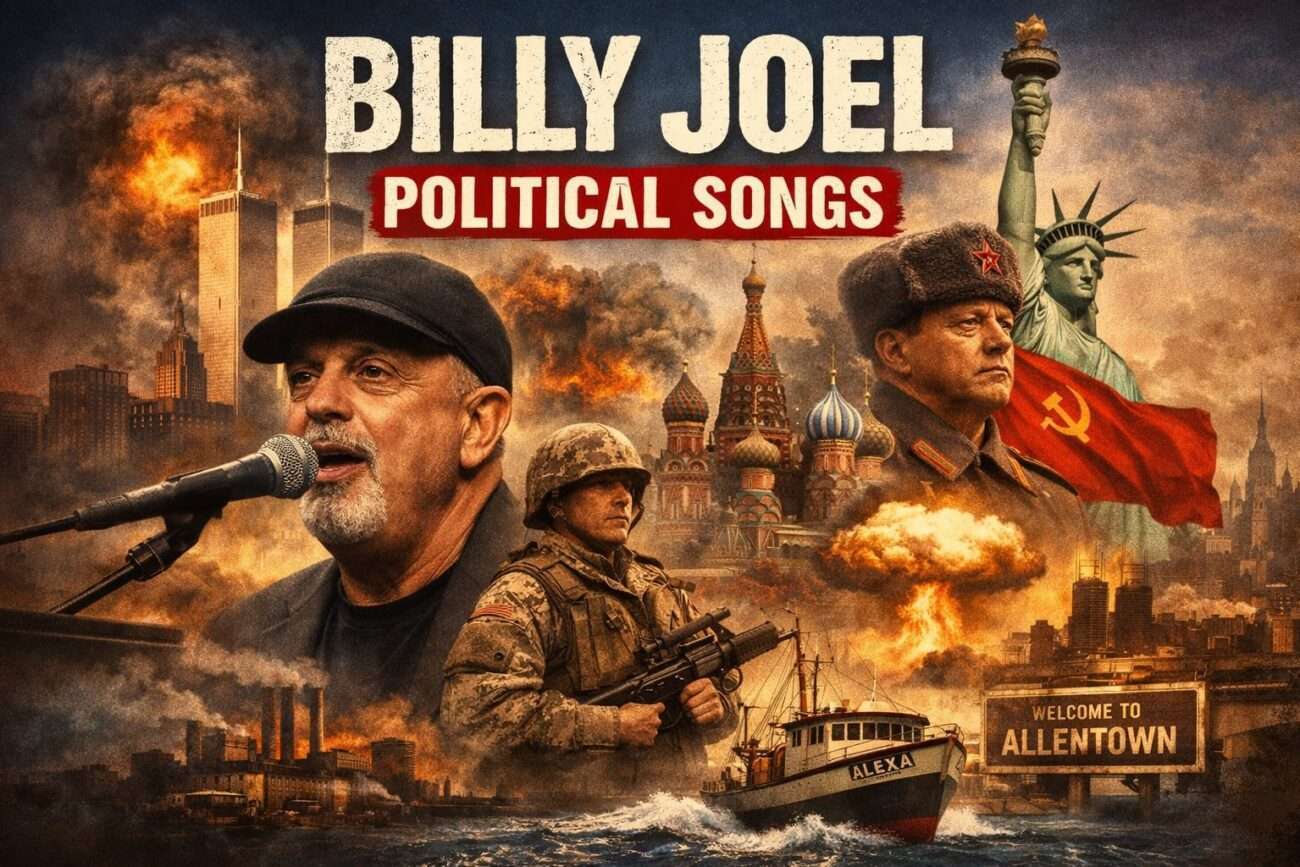
Billy Joel political songs occupy a unique space in American music. While he never considered himself a protest singer, songs like “Goodnight Saigon,” “Allentown,” “Leningrad,” “The Downeaster ‘Alexa,’” “Miami 2017,” and “We Didn’t Start the Fire” tackle war, economic decline, Cold War tension, and generational conflict with unusual depth. This article examines how Billy Joel addressed political realities without embracing the label of activist songwriter—and why that restraint may be the very reason these songs continue to resonate decades later.
This article is part of the broader Billy Joel Hub, where you can explore album deep dives, song rankings, and detailed lyrical analysis across his career.
The Tension Between Politics and Portraiture in Billy Joel’s Music
There’s a quiet contradiction running through Billy Joel’s catalog. He wrote about Vietnam veterans struggling with memory, steel towns watching generational promises erode, fishermen squeezed by shifting economics, and children raised under the shadow of nuclear fear. He imagined cities collapsing and cataloged decades of global unrest in a single driving anthem. On paper, that résumé sounds unmistakably political.
And yet, Billy Joel consistently rejected that label.
He did not see himself as a protest singer. He resisted being framed as a spokesperson. He never aligned his music with a movement or ideology. Instead, he insisted that he was writing about people—about lived experience inside historical moments rather than arguments about those moments.
That distinction is not semantic. It is the foundation of why these songs have endured. Joel did not write to persuade. He wrote to observe. He did not try to win debates. He tried to capture what it felt like to live through them. The difference between those two impulses—advocacy and documentation—is what defines his most powerful work.
Billy Joel Never Claimed to Be a Protest Singer
When people discuss political songwriting in modern American music, certain names immediately surface: Bob Dylan, Neil Young, and Bruce Springsteen. Dylan gave voice to civil unrest in the 1960s. Neil Young responded directly to national tragedy. Springsteen framed working-class struggle with unmistakable moral urgency. Each of them, in different ways, stepped into the role of cultural commentator.
Billy Joel never did.
For a broader look at his career and evolution, see the full Billy Joel biography.
He emerged in the same era, writing about many of the same forces shaping American life, but he positioned himself differently. He did not present himself as a conscience for the nation. He did not use his platform to advance policy arguments or attach himself to movements. Instead, he consistently described himself as a storyteller observing the world around him.
That difference is more than stylistic. Protest songwriting often seeks to persuade; Joel’s songwriting seeks to portray. He was less interested in telling listeners what should change and more interested in capturing what already was. War, economic anxiety, generational resentment, Cold War suspicion—these were not themes to be weaponized. They were environments his characters had to survive.
By declining the protest label, Joel protected the integrity of his lens. The ideology stayed in the background. The human being remained in the foreground. And that choice would shape every politically charged song he wrote.
The Songs That Prove the Point
That philosophy becomes clearest when you examine the songs themselves. Across different decades and albums, Joel returned to moments of national strain—war, economic decline, generational conflict, Cold War tension—not to argue about them, but to place real people inside them. Taken together, these songs form a body of work that engages political reality without becoming political advocacy.
Angry Young Man
Prelude/Angry Young Man may be one of the clearest examples of Billy Joel examining political energy without endorsing it.
Released in 1976 on Turnstiles, the song captures a particular post-1960s archetype: the perpetually indignant young man convinced that the system is irreparably broken. The rapid, almost percussive piano introduction feels urgent and breathless, as if mirroring the psychological tension of its subject. Joel presents a figure who is morally certain, intellectually rigid, and fueled by grievance.
But he does not glorify him.
He observes him.
The angry young man is principled. He believes his outrage proves his integrity. Yet the song carries a quiet undercurrent of skepticism. What happens when anger becomes identity? What happens when indignation hardens into permanent posture? Joel does not mock the character, but neither does he romanticize him. There is a sense that certainty can become its own trap.
Listening to it now, decades later, the song feels remarkably current. Every generation produces voices convinced they alone see clearly and that compromise equals surrender. Joel understood that kind of conviction. He also understood its limits. Instead of using the song to rally listeners toward a cause, he turned the lens on the psychology of protest itself.
That shift—from advocating outrage to examining it—is what separates this song from traditional protest music. It does not tell the listener what to think about politics. It asks what politics does to a person when anger becomes permanent.
Goodnight Saigon
Goodnight Saigon stands as one of the most powerful entries among Billy Joel political songs, yet it is also one of the clearest examples of why he resisted the protest label.
Released in 1982 on The Nylon Curtain, the song arrived nearly a decade after the end of the Vietnam War. By then, the headlines had moved on, but the emotional consequences had not. Veterans were still wrestling with reintegration. The country was still divided over what the war meant. Rather than revisit the political arguments that defined the era, Joel turned his attention to the soldiers themselves. The opening chant feels communal and grounded, not theatrical, and immediately places the listener inside a shared memory.
I first heard “Goodnight Saigon” as a college freshman. Vietnam had technically ended when I was young, but sitting in a dorm room years later, the war suddenly felt immediate. The men in that song were barely older than I was at the time. The realization was uncomfortable. These were not distant historical figures. They were young men who could have been in the classroom next door. The song shifted Vietnam from something abstract and political into something human and painfully close.
If you’d like a deeper breakdown of the song’s structure, historical context, and lyrical themes, I explored it in detail in my full in-depth analysis of “Goodnight Saigon.”
What makes “Goodnight Saigon” endure is what it refuses to do. Joel does not name policymakers. He does not issue a verdict on whether the war was justified. He does not frame the soldiers as symbols in a larger ideological battle. Instead, he centers brotherhood, fear, loyalty, and survival. “We held the day in the palm of our hand.” That line is not policy commentary. It is lived experience.
The restraint is deliberate. By refusing to reduce the war to argument, Joel created something more lasting than a protest anthem. The song does not tell listeners how to interpret Vietnam. It honors those who lived through it and leaves space for the audience to wrestle with their own conclusions. That is documentation, not advocacy. And that distinction is precisely why the song still carries weight decades later.
By refusing to turn the Vietnam War into a slogan, Joel created something more durable than protest. He preserved the humanity of the men who fought it and allowed the politics to remain in the background where they belonged. That instinct—to document the emotional cost of national decisions rather than argue their legitimacy—would surface again in his writing, this time not in a war zone, but in the quiet unraveling of American industry.
Allentown
Allentown captures a different kind of national reckoning—one fought not on battlefields, but on factory floors.
Released in 1982, the song arrived during a period of economic turbulence in the United States. Manufacturing towns across the Northeast and Midwest were experiencing layoffs, plant closures, and the erosion of industries that had sustained generations of families. Steel production was declining. Confidence was thinning. The American promise that hard work guaranteed stability was beginning to feel less certain. Rather than frame the crisis as policy failure or partisan debate, Joel focused on the people living inside it.
The power of “Allentown” lies in its restraint. Joel does not shout. He does not blame. The narrator is not a protester standing outside a government building. He is a worker trying to hold on to dignity while watching the ground shift beneath him. “Well we’re living here in Allentown” is not defiant; it’s weary. The tone suggests endurance more than outrage, as if the characters are recalibrating expectations rather than demanding restitution.
What makes the song endure is its refusal to simplify the problem. Economic decline is not presented as villainy. It is presented as reality. Joel understood that when industries collapse, communities absorb the shock long after the headlines fade. The disappointment in the song feels generational. Fathers who once believed their sons would inherit stability now watch that assumption dissolve. Yet even in frustration, the song preserves pride. These are not caricatures of working-class struggle. They are individuals trying to reconcile hope with circumstance.
That same instinct—to portray the emotional cost of structural change rather than debate its mechanics—appears again in a quieter song about survival on the water, where pride and pressure collide far from the factory gates.
The Downeaster ‘Alexa’
The Downeaster ‘Alexa’ may be the quietest entry among Billy Joel political songs, but it is no less revealing.
Released in 1989 on Storm Front, the song centers on a Long Island fisherman struggling to sustain his livelihood amid tightening regulations, rising costs, and shrinking margins. The economic pressures are real. Environmental restrictions were reshaping the fishing industry. Global competition was intensifying. Independent operators were being squeezed from multiple sides. Yet Joel does not frame the story as a policy debate. He places us inside the mind of a man who measures survival not in headlines, but in daily effort.
The narrator is not demanding reform. He is enduring. “I have lived my life like a man.” That line carries dignity rather than defiance. There is pride in the work, even as the margins thin and the future narrows. The politics of regulation and trade remain present, but they stay in the background. What dominates is responsibility — to crew, to family, to self-respect.
It is worth noting that Joel named the boat after his daughter, Alexa. That detail changes the emotional register of the song. The struggle is not abstract. It is tied to legacy. The fisherman is not merely fighting economic pressure; he is fighting to preserve something for the next generation. In that sense, the song becomes less about regulation and more about inheritance — what survives when systems shift.
Again, Joel avoids easy villains. He does not condemn environmental law. He does not rail against foreign competition. He does not romanticize the fisherman into a martyr. Instead, he documents the strain of adapting to forces larger than one individual can control. The song’s power lies in its humility. It trusts the listener to feel the tension without being told how to resolve it.
In moving from factory floors to open water, Joel continues the same pattern established in “Allentown.” Structural change reshapes lives. Pride remains. Ideology stays implied. And the focus remains fixed on the human being navigating the tide rather than the policy shaping it.
Miami 2017 (Seen the Lights Go Out on Broadway)
Miami 2017 (Seen the Lights Go Out on Broadway) expands the scope from individual struggle to civic anxiety.
Written during New York City’s fiscal crisis in the mid-1970s, the song imagines a future in which Manhattan collapses and its residents scatter south. At the time, bankruptcy was not a dramatic fantasy; it was a legitimate fear. Crime was rising. Infrastructure was decaying. Headlines questioned whether the city could survive its financial implosion. Joel captured that unease not with outrage, but with eerie calm.
The song unfolds as recollection rather than alarm. Joel narrates the imagined collapse as if looking back on it years later, which gives the story unsettling credibility. There is no speech about government mismanagement. No rallying cry for reform. Instead, there is a quiet acknowledgment that even iconic institutions can falter. Broadway goes dark. Skyscrapers empty. Life relocates.
For those of us who grew up in New York, the fear was not abstract. The city’s fragility was part of the cultural atmosphere. Listening now, the song feels less like dystopian exaggeration and more like emotional documentation of a vulnerable moment in urban history. Joel wasn’t predicting destruction so much as preserving the mood of uncertainty that defined that era.
What makes “Miami 2017” fit within Billy Joel political songs is not its subject matter, but its tone. It resists panic. It resists blame. It captures civic fragility without turning into a lecture. By framing collapse as narrative rather than accusation, Joel once again chooses documentation over advocacy.
And that instinct—to humanize ideological tension instead of inflame it—would reach its most personal expression when he turned his attention from American cities to Cold War divisions across an ocean.
Leningrad
Leningrad may be the clearest example of Billy Joel engaging global politics while refusing to behave politically.
Released in 1989 on Storm Front, the song contrasts Joel’s American childhood with that of Viktor, a Russian clown who grew up in the Soviet Union during the Cold War. Two boys raised under different flags. Two governments teaching suspicion of the other side. For decades, the tension between their nations shaped global politics. Yet when Joel finally meets Viktor face to face, the ideological abstraction dissolves.
The enemy becomes human.
Joel recounts his own childhood memories of nuclear drills and Cold War anxiety alongside Viktor’s upbringing inside a tightly controlled Soviet system. Neither story is exaggerated. Neither side is caricatured. Joel does not attempt to settle debates about capitalism versus communism. Instead, he places two ordinary lives beneath those arguments and allows the contrast to speak for itself.
If you’d like a deeper exploration of the historical context, Cold War parallels, and lyrical structure, I break it down fully in my in-depth analysis of the meaning of “Leningrad.”
What gives the song durability is its restraint. Joel neither condemns nor excuses. He does not argue that one system prevailed morally over the other. He simply shows how children grow up inside the stories their nations tell them. In doing so, he exposes the limits of ideological identity without turning the song into a sermon.
After writing about war, economic pressure, and civic instability, “Leningrad” narrows the lens to something even more personal: recognition. The realization that political narratives flatten human complexity. And that quiet humanization sets the stage for Joel’s broadest historical sweep.
We Didn’t Start the Fire
We Didn’t Start the Fire is often cited as the most overtly political of Billy Joel political songs. The rapid-fire lyrics move through decades of political leaders, wars, scandals, assassinations, cultural shifts, and global flashpoints. On the surface, it feels like a protest anthem disguised as a history lesson.
But it is not protest. It is accumulation.
The song emerged from a conversation about generational blame. When told that his generation had left the world in chaos, Joel responded not with defense but with documentation. He began listing the events that defined his own childhood and adulthood. The result is not commentary. There are no qualifiers, no judgments, no ideological framing. There is only the relentless stacking of history.
If you’d like a deeper breakdown of the historical references and structural intent behind the song, I explore it fully in my detailed analysis of “We Didn’t Start the Fire.”
What makes the song powerful is its refusal to editorialize. Joel does not tell the listener which events mattered most or who was responsible. “It was always burning since the world’s been turning” widens perspective rather than absolving responsibility. The message is not that turmoil is acceptable. It is that turmoil is continuous.
In many ways, this song completes the pattern seen throughout his catalog. Whether documenting soldiers in Vietnam, workers in Pennsylvania, fishermen on Long Island, or children raised during the Cold War, Joel resists the urge to simplify history into accusation. He catalogs. He observes. He preserves complexity.
And that instinct—to document rather than declare—is exactly why he resisted the political label that others tried to assign him.
Why Billy Joel Rejected the Political Label
By this point, the pattern is clear.
Billy Joel wrote about Vietnam without issuing a verdict on the war. He wrote about collapsing steel towns without endorsing an economic platform. He wrote about Cold War division without turning it into ideological propaganda. He wrote about generational frustration without sanctifying outrage. In every case, he approached political reality sideways — through human experience rather than argument.
That was not avoidance. It was discipline.
Protest songs often seek to persuade. They aim to shift public opinion or energize a movement. Joel’s songs do something different. They preserve atmosphere. They capture what it felt like to live inside a moment shaped by forces larger than the individual. The soldier, the factory worker, the fisherman, the city resident, the Cold War child — these are not mouthpieces for ideology. They are witnesses to history.
There is also a practical dimension to this restraint. Advocacy ages quickly. Political arguments become tied to the specific conditions that produced them. As administrations change and policy debates evolve, songs rooted in explicit positions can become artifacts of their moment. Joel understood that. By anchoring his writing in lived experience rather than partisan framing, he allowed the songs to outlast the debates that surrounded them.
That choice explains their durability.
“Goodnight Saigon” still resonates because it honors the humanity of soldiers rather than litigating the Vietnam War. “Allentown” still feels relevant because economic anxiety has not disappeared, even if the industries have changed. “Leningrad” continues to matter because geopolitical rivalry never fully vanishes; it simply shifts shape. “We Didn’t Start the Fire” remains recognizable because history never stops accumulating.
Joel rejected the political label not because he avoided serious subjects, but because he refused to reduce them. He did not want to be cast as a spokesperson. He wanted to be a documentarian of his time. That distinction preserved both his audience and his legacy.
In an era that often rewards loud certainty, Billy Joel chose clarity without slogans. He trusted that careful observation would carry more weight than rhetoric. And decades later, the endurance of these songs suggests he was right.
Howard Dee’s Closing Thoughts
Billy Joel political songs endure not because they take sides, but because they take people seriously.
Across war, economic collapse, civic instability, and Cold War tension, Joel consistently chose to document rather than declare. He trusted the audience to draw conclusions from lived experience instead of instructing them what those conclusions should be. That restraint gave his music a wider lifespan than most protest songs ever achieve.
The power of these songs lies in their refusal to simplify. They acknowledge conflict without flattening it into slogans. They recognize historical weight without turning into lectures. They preserve complexity in a way that feels increasingly rare.
In the end, Joel’s rejection of the political label was not a retreat from serious subject matter. It was a commitment to something more enduring. He did not want to be remembered as an activist of a particular era. He wanted to capture what it felt like to live through it.
Decades later, that choice still resonates.
Frequently Asked Questions
Did Billy Joel consider himself political?
Billy Joel has repeatedly said in interviews that he does not consider himself a political artist. While he has written about war, economic instability, generational tension, and Cold War anxiety, he has consistently framed his work as storytelling rather than advocacy. He has resisted aligning himself with partisan movements or positioning himself as a spokesperson for a cause.
That distinction is not accidental. Joel’s songwriting approach centers on individuals navigating historical forces rather than on the forces themselves. In songs like “Goodnight Saigon” and “Allentown,” the focus remains on soldiers and workers rather than policymakers or platforms. Even when addressing global tension in “Leningrad,” Joel avoids ideological argument. His rejection of the political label reflects a deliberate choice to document lived experience rather than shape political opinion.
What is Billy Joel’s most political song?
Among Billy Joel political songs, “We Didn’t Start the Fire” is most often cited as the most overtly political because it directly references wars, presidents, scandals, cultural flashpoints, and global crises across four decades. Its rapid accumulation of names and events gives the impression of sweeping political commentary.
However, whether it is truly his “most political” song depends on how one defines the term. If political means explicitly referencing public events, then “We Didn’t Start the Fire” likely leads the list. If political means exploring the human consequences of national decisions, then “Goodnight Saigon,” “Allentown,” or even “The Downeaster ‘Alexa’” may carry deeper emotional weight. Joel’s strength lies less in argument and more in immersion. He places listeners inside moments shaped by politics rather than debating them outright.
Is “Goodnight Saigon” anti-war?
“Goodnight Saigon” is frequently described as anti-war, but the song itself avoids issuing a direct judgment about the Vietnam War. Instead of condemning political leaders or military policy, Joel focuses on the shared experience of the soldiers. The central themes are brotherhood, fear, survival, and loyalty under pressure.
Because the song does not advocate a position, it functions more as testimony than protest. It honors the emotional reality of those who served without reducing their experience to an ideological statement. That restraint is part of why the song continues to resonate across generations. Listeners are free to interpret the broader political implications, but Joel himself does not dictate them.
What did Billy Joel say about “We Didn’t Start the Fire”?
Billy Joel has explained that “We Didn’t Start the Fire” grew out of a conversation in which a younger person suggested that his generation had left the world in chaos. Rather than defend himself, Joel began listing the events that shaped his own upbringing. The song became a rapid historical catalog rather than a rebuttal.
He has described it as an accumulation of moments rather than a political thesis. The refrain — “It was always burning since the world’s been turning” — reflects continuity rather than absolution. Joel was not attempting to excuse his generation or promote a specific ideology. He was illustrating that every era inherits instability from the one before it. The song’s staying power comes from that broader perspective, not from partisan alignment.
Explore More Billy Joel on 70sMusicWisdoms.com
If you’re exploring Billy Joel political songs, you may also want to read:
- Billy Joel Hub
- Full Billy Joel Biography
- Deep Dive: Goodnight Saigon
- Deep Dive: Leningrad
- Deep Dive: We Didn’t Start the Fire
- The 15 Best Billy Joel Deep Cuts — Songs Casual Fans Missed
- The 15 Most Career-Defining Early Songs of Billy Joel (1971–1976)