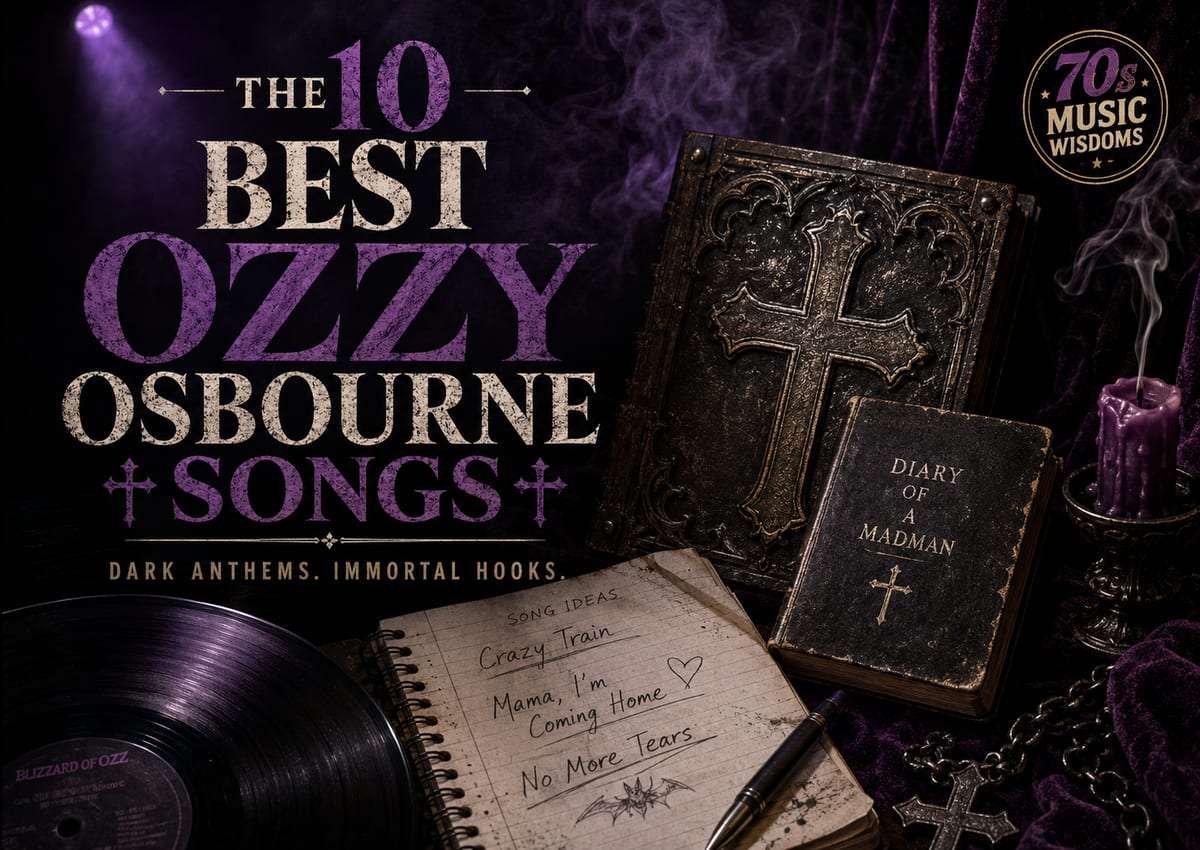
Ozzy Osbourne belongs on a 70s music site for a simple reason: before the solo records, the voice was already part of the soundtrack. As Black Sabbath’s original singer, Ozzy Osbourne helped define heavy metal during the 1970s. That connection matters because the solo career did not arrive from nowhere. Listeners brought years of familiarity with them, and the best post-band recordings often work because they carry recognizable instincts into a different decade.
Ozzy’s solo career did something few band breakups accomplish: it created a second body of work nearly as culturally important as the first. With Randy Rhoads, he found a guitarist whose classical precision gave the early albums a completely different musical identity from Sabbath. Later records changed players and production styles, but the essentials remained the same: Ozzy’s unmistakable voice, dark humor, melodic instincts, and ability to turn heavy music into songs that enormous audiences could sing.
This ranking focuses on Ozzy Osbourne as a solo artist. Band recordings are left out so the list can show what changed once the name on the record was his alone. The production, collaborators, and radio landscape may have shifted, but the personality that made the earlier work memorable is still there. These are the 10 best Ozzy Osbourne songs, ranked.
#10 Shot in the Dark
Album: The Ultimate Sin
Release year: 1986
Songwriters: Ozzy Osbourne, Phil Soussan
“Shot in the Dark” is one of Ozzy’s most polished 1980s singles. The keyboards and production place it firmly in the MTV era, but the melody is strong enough to keep the song from becoming a period curiosity.
Jake E. Lee’s guitar work gives the track muscle while Ozzy delivers one of his most accessible choruses. It remains a useful reminder that his solo career could absorb changing hard-rock production without losing its identity.
It earns the opening spot because a Top 10 should do more than stack the obvious hits. This is the kind of recording that helps explain the shape of the catalog: where the artist was going, what he was willing to leave behind, and why the solo years deserve to be heard as more than an appendix to the band.
#9 Bark at the Moon
Album: Bark at the Moon
Release year: 1983
Songwriters: Ozzy Osbourne
“Bark at the Moon” had the difficult job of opening Ozzy’s first studio album after Randy Rhoads’ death. Jake E. Lee immediately established a different guitar personality, with a sharp, aggressive riff that gave the song its own identity.
The track also became one of Ozzy’s defining videos, leaning fully into horror imagery and theatrical transformation. The combination of riff, hook, and visual spectacle made it an enduring solo-era anthem.
Placed here, the song also shows how quickly a solo identity can become recognizable. The production belongs to its era, but the phrasing and melodic instincts connect it to the singer listeners already knew. That tension between familiarity and change is one of the pleasures of revisiting these records now.
#8 Mama, I’m Coming Home
Album: No More Tears
Release year: 1991
Songwriters: Ozzy Osbourne, Zakk Wylde, Lemmy Kilmister
“Mama, I’m Coming Home” became Ozzy’s biggest mainstream ballad without asking him to sound like anyone else. Zakk Wylde’s guitar gives the song warmth, while Lemmy Kilmister’s lyrical contribution helps keep the sentiment direct rather than sugary.
The single crossed into the pop Top 40 and became a concert staple. Ozzy’s voice, often associated with menace, turns out to be just as distinctive when the song is vulnerable.
This is also the sort of track that benefits from distance. Without the pressure of being the biggest single, it can be heard as part of a larger body of work, and the details in the arrangement become easier to appreciate. It is a strong reminder that the solo catalog has more depth than a greatest-hits playlist suggests.
#7 No More Tears
Album: No More Tears
Release year: 1991
Songwriters: Ozzy Osbourne, Zakk Wylde, Randy Castillo, Mike Inez, John Purdell
“No More Tears” is one of the most ambitious tracks in Ozzy’s solo catalog. The bass figure creates a slow, ominous pull, and the arrangement keeps expanding until Zakk Wylde’s guitar solo turns the song into a full-scale epic.
The track works because it is heavy without relying on speed. Ozzy’s vocal sits above the arrangement like a narrator inside a nightmare, giving the song the same uneasy quality that defined his earliest work.
At this point in the ranking, the separation between band history and solo identity becomes especially clear. The song does not need to reference the past directly. The connection comes through the voice, the melodic choices, and the confidence of a performer who already knew how to command a record.
#6 Mr. Crowley
Album: Blizzard of Ozz
Release year: 1980
Songwriters: Ozzy Osbourne, Randy Rhoads, Bob Daisley
“Mr. Crowley” opens with Don Airey’s gothic keyboard introduction before Randy Rhoads takes over with one of the defining guitar performances of early-1980s metal. The song is theatrical, melodic, and technically sophisticated without losing its dark atmosphere.
Rhoads’ solos are the obvious highlight, but Ozzy’s vocal melody is what makes the track a song rather than simply a guitar showcase. That balance explains why their partnership remains so influential.
What pushes it into the upper half is durability. Plenty of records from the same period were built around fashionable sounds that aged badly; this one still has a musical center strong enough to survive the production choices around it. The song remains satisfying even after the era-specific gloss becomes part of the nostalgia.
#5 Flying High Again
Album: Diary of a Madman
Release year: 1981
Songwriters: Ozzy Osbourne, Randy Rhoads, Bob Daisley, Lee Kerslake
“Flying High Again” combines one of Rhoads’ most memorable riffs with an Ozzy chorus that is almost cheerful by his standards. The contrast between heavy guitar and melodic lift gives the song its staying power.
It became a major rock-radio track and helped prove that Blizzard of Ozz was not a one-album miracle. The band had developed a sound that was technically advanced but still immediate enough for radio.
The No. 5 position is where the catalog’s strongest themes start to concentrate. This track combines a memorable hook with a performance that reveals something about the singer beyond simple technique. It is the point where the solo career stops feeling merely successful and starts feeling essential to the artist’s larger story.
#4 Diary of a Madman
Album: Diary of a Madman
Release year: 1981
Songwriters: Ozzy Osbourne, Randy Rhoads, Bob Daisley, Lee Kerslake
The title track of Diary of a Madman is one of the most musically complex songs Ozzy ever recorded. Rhoads’ classical influence shapes the acoustic opening and the shifting heavy sections, while Ozzy’s vocal keeps the song anchored in a memorable melodic line.
The track feels genuinely unstable, moving between beauty and menace in a way that matches the lyric. It is one of the clearest examples of how far the early solo band could push beyond straightforward hard rock.
A song this high has to do more than trigger recognition. It needs to represent a distinct piece of the solo identity, and this one does. The writing, arrangement, and vocal all point in the same direction, giving the record a sense of purpose that has held up long after its original radio moment.
#3 I Don’t Know
Album: Blizzard of Ozz
Release year: 1980
Songwriters: Ozzy Osbourne, Randy Rhoads, Bob Daisley
“I Don’t Know” opens Blizzard of Ozz with a riff that immediately announces a new chapter. Ozzy sounds energized, Rhoads sounds unlike any guitarist from Sabbath, and the rhythm section gives the track a sharper, faster attack than his old band typically used.
The lyric is also classic Ozzy: confronted with people demanding answers, he admits he does not have them. That mixture of uncertainty and defiance gives the song more personality than a simple comeback anthem.
By No. 3, the argument is less about whether the song belongs and more about how high it should go. This is one of the recordings that can stand beside the best-known band material without needing the comparison to justify it. It has its own atmosphere, its own emotional logic, and its own reason to last.
#2 Crazy Train
Album: Blizzard of Ozz
Release year: 1980
Songwriters: Ozzy Osbourne, Randy Rhoads, Bob Daisley
“Crazy Train” is the song that made Ozzy’s solo career undeniable. Randy Rhoads’ riff is one of the most recognizable in rock history, and Ozzy’s melody turns a song about fear and social instability into something enormous crowds can sing.
The record has become so familiar that it is easy to forget how radical the combination sounded in 1980. The guitar is precise and modern, the chorus is almost pop, and Ozzy remains unmistakably himself in the middle of it all.
The runner-up spot goes to a song that could easily be No. 1 on a different day. It captures nearly everything that made the solo career worthwhile: a distinctive voice, a strong melodic idea, and enough personality to separate the record from the artist’s earlier band identity. Only one song edges it out.
#1 Over the Mountain
Album: Diary of a Madman
Release year: 1981
Songwriters: Ozzy Osbourne, Randy Rhoads, Bob Daisley, Lee Kerslake
“Over the Mountain” takes No. 1 because it captures the early Ozzy solo band at full speed and full confidence. Lee Kerslake’s opening drums launch the track, Rhoads delivers a riff that is both heavy and agile, and Ozzy sings one of his strongest melodies.
“Crazy Train” is the bigger cultural landmark, but “Over the Mountain” may be the more complete band performance. It shows exactly why the Rhoads era remains the emotional center of Ozzy’s solo catalog: technical brilliance serving songs that are immediate, strange, and unforgettable.
That is why it finishes at No. 1. The best solo song is not necessarily the loudest, the most technically impressive, or even the biggest chart hit. It is the recording that most completely explains why the artist needed a solo career in the first place. This one does exactly that.
What Did We Leave Out?
Major omissions include “Suicide Solution,” “Believer,” “Rock ’n’ Roll Rebel,” “Miracle Man,” “Perry Mason,” “Gets Me Through,” and later collaborations. Ozzy’s solo catalog is deep enough that a second Top 10 could be built without repeating a song.
Black Sabbath tracks are excluded. “War Pigs,” “Paranoid,” and “Iron Man” are foundational, but the point here is to hear the separate identity Ozzy created after leaving the band.
Why Ozzy Osbourne’s Best Solo Songs Still Work
Ozzy’s best solo music lasts because his voice is more melodic than his image suggests. He has always depended on great guitarists, but the songs survive because he knows how to find a vocal line that cuts through heavy arrangements.
For a 70s audience, the solo career is one of rock’s great second acts. Sabbath established the language; Ozzy’s solo records proved he could speak it in a completely different voice.
More Classic Rock Favorites
If Ozzy Osbourne is part of your soundtrack, keep going with these rankings from artists and bands who shared the same classic-rock world.