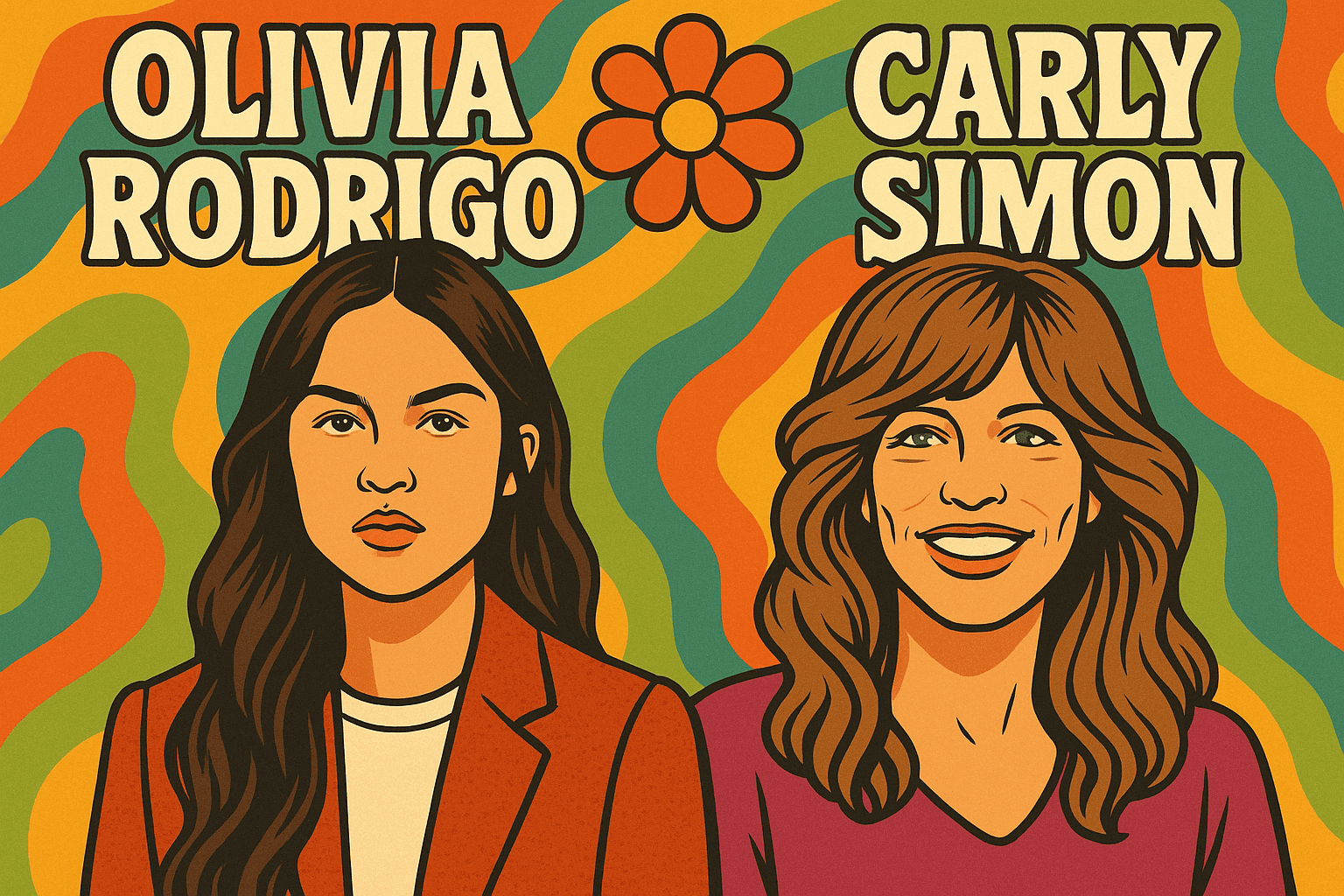
If you grew up on the radio magic of the 1970s, you already know there’s nothing quite like hearing a singer who tells the truth. Carly Simon did that better than almost anyone. And lately, I’ve been hearing a lot from Boomers who ask me, “Howard, who’s the Carly Simon of today?” Surprisingly, the answer isn’t complicated. It’s Olivia Rodrigo—a name your kids and grandkids probably talk about nonstop.
This article is my way of showing Boomers exactly who Olivia is by connecting her directly to the emotional power of Carly. Different eras, different production styles—but the same confessional honesty that made Carly Simon an icon.
Why Carly Simon Is the Perfect ’70s Lens for Understanding Olivia Rodrigo
When Carly Simon released No Secrets in 1972, she delivered something the world wasn’t quite prepared for: a young woman telling the unfiltered truth. “You’re So Vain” wasn’t just a hit. It was an event. A cultural guessing game. A conversation starter.
Fast-forward fifty years, and Olivia Rodrigo did the same with “drivers license.” Teen heartbreak wasn’t new—but Olivia made it universal, the same way Carly once had. If you remember hearing Carly’s voice for the first time and thinking, She’s saying what I feel, then you already understand the pull Olivia has on today’s generation.
Both artists built careers on emotional transparency. They don’t hint at feelings. They pour them onto the page.
Both Artists Turned Heartbreak into a National Conversation
Carly Simon practically invented the drama-filled breakup anthem. “You’re So Vain”—loaded with mystery, pointed details, and sharp edges—became a national obsession. Listeners debated the subject for decades.
Olivia Rodrigo walked into the modern era and did the exact same thing.
When “drivers license” dropped in 2021, fans, journalists, and late-night hosts all jumped into the drama, trying to decipher the real-life story behind the song. The cultural moment that erupted was the closest thing this generation has had to the “You’re So Vain” guessing game.
Boomers, if you ever wondered why Olivia became such a phenomenon so quickly, this is the reason. She didn’t just release a song. She released a confession—and people recognized truth when they heard it.
Olivia Rodrigo’s “You’re So Vain” Moment at the Rock & Roll Hall of Fame
If Boomers want the clearest proof of how closely Olivia Rodrigo’s artistry connects to Carly Simon’s legacy, they only need to watch one moment: Olivia performing “You’re So Vain” at the 2022 Rock & Roll Hall of Fame Induction Ceremony, honoring Carly’s induction.
This wasn’t a gimmick or a publicity stunt. It was a symbolic passing of the torch. Olivia delivered the song with a confidence that stunned even the most skeptical viewers. She didn’t imitate Carly. She didn’t modernize the arrangement for shock value. She inhabited the song—delivering it with the same sly bite and emotional grit that made it iconic.
Boomers immediately recognized the attitude behind the lyrics. Younger fans, many hearing the song for the first time, suddenly understood why “You’re So Vain” became a cultural hurricane in 1972.
Even Mick Jagger—who famously sang backing vocals on the original—publicly praised her performance. In that moment, Olivia didn’t just honor Carly Simon. She reminded the world why Carly mattered in the first place.
And let’s be honest: a lot of people walked away saying what most won’t admit aloud—
Olivia Rodrigo’s version hit harder.
That’s a conversation we’ll dive into in a dedicated follow-up article.
The Confessional Songwriting Gene Runs Straight Through Both Careers
One of Carly Simon’s greatest gifts was her ability to turn her emotional life into song. “That’s the Way I’ve Always Heard It Should Be” reads like a private letter—hesitant, vulnerable, and honest.
Olivia writes with that same fearless clarity.
Songs like “traitor,” “vampire,” and “making the bed” aren’t polished pop fantasies. They’re raw emotional dispatches. Olivia’s lyrics sound like they were written in the middle of the night, on the floor of a messy bedroom, just like Carly once did at the piano in her New York apartment.
What Carly did for Boomers—giving them a voice for heartbreak and insecurity—Olivia does for Gen Z.
Simple Arrangements. Big Emotion. A Timeless Formula.
Carly Simon’s early catalog wasn’t built on flashy production. Her sound was intimate: piano, guitar, and emotionally open vocals.
Olivia Rodrigo takes the same approach in a world addicted to overproduction. She leans on:
- bare piano lines
- understated guitar work
- unpolished, emotionally honest vocals
Put “drivers license” next to “That’s the Way I’ve Always Heard It Should Be,” and you’ll hear the same structure, the same storytelling heartbeat, and the same emotional precision.
Explosive Early Success That Defined a Generation
When No Secrets exploded in 1972, Carly Simon immediately became the voice of a generation wrestling with heartbreak, self-discovery, and the messiness of relationships.
Olivia Rodrigo did the same with SOUR in 2021.
She didn’t just chart—she defined the emotional vocabulary of her generation. “good 4 u” became the cathartic scream-along anthem that teens (and a surprising number of adults) needed.
Both albums became cultural snapshots of their eras.
Both Women Were Unapologetically Honest at a Time Their Generations Needed It
Carly Simon’s songwriting pushed against the expectation that women should soften their pain. She didn’t do that. Her honesty was her power.
Olivia Rodrigo walks the same path today.
Her lyrics are pointed, direct, and often brutally honest. She refuses to hide behind “nice” or “polite.” She tells the truth—even when it’s uncomfortable.
And that’s why millions of young listeners trust her.
Both Artists Became Accidental Generational Voices
Neither Carly Simon nor Olivia Rodrigo set out to be the voice of their generation. They simply told the truth, and their truth resonated.
Boomers found themselves in Carly’s songs.
Gen Z finds themselves in Olivia’s.
Different worlds.
Same emotional core.
Final Thoughts from Howard Dee
When I listen to Olivia Rodrigo, I’m not hearing “teen pop.” I’m hearing the same emotional honesty that Carly Simon delivered five decades earlier. Their voices differ. Their styles differ. But the lineage is unmistakable.
Carly Simon gave Boomers permission to feel things deeply without hiding it. Olivia Rodrigo is doing the exact same thing today.
Music evolves.
But human heartbreak never does.
And every generation deserves its own Carly Simon—someone brave enough to tell the truth.