
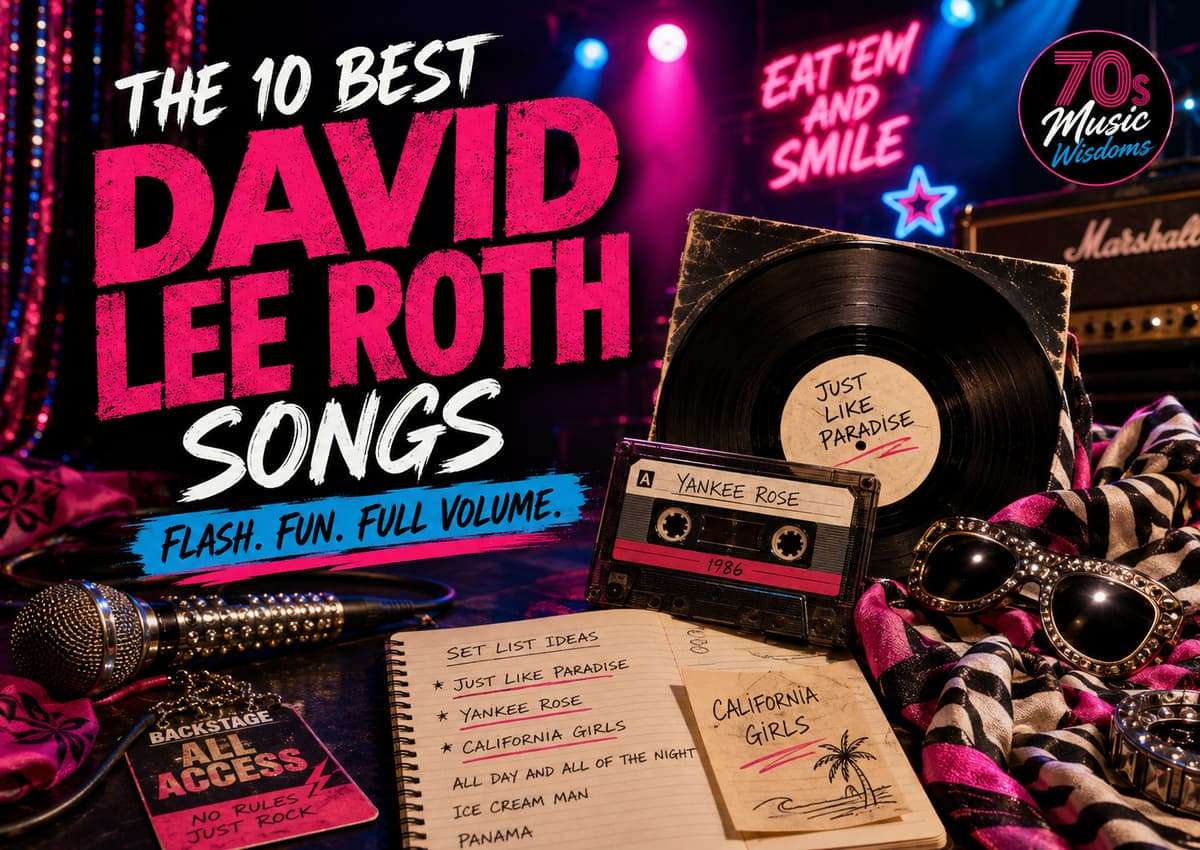
David Lee Roth belongs on a 70s music site for a simple reason: before the solo records, the voice was already part of the soundtrack. David Lee Roth fronted Van Halen through the band’s explosive late-1970s rise and first run of multiplatinum albums. That connection matters because the solo career did not arrive from nowhere. Listeners brought years of familiarity with them, and the best post-band recordings often work because they carry recognizable instincts into a different decade.
His solo career initially felt like the logical extension of the larger-than-life personality fans already knew. Crazy from the Heat turned standards and pop covers into MTV events, while Eat ‘Em and Smile and Skyscraper paired Roth with virtuoso players and songs built around wit, flash, and movement. The catalog is uneven, but at its best it captures one of rock’s great frontmen completely unconstrained.
This ranking focuses on David Lee Roth as a solo artist. Band recordings are left out so the list can show what changed once the name on the record was his alone. The production, collaborators, and radio landscape may have shifted, but the personality that made the earlier work memorable is still there. These are the 10 best David Lee Roth songs, ranked.
#10 Sensible Shoes
Album: A Little Ain’t Enough
Release year: 1991
Songwriters: David Lee Roth, Steve Hunter
“Sensible Shoes” is a bluesier, more relaxed Roth than the high-speed material that made him famous. The song lets him lean into humor and swagger without needing a guitar Olympics backdrop.
In the larger arc of A Little Ain’t Enough, the song helps show why the solo catalog deserves to be heard on its own terms. The 1991 production places it firmly in its period, but the melody and vocal personality keep it from feeling like a museum piece. For longtime fans, “Sensible Shoes” is another point where the familiar voice meets a different musical frame.
It earns the opening spot because a Top 10 should do more than stack the obvious hits. This is the kind of recording that helps explain the shape of the catalog: where the artist was going, what he was willing to leave behind, and why the solo years deserve to be heard as more than an appendix to the band.
#9 She’s My Machine
Album: Your Filthy Little Mouth
Release year: 1994
Songwriters: David Lee Roth, Terry Kilgore
“She’s My Machine” gave Roth one of his stronger 1990s rockers. Terry Kilgore’s guitar work is muscular, and Roth sounds more interested in groove than in competing with the changing hard-rock landscape.
In the larger arc of Your Filthy Little Mouth, the song helps show why the solo catalog deserves to be heard on its own terms. The 1994 production places it firmly in its period, but the melody and vocal personality keep it from feeling like a museum piece. For longtime fans, “She’s My Machine” is another point where the familiar voice meets a different musical frame.
Placed here, the song also shows how quickly a solo identity can become recognizable. The production belongs to its era, but the phrasing and melodic instincts connect it to the singer listeners already knew. That tension between familiarity and change is one of the pleasures of revisiting these records now.
#8 A Lil’ Ain’t Enough
Album: A Little Ain’t Enough
Release year: 1991
Songwriters: David Lee Roth, Robbie Nevil
The title track of A Little Ain’t Enough is classic Roth excess translated into an early-1990s production. The chorus is broad, the guitars are bright, and the lyric turns appetite into philosophy.
In the larger arc of A Little Ain’t Enough, the song helps show why the solo catalog deserves to be heard on its own terms. The 1991 production places it firmly in its period, but the melody and vocal personality keep it from feeling like a museum piece. For longtime fans, “A Lil’ Ain’t Enough” is another point where the familiar voice meets a different musical frame.
This is also the sort of track that benefits from distance. Without the pressure of being the biggest single, it can be heard as part of a larger body of work, and the details in the arrangement become easier to appreciate. It is a strong reminder that the solo catalog has more depth than a greatest-hits playlist suggests.
#7 Just Like Paradise
Album: Skyscraper
Release year: 1988
Songwriters: David Lee Roth, Brett Tuggle
“Just Like Paradise” became Roth’s biggest solo pop hit. The song is brighter and more radio-friendly than much of Eat ‘Em and Smile, but Roth’s personality keeps it from becoming generic.
In the larger arc of Skyscraper, the song helps show why the solo catalog deserves to be heard on its own terms. The 1988 production places it firmly in its period, but the melody and vocal personality keep it from feeling like a museum piece. For longtime fans, “Just Like Paradise” is another point where the familiar voice meets a different musical frame.
At this point in the ranking, the separation between band history and solo identity becomes especially clear. The song does not need to reference the past directly. The connection comes through the voice, the melodic choices, and the confidence of a performer who already knew how to command a record.
#6 Damn Good
Album: Skyscraper
Release year: 1988
Songwriters: David Lee Roth, Steve Vai
“Damn Good” strips away much of Roth’s usual circus and reveals a surprisingly reflective song. Steve Vai’s acoustic guitar gives the track space, while Roth looks backward with more sincerity than his public image usually allowed.
In the larger arc of Skyscraper, the song helps show why the solo catalog deserves to be heard on its own terms. The 1988 production places it firmly in its period, but the melody and vocal personality keep it from feeling like a museum piece. For longtime fans, “Damn Good” is another point where the familiar voice meets a different musical frame.
What pushes it into the upper half is durability. Plenty of records from the same period were built around fashionable sounds that aged badly; this one still has a musical center strong enough to survive the production choices around it. The song remains satisfying even after the era-specific gloss becomes part of the nostalgia.
#5 Yankee Rose
Album: Eat ‘Em and Smile
Release year: 1986
Songwriters: David Lee Roth, Steve Vai
“Yankee Rose” announced Roth’s full-band solo era with maximum confidence. Steve Vai’s talking-guitar introduction immediately signaled that Roth had found a guitarist capable of matching the spectacle associated with his former band.
In the larger arc of Eat ‘Em and Smile, the song helps show why the solo catalog deserves to be heard on its own terms. The 1986 production places it firmly in its period, but the melody and vocal personality keep it from feeling like a museum piece. For longtime fans, “Yankee Rose” is another point where the familiar voice meets a different musical frame.
The No. 5 position is where the catalog’s strongest themes start to concentrate. This track combines a memorable hook with a performance that reveals something about the singer beyond simple technique. It is the point where the solo career stops feeling merely successful and starts feeling essential to the artist’s larger story.
#4 Tobacco Road
Album: Eat ‘Em and Smile
Release year: 1986
Songwriters: John D. Loudermilk
Roth’s version of “Tobacco Road” turns the standard into a hard-rock showcase. The band attacks the arrangement with precision, but Roth’s theatrical phrasing keeps the performance from becoming a technical exercise.
In the larger arc of Eat ‘Em and Smile, the song helps show why the solo catalog deserves to be heard on its own terms. The 1986 production places it firmly in its period, but the melody and vocal personality keep it from feeling like a museum piece. For longtime fans, “Tobacco Road” is another point where the familiar voice meets a different musical frame.
A song this high has to do more than trigger recognition. It needs to represent a distinct piece of the solo identity, and this one does. The writing, arrangement, and vocal all point in the same direction, giving the record a sense of purpose that has held up long after its original radio moment.
#3 Goin’ Crazy!
Album: Eat ‘Em and Smile
Release year: 1986
Songwriters: David Lee Roth, Steve Vai
“Goin’ Crazy!” is one of the purest expressions of Roth’s solo personality: colorful, melodic, restless, and completely aware that rock music can also be entertainment.
In the larger arc of Eat ‘Em and Smile, the song helps show why the solo catalog deserves to be heard on its own terms. The 1986 production places it firmly in its period, but the melody and vocal personality keep it from feeling like a museum piece. For longtime fans, “Goin’ Crazy!” is another point where the familiar voice meets a different musical frame.
By No. 3, the argument is less about whether the song belongs and more about how high it should go. This is one of the recordings that can stand beside the best-known band material without needing the comparison to justify it. It has its own atmosphere, its own emotional logic, and its own reason to last.
#2 California Girls
Album: Crazy from the Heat
Release year: 1985
Songwriters: Brian Wilson, Mike Love
Roth’s cover of the Beach Boys’ “California Girls” was the perfect solo launch. He did not try to out-sing the original; he turned it into a character piece, using humor, style, and a memorable video to establish that his post-Van Halen career would be built around personality as much as music.
In the larger arc of Crazy from the Heat, the song helps show why the solo catalog deserves to be heard on its own terms. The 1985 production places it firmly in its period, but the melody and vocal personality keep it from feeling like a museum piece. For longtime fans, “California Girls” is another point where the familiar voice meets a different musical frame.
The runner-up spot goes to a song that could easily be No. 1 on a different day. It captures nearly everything that made the solo career worthwhile: a distinctive voice, a strong melodic idea, and enough personality to separate the record from the artist’s earlier band identity. Only one song edges it out.
#1 Just a Gigolo/I Ain’t Got Nobody
Album: Crazy from the Heat
Release year: 1985
Songwriters: Leonello Casucci, Julius Brammer, Irving Caesar / Spencer Williams, Roger Graham
“Just a Gigolo/I Ain’t Got Nobody” takes No. 1 because it revealed the full scope of Roth’s solo persona. The medley connects lounge music, vaudeville humor, rock-star ego, and genuine loneliness in a performance that could not plausibly belong to anyone else.
In the larger arc of Crazy from the Heat, the song helps show why the solo catalog deserves to be heard on its own terms. The 1985 production places it firmly in its period, but the melody and vocal personality keep it from feeling like a museum piece. For longtime fans, “Just a Gigolo/I Ain’t Got Nobody” is another point where the familiar voice meets a different musical frame.
That is why it finishes at No. 1. The best solo song is not necessarily the loudest, the most technically impressive, or even the biggest chart hit. It is the recording that most completely explains why the artist needed a solo career in the first place. This one does exactly that.
What Did We Leave Out?
Other contenders include “Stand Up,” “Hot Dog and a Shake,” “Knucklebones,” “Sunburn,” “She’s My Machine,” and later solo experiments. Roth’s catalog rewards listeners who enjoy the personality as much as the songs.
Van Halen tracks are excluded. “Jump,” “Panama,” and “Ain’t Talkin’ ’Bout Love” explain the legend, but the solo career is where Roth proved how much of the spectacle belonged specifically to him.
Why David Lee Roth’s Best Solo Songs Still Work
Roth’s best solo music lasts because he understood that rock performance is partly theater. He could sing, but he also knew how to frame a song, sell a joke, create an image, and make a three-minute record feel like an event.
For a 70s audience, the solo years are the continuation of the frontman who helped make early Van Halen feel dangerous and fun at the same time.
More Classic Rock Favorites
If David Lee Roth is part of your soundtrack, keep going with these rankings from artists and bands who shared the same classic-rock world.


