
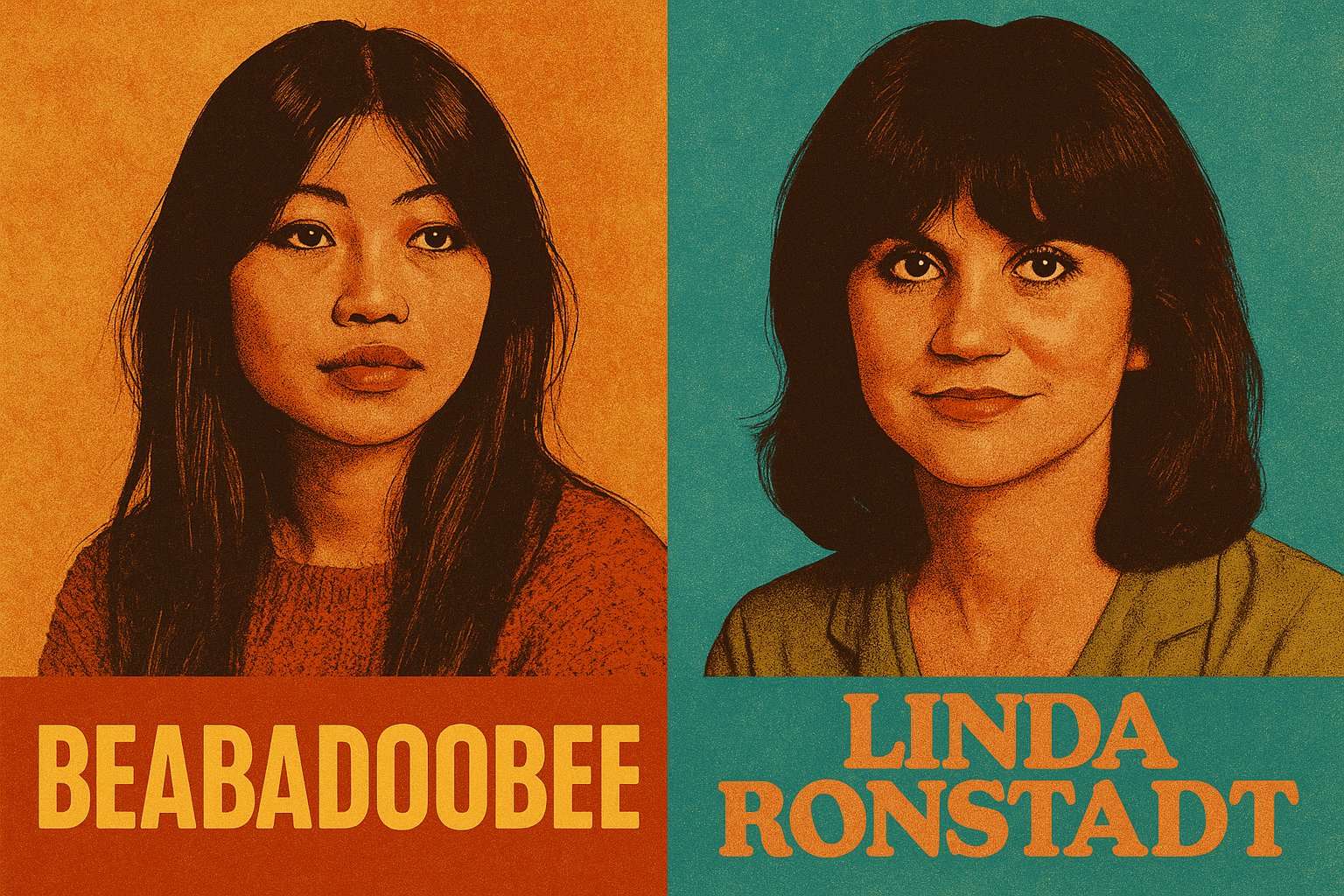
By Howard Dee
Some artists blow you away with power. Others win you over with spectacle. But every generation gets one artist who doesn’t need volume or drama to leave a permanent mark. They just tell the truth softly — and somehow that truth becomes louder than anything else happening around them.
In the 1970s, that artist was Linda Ronstadt.
Today, it’s Beabadoobee.
People don’t naturally connect them because they’re looking at the wrong things — the era, the production style, the industry landscape. But when you look at the writing, the emotional tone, and the way both artists use small moments to communicate big feelings, the connection becomes undeniable.
To prove it, let’s go deeper — not surface-level comparisons, but real song-to-song parallels that show exactly how these two artists share the same emotional DNA across two completely different musical generations.
Soft Power, Not Big Personalities
Linda Ronstadt wasn’t the loudest voice of the 1970s. She wasn’t the most flamboyant. But she had an emotional honesty that made her the quiet heartbeat of her era.
Beabadoobee isn’t the loudest voice of the 2020s either. She isn’t theatrical, she isn’t bombastic — but her music has become a kind of emotional refuge for young listeners navigating love, longing, and identity in a chaotic world.
Both artists prove the same truth:
softness can hit harder than power.
And the best place to see that is in the songs themselves.
1. “Glue Song” (Beabadoobee) vs. “Love Has No Pride” (Linda Ronstadt)
Theme: Vulnerability without ego or armor
Beabadoobee — “Glue Song”
“Glue Song” is shy, tender, almost embarrassed by how honest it is. Bea sings:
“I’ve been stuck by you, glue / Right onto you.”
It’s simple, childlike, and completely exposed — the kind of lyric someone writes when they’re in love but still scared to say it out loud. There’s no attempt to sound poetic, no attempt to be clever. The purity is the point.
Linda Ronstadt — “Love Has No Pride”
Linda approaches vulnerability from a more adult perspective, but the emotional posture is the same:
“Love has no pride when I call out your name.”
She strips away ego. She strips away pride. She sings like someone who knows love often requires surrender.
Why these two songs prove the connection
Both artists write love as something that makes you smaller — willingly, softly, without shame. There’s no bravado, no power games, no drama. Just openness.
Different decades.
Same emotional silhouette.
2. “Coffee” (Beabadoobee) vs. “Long Long Time” (Linda Ronstadt)
Theme: Quiet heartbreak that doesn’t fade — even when you wish it would
Beabadoobee — “Coffee”
One of Bea’s earliest songs, and still one of her most emotionally honest. She writes heartbreak through tiny details:
“Don’t stay awake for too long / Don’t go to bed.”
It’s intimate. Almost whispered. It feels like reading a page from someone’s private journal — a moment captured before the writer talked themselves out of sharing it.
Linda Ronstadt — “Long Long Time”
Linda’s delivery is more polished, but the ache is the same. She sings:
“I’ve done everything I know to try and make you mine.”
It’s raw. It’s adult. It’s heartbreak without theatrics — just a tired, painful truth said simply.
Why these songs matter
Both artists describe heartbreak not as a dramatic collapse, but as a quiet ache that follows you for years. No explosions. No bitter monologues. Just longing that you can’t walk away from.
3. “The Perfect Pair” (Beabadoobee) vs. “You’re No Good” (Linda Ronstadt)
Theme: Breaking up with soft frustration instead of rage
Beabadoobee — “The Perfect Pair”
Bea is frustrated here — but even frustration shows up as vulnerability:
“It’s only you, and how I feel so far.”
She’s tired, disappointed, emotionally drained. But she’s not vindictive. Even at her sharpest, she remains gentle.
Linda Ronstadt — “You’re No Good”
Linda’s most famous breakup song has an edge, but not hostility. She sings:
“You’re no good, you’re no good, you’re no good.”
It’s confident. Firm. But still delivered with warmth and melody rather than fury.
Why the pairing works
Neither artist uses bitterness as a weapon. They use clarity. They speak their truth plainly, softly, and without destroying the other person.
Two breakup songs.
Same emotional maturity.
4. “Care” (Beabadoobee) vs. “Poor Poor Pitiful Me” (Linda Ronstadt)
Theme: Masking insecurity with an upbeat melody
Beabadoobee — “Care”
“Care” is bright, jangly, and fun — but it’s masking something heavier:
“I don’t want your sympathy, I guess I’ve had it rough.”
It’s the classic Beabadoobee move: sadness you can dance to. Pain delivered through a smile.
Linda Ronstadt — “Poor Poor Pitiful Me”
Linda pioneered this exact trick decades earlier. The track is upbeat, almost playful — but the lyrics carry bite:
“Well, I lay my head on the railroad track / Waitin’ on the Double E.”
It’s dark humor hiding in a cheerful melody.
What this reveals about both artists
They share the same instinct:
use brightness as camouflage for vulnerability.
It’s emotional truth wrapped in melodic sugar.
What These Song Comparisons Actually Prove
When you look at their catalogs side by side, the connection becomes clearer than ever:
1. They both write about small moments, not grand gestures.
The emotional stakes are intimate. Personal. Human.
2. They both sing with quiet intensity instead of power.
No need to belt. No need to dominate the room.
3. They both articulate female emotion without theatrics.
Their honesty is gentle, not performative.
4. They both elevate simplicity into emotional impact.
Short lines. Clean melodies. Truth without ornament.
5. They both use “softness” as their artistic identity.
Not weakness — strength through understatement.
6. They both created a blueprint for their generation’s emotional language.
Linda shaped the 1970s.
Bea shapes the 2020s.
7. They both turn vulnerability into connection — and connection into cultural influence.
That’s the lineage.
That’s the echo.
That’s the story.
Final Thoughts from Howard Dee
Beabadoobee and Linda Ronstadt aren’t similar because of genre or demographics.
They’re similar because they approach songwriting the same way:
Tell the truth.
Say it softly.
Let the melody carry the emotional weight.
And make small feelings feel big.
Linda Ronstadt was the quiet emotional compass of the 1970s.
Beabadoobee is that compass today — for a different generation, in a different world, with the same emotional honesty.
Different decades.
Same heart.
Same quiet power.


