
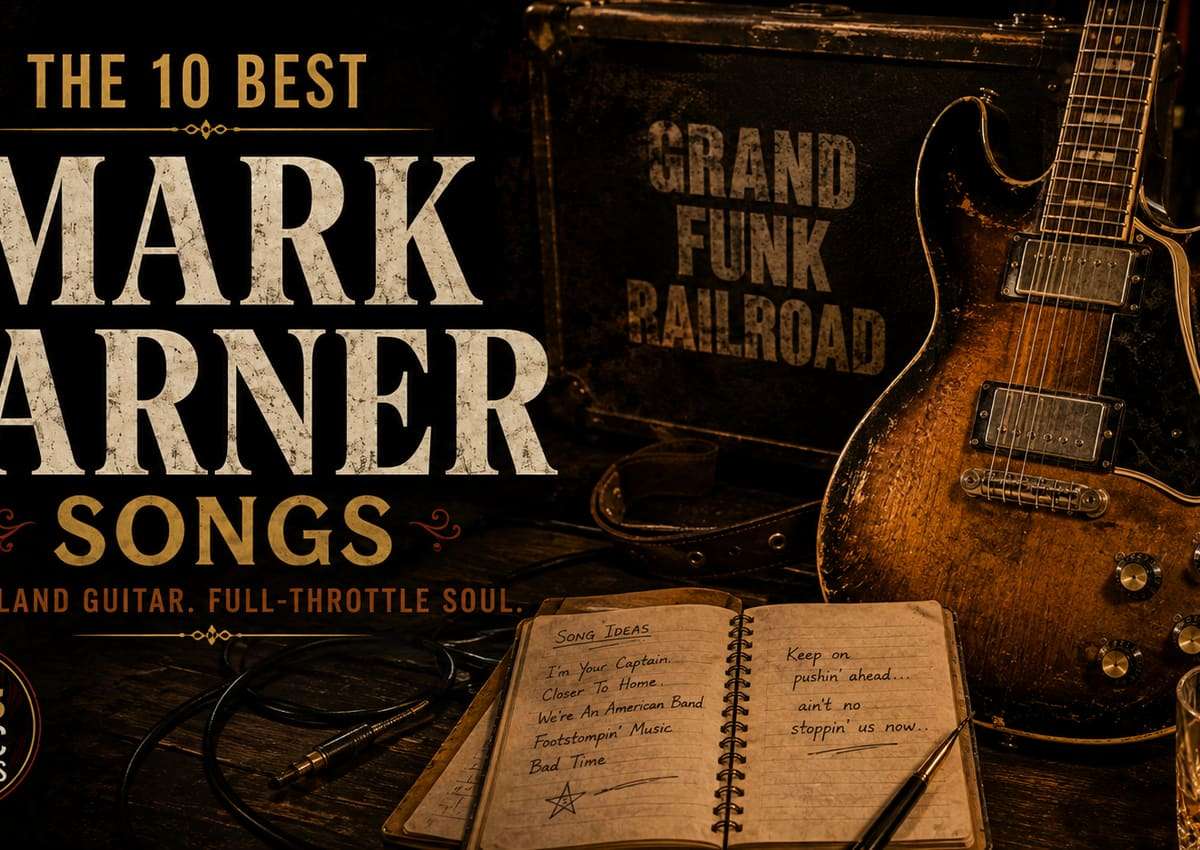
Mark Farner belongs on a 70s music site for a simple reason: before the solo records, the voice was already part of the soundtrack. As Grand Funk Railroad’s singer, guitarist, and principal early songwriter, Mark Farner was one of the most recognizable voices of 1970s American hard rock. That connection matters because the solo career did not arrive from nowhere. Listeners brought years of familiarity with them, and the best post-band recordings often work because they carry recognizable instincts into a different decade.
Farner’s solo career moved through several distinct phases. His first records after Grand Funk stayed close to straightforward rock and R&B, while his late-1980s and early-1990s albums increasingly reflected his Christian faith. That shift can make the catalog feel fragmented, but the same qualities remain: a strong, slightly rough vocal, direct guitar playing, and lyrics that rarely hide what he believes or feels.
This ranking focuses on Mark Farner as a solo artist. Band recordings are left out so the list can show what changed once the name on the record was his alone. The production, collaborators, and radio landscape may have shifted, but the personality that made the earlier work memorable is still there. These are the 10 best Mark Farner songs, ranked.
#10 Crystal Eyes
Album: No Frills
Release year: 1978
Songwriters: Mark Farner
“Crystal Eyes” comes from the second phase of Farner’s first solo run and shows him working with a lean, uncluttered rock band. The song is melodic but still grounded in the blunt guitar sound listeners associated with Grand Funk.
No Frills never became a major commercial record, yet tracks like this show that Farner’s songwriting voice remained recognizable outside the band.
It earns the opening spot because a Top 10 should do more than stack the obvious hits. This is the kind of recording that helps explain the shape of the catalog: where the artist was going, what he was willing to leave behind, and why the solo years deserve to be heard as more than an appendix to the band.
#9 If It Took All Day
Album: No Frills
Release year: 1978
Songwriters: Mark Farner
“If It Took All Day” has the casual, good-humored energy suggested by the album title. Farner sounds less interested in building an arena anthem than in making a straightforward rock-and-roll record with a strong groove.
That lack of grandeur is refreshing. The solo setting allowed him to step away from the expectations attached to Grand Funk’s size and reputation.
Placed here, the song also shows how quickly a solo identity can become recognizable. The production belongs to its era, but the phrasing and melodic instincts connect it to the singer listeners already knew. That tension between familiarity and change is one of the pleasures of revisiting these records now.
#8 Faith Keeps It Away
Album: No Frills
Release year: 1978
Songwriters: Mark Farner
“Faith Keeps It Away” is especially interesting in hindsight because it points toward the explicitly Christian direction Farner would pursue years later. The theme is already present, but the music remains rooted in late-1970s rock.
It connects two parts of his solo career that can otherwise seem separate: the Grand Funk alumnus and the faith-centered songwriter.
This is also the sort of track that benefits from distance. Without the pressure of being the biggest single, it can be heard as part of a larger body of work, and the details in the arrangement become easier to appreciate. It is a strong reminder that the solo catalog has more depth than a greatest-hits playlist suggests.
#7 Airborne Ranger
Album: Just Another Injustice
Release year: 1988
Songwriters: Mark Farner, Chris Post
“Airborne Ranger” opens Farner’s late-1980s Christian-rock period with muscular guitar and a direct sense of purpose. The production is more contemporary than his 1970s solo records, but the voice remains unmistakable.
The song shows how Farner translated hard-rock energy into a new lyrical framework rather than abandoning the musical language that had made him famous.
At this point in the ranking, the separation between band history and solo identity becomes especially clear. The song does not need to reference the past directly. The connection comes through the voice, the melodic choices, and the confidence of a performer who already knew how to command a record.
#6 Judgment Day Blues
Album: Just Another Injustice
Release year: 1988
Songwriters: Mark Farner
“Judgment Day Blues” puts the spiritual concerns of Farner’s later career into a blues-rock setting. The title makes the message clear, while the arrangement keeps enough grit to connect with longtime rock listeners.
Farner has never been a writer who hides behind ambiguity. The directness is either the attraction or the challenge, and this track is one of the strongest examples.
What pushes it into the upper half is durability. Plenty of records from the same period were built around fashionable sounds that aged badly; this one still has a musical center strong enough to survive the production choices around it. The song remains satisfying even after the era-specific gloss becomes part of the nostalgia.
#5 Just Another Injustice
Album: Just Another Injustice
Release year: 1988
Songwriters: Mark Farner
The title track of Just Another Injustice combines social frustration with Farner’s increasingly faith-centered perspective. The guitar work gives the song weight, while the vocal carries the same urgency heard on his 1970s records.
It is one of the better bridges between his secular hard-rock past and the subject matter that dominated his later solo albums.
The No. 5 position is where the catalog’s strongest themes start to concentrate. This track combines a memorable hook with a performance that reveals something about the singer beyond simple technique. It is the point where the solo career stops feeling merely successful and starts feeling essential to the artist’s larger story.
#4 Wake Up
Album: Wake Up
Release year: 1989
Songwriters: Mark Farner, Gordon VanEkstrom
“Wake Up” is Farner’s message-first songwriting at its most direct. The title is both command and spiritual appeal, delivered over a rock arrangement that leaves no doubt about the urgency he feels.
The song is important to the solo story because it captures the period when his Christian identity moved fully to the center of the records rather than appearing as one theme among many.
A song this high has to do more than trigger recognition. It needs to represent a distinct piece of the solo identity, and this one does. The writing, arrangement, and vocal all point in the same direction, giving the record a sense of purpose that has held up long after its original radio moment.
#3 Isn’t It Amazing
Album: Just Another Injustice
Release year: 1988
Songwriters: John Beland
Written by John Beland, “Isn’t It Amazing” gives Farner a more melodic setting than much of Just Another Injustice. His voice softens without losing its rough edge, making the song one of the album’s most accessible moments.
The track remains among his better-known solo recordings from the Christian-rock years and shows that he could be effective as an interpreter as well as a writer.
By No. 3, the argument is less about whether the song belongs and more about how high it should go. This is one of the recordings that can stand beside the best-known band material without needing the comparison to justify it. It has its own atmosphere, its own emotional logic, and its own reason to last.
#2 Some Kind of Wonderful
Album: Some Kind of Wonderful
Release year: 1991
Songwriters: John Ellison
Farner’s solo-era version of “Some Kind of Wonderful” revisits a song Grand Funk had turned into a major hit. The lyrical perspective was adjusted to fit his Christian message, transforming a familiar oldies-rock favorite into a statement of faith.
It is technically a return to earlier material, but the reinterpretation is significant because it shows how completely Farner had reframed his musical identity by the early 1990s.
The runner-up spot goes to a song that could easily be No. 1 on a different day. It captures nearly everything that made the solo career worthwhile: a distinctive voice, a strong melodic idea, and enough personality to separate the record from the artist’s earlier band identity. Only one song edges it out.
#1 He Sent Me You
Album: No Frills
Release year: 1978
Songwriters: Mark Farner
“He Sent Me You” takes No. 1 because it stands at the crossroads of Farner’s solo story. Musically it is still close to the straightforward rock of his Grand Funk years, but lyrically it anticipates the spiritual focus that would dominate the next phase of his career.
That combination makes it more revealing than a simple re-recording of a Grand Funk classic. It sounds like an artist in transition, carrying the old voice and guitar style toward a new personal direction.
That is why it finishes at No. 1. The best solo song is not necessarily the loudest, the most technically impressive, or even the biggest chart hit. It is the recording that most completely explains why the artist needed a solo career in the first place. This one does exactly that.
What Did We Leave Out?
Other worthwhile tracks include “Without You,” “All the Love You Give Me,” “Come to Jesus,” “Love Power,” “Into the Light,” “The Vision,” and “Well Done.” Farner’s solo catalog is unevenly distributed across rock and Christian releases, so different listeners will rank the eras very differently.
Grand Funk Railroad songs are excluded except where Farner deliberately reinterpreted earlier material in a new solo context. “I’m Your Captain,” “Footstompin’ Music,” and “Bad Time” belong to the band story and should be ranked there.
Why Mark Farner’s Best Solo Songs Still Work
Farner’s solo work lasts for the listeners who connect with its directness. He never became an ironic or detached songwriter. Whether singing about relationships, injustice, or faith, the point is delivered plainly and with the same physical vocal presence that defined Grand Funk.
For a 70s audience, the solo records are an interesting continuation because they reveal how a familiar hard-rock frontman changed when the band identity disappeared. The commercial scale became smaller, but the conviction behind the music did not.
Farner’s solo catalog is also a reminder that commercial visibility and artistic continuity are not the same thing. Grand Funk played arenas and sold millions of records; the later solo releases reached a much smaller audience. Yet Farner kept using the same fundamental tools—direct guitar riffs, forceful vocals, and plainspoken conviction—while the subjects of the songs changed around him. For listeners uninterested in the faith-centered material, that later period may feel distant from the 1970s records. For others, it is the most revealing part of his career because the music became more explicitly tied to personal belief. Either way, the solo albums document a real evolution rather than an attempt to endlessly reproduce Grand Funk’s commercial peak.
More Classic Rock Favorites
If Mark Farner is part of your soundtrack, keep going with these rankings from artists and bands who shared the same classic-rock world.


