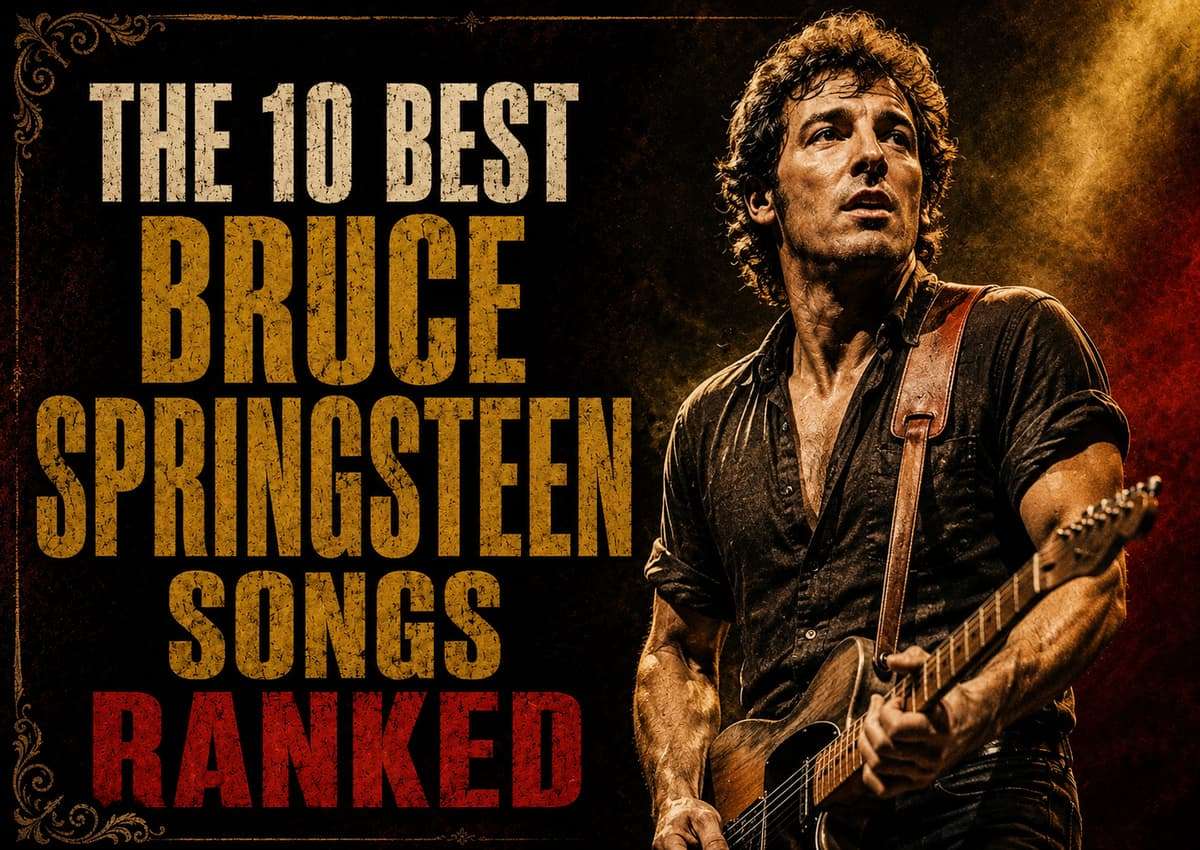
Bruce Springsteen’s catalog is so deep that a Top 10 list is less a final verdict than an argument worth having. Since his first two albums arrived in 1973, Springsteen has built one of American rock’s richest bodies of work: street-corner romances, working-class dramas, desperate escapes, broken promises, and stubborn hope, all delivered with a band capable of moving from a whisper to a full-throttle roar.
The breakthrough was Born to Run in 1975, the album that transformed a gifted New Jersey songwriter into a national figure. Darkness on the Edge of Town made the writing tougher and more adult. The River widened the emotional range, Nebraska stripped everything to the bone, and Born in the U.S.A. turned Springsteen into a global superstar without abandoning the uneasy stories underneath the hooks. His official 2024 Best Of collection spans that entire arc, while his own site still describes Born to Run as the record that made a once-in-a-decade impact.
This ranking is not based simply on chart position. In fact, Springsteen already has a chart-based Top 10 on 70s Music Wisdoms. This list asks a different question: which ten songs best combine songwriting, performance, cultural impact, emotional weight, and the qualities that make Springsteen unmistakably Springsteen? That means huge singles matter, but so do album tracks that became central to his legend on stage.
#10. Rosalita (Come Out Tonight)
Album: The Wild, the Innocent & the E Street Shuffle (1973)
Released: 1973
Songwriter: Bruce Springsteen
Before Springsteen became an arena institution, “Rosalita” captured the glorious chaos of the early E Street sound. It is part love song, part declaration of independence, and part bar-band explosion. The arrangement keeps tumbling forward: horns, piano, guitar, shifting rhythms, shouted lines and sudden turns that sound as if the whole band is trying to squeeze through the same doorway at once.
What makes it essential is the personality. Springsteen is not yet the solemn chronicler of factory towns or failed American dreams. He is a young hustler trying to convince Rosie—and perhaps himself—that the future is about to open up. The song became a live-show centerpiece because its looseness invites celebration. It also provides a perfect snapshot of the moment when Springsteen’s ambitions were already enormous even if his audience was not.
#9. Badlands
Album: Darkness on the Edge of Town (1978)
Released: 1978
Songwriter: Bruce Springsteen
“Badlands” opens Darkness on the Edge of Town like a door being kicked in. The piano figure is instantly recognizable, the drums hit with purpose, and Springsteen sounds less interested in escaping than in surviving with dignity. After the romantic sweep of Born to Run, this was a harder vision of adulthood. Dreams still matter, but now they come with a price.
The song’s power comes from the tension between frustration and defiance. Springsteen writes about work, class, fear and dissatisfaction without letting the record collapse into despair. The chorus is communal, almost built for thousands of people to sing back at him. That balance became one of his defining gifts: acknowledging how difficult life can be while refusing to surrender the possibility that it can mean something. “Badlands” remains one of the clearest statements of that philosophy.
#8. Racing in the Street
Album: Darkness on the Edge of Town (1978)
Released: 1978
Songwriter: Bruce Springsteen
If “Badlands” is the fight, “Racing in the Street” is what happens after the crowd goes home. Built around Roy Bittan’s spare piano and a patient arrangement, the song turns the familiar Springsteen imagery of cars and roads into something sadder and more complicated. Driving is no longer simply escape. It is a ritual that keeps disappointment at bay.
The narrator still races, still works on his car, still seeks the brief electricity of competition. But the emotional center is the woman beside him, whose own hopes have dimmed. Springsteen’s writing here is cinematic without becoming flashy. Small details carry the weight, and the E Street Band understands that restraint is the point. The closing instrumental passage feels like a long road disappearing into darkness. Few songs better demonstrate why Springsteen belongs in the conversation about America’s great narrative songwriters.
More Great 70s Music Rankings
Keep exploring the artists and songs that defined the era.
#7. Atlantic City
Album: Nebraska (1982)
Released: 1982
Songwriter: Bruce Springsteen
“Atlantic City” proves Springsteen did not need the E Street Band at full power to sound enormous. Recorded in the stark home-demo setting of Nebraska, the song places a desperate couple against organized crime, economic pressure and the fading promise of a resort town trying to reinvent itself. The arrangement is skeletal, which makes every image feel closer.
The brilliance is in the moral uncertainty. The narrator is not presented as a gangster or hero. He is a man running out of options, convincing himself that one dangerous choice might provide a way forward. That makes the song both specific and universal. Springsteen has always been fascinated by the line between survival and compromise, and “Atlantic City” walks directly along it. The later full-band versions are thrilling, but the original’s haunted intimacy remains difficult to beat.
#6. The River
Album: The River (1980)
Released: 1980
Songwriter: Bruce Springsteen
“The River” is one of Springsteen’s finest examples of turning an ordinary life into epic material without romanticizing it. A young couple faces pregnancy, marriage, shrinking job prospects and the slow erosion of the future they once imagined. The river itself changes meaning as the story unfolds: first freedom, then memory, then a painful measure of what has been lost.
The harmonica establishes the mood before the narrative even begins. From there, Springsteen keeps the language direct and the performance controlled. He does not tell listeners what to feel. The details do the work. The result is a song that became a concert favorite even though its subject is quiet devastation. It also marks a crucial point in Springsteen’s evolution, when the youthful characters who once dreamed of running away had to confront what happened if they stayed.
#5. Born in the U.S.A.
Album: Born in the U.S.A. (1984)
Released: 1984
Songwriter: Bruce Springsteen
Few songs demonstrate the difference between sound and subject more dramatically. The enormous drums, synthesizer hook and shouted chorus can make “Born in the U.S.A.” feel triumphant from across a stadium. Listen to the verses and a much darker story emerges: a Vietnam veteran returns to a country that has little place for him.
That contradiction is not a flaw; it is the song’s engine. The record became one of Springsteen’s most recognizable performances while its meaning was repeatedly simplified or misunderstood. His official site still notes that the title track is often misread as a patriotic anthem. The song belongs this high because it works simultaneously as a piece of popular music and as social commentary. It helped propel Springsteen to a level of fame few rock artists ever reach, yet the character at its center remains isolated and wounded.
#4. Jungleland
Album: Born to Run (1975)
Released: 1975
Songwriter: Bruce Springsteen
“Jungleland” is Springsteen at his most cinematic and ambitious. The closing track on Born to Run unfolds like a miniature rock opera, moving through piano, strings, street poetry, guitar and one of Clarence Clemons’ defining saxophone performances. It takes the romantic mythology of the city that runs throughout the album and follows it to a tragic conclusion.
The song is deliberately oversized, but the scale never feels empty. Every shift in the arrangement pushes the story forward. By the end, the youthful dream of the street has collided with violence, loneliness and consequence. That makes “Jungleland” an ideal finale to Born to Run: the same world that promised freedom also carries danger. Onstage, it became a ritual, especially because of Clemons’ solo. In Springsteen’s catalog, few tracks better show how rock and roll could be used as narrative theater.
#3. Dancing in the Dark
Album: Born in the U.S.A. (1984)
Released: 1984
Songwriter: Bruce Springsteen
It would be easy to underrate “Dancing in the Dark” because it was such a massive pop hit. That would miss how sharp the writing is. Under the bright synthesizers and irresistible beat is a narrator frustrated with himself, his work and the pressure to create something meaningful. Springsteen turned writer’s-block anxiety into his highest-charting single, reaching No. 2 on the Billboard Hot 100.
The record also shows his ability to adapt without losing his identity. This is unmistakably an ’80s production, yet the restless character could have walked out of an earlier Springsteen song. The famous video helped make him an MTV star, but the song has lasted because the hook and the emotional premise are stronger than the period details. It is proof that accessibility and substance do not have to be opposites.
#2. Born to Run
Album: Born to Run (1975)
Released: 1975
Songwriter: Bruce Springsteen
“Born to Run” is the record that changed everything. Springsteen spent months constructing a dense wall of sound that could match the scale of the dream in the lyrics. Guitars, keyboards, saxophone, drums and bells pile together until the track feels less like a song than a vehicle accelerating toward the horizon.
The theme is classic Springsteen: escape, love, desperation and the belief that somewhere beyond the current limits there must be a better life. Yet the song’s greatness comes from how completely music and idea reinforce each other. It does not merely describe urgency; it sounds urgent. The album reached No. 3 in the United States, and the title track became the song most closely associated with Springsteen’s rise. Nearly every later arena anthem in his catalog carries some trace of the blueprint established here.
#1. Thunder Road
Album: Born to Run (1975)
Released: 1975
Songwriter: Bruce Springsteen
“Thunder Road” earns the top spot because it contains almost everything that makes Springsteen great without needing the full bombast of “Born to Run.” It begins intimately, with harmonica and piano, as if the listener has arrived on Mary’s porch in the middle of a private conversation. From there the arrangement keeps opening until the entire E Street Band seems to be pushing toward the road ahead.
The song is an invitation, but not a naive one. The characters know they are carrying disappointment, age, missed chances and old ghosts with them. Escape may not solve everything. It may not even work. What matters is the decision to try. That mixture of realism and hope is central to Springsteen’s best writing.
As the opening track to Born to Run, “Thunder Road” sets the emotional terms for the album and, in many ways, for the career that followed. The official Springsteen site lists it across decades of live releases and compilations, evidence of how permanently it entered his repertoire. “Born to Run” may be the bigger anthem, but “Thunder Road” is the more complete Springsteen song: character, place, motion, longing and possibility compressed into one extraordinary performance.
What Did We Leave Out?
With Springsteen, the omissions could form another excellent Top 10. “Backstreets” has an argument on emotional intensity alone. “Prove It All Night,” “The Promised Land,” “Hungry Heart,” “I’m on Fire,” “Glory Days,” “Brilliant Disguise,” “Streets of Philadelphia” and “The Rising” all belong in serious conversations about his best work. Fans who value the early records may push “4th of July, Asbury Park (Sandy)” or “Incident on 57th Street” much higher. Others will insist that a concert staple such as “Tenth Avenue Freeze-Out” is indispensable.
That disagreement is the point. Springsteen’s catalog is large enough that the ranking changes depending on whether you prioritize storytelling, hits, live performance, cultural impact or personal connection. Tell us which song you would move into the Top 10—and which one you would take out.
Why Bruce Springsteen’s Best Songs Still Work
Springsteen’s best songs survive because they are built around people before they are built around mythology. The cars, highways, boardwalks, factories and small towns are memorable, but they matter because someone is trying to make a life inside them. His characters want love, work, dignity, escape, redemption, or simply one good night before morning arrives.
The E Street Band gives those stories scale. Roy Bittan’s piano, Clarence Clemons’ saxophone, Max Weinberg’s drums, Garry Tallent’s bass, Steven Van Zandt’s guitar and the larger E Street family helped create a sound capable of turning private anxieties into communal experiences. That is why songs about disappointment can feel exhilarating in concert.
Most importantly, Springsteen rarely treats hope as easy. The best songs acknowledge the cost of believing in something. “The River” remembers what disappeared. “Badlands” insists on pushing forward anyway. “Thunder Road” offers no guarantee beyond the chance to leave. That tension is why the music continues to connect across generations.